

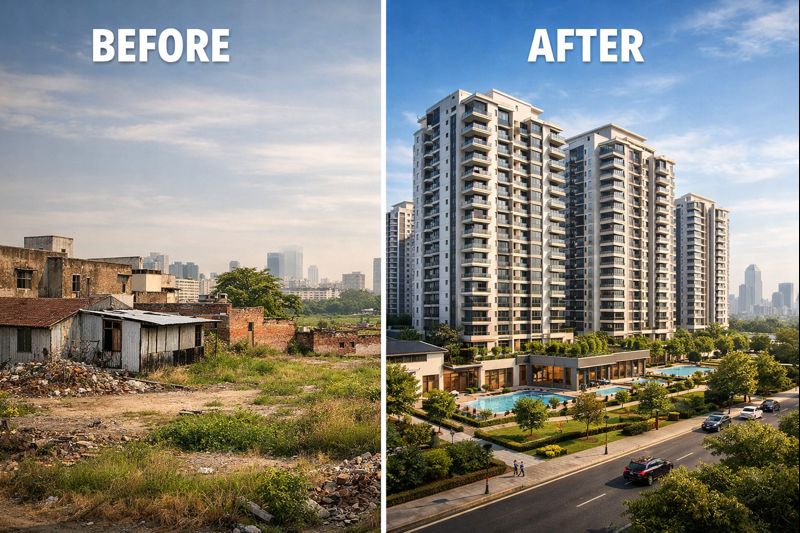
Understanding Property Sales to Private Developers
Selling a property to a private developer is different from selling it to an individual homebuyer. Developers purchase land or old buildings mainly for redevelopment — such as apartments, commercial complexes, or mixed-use projects. Their buying price depends not on the current structure, but on how much they can build and sell in the future. This makes such transactions highly strategic for property owners.
Why Developers Value Property Differently
Developers assess a property based on:
- Permissible construction area (FSI/FAR)
- Zoning and land-use rules
- Road access and frontage
- Market demand for residential or commercial units
Unlike individual buyers who look for personal use, developers calculate future saleable area and profit margins before making an offer.
Common Ways to Sell Property to Developers
1. Outright Sale
The owner sells the land for a one-time payment.
- Best for owners who want immediate liquidity.
- Usually fetches less than redevelopment-based value.
2. Joint Development Agreement (JDA)
The owner contributes land, and the developer handles construction and approvals.
The owner receives:
- A share of built-up area (flats/shops), or
- A mix of constructed space and cash.
This model allows owners to benefit from future market appreciation.
3. Revenue-Sharing Model
Instead of receiving flats, the owner gets a percentage of total sales revenue from the project.
This links the owner’s income directly to market prices but requires transparent accounting.
4. Land Aggregation or Collective Sale
When multiple neighboring owners pool their plots and sell together, the combined land size attracts larger developers and improves negotiation power. By Identifying neighboring plots to form one large, continuous parcel increases development potential, making the land suitable for larger projects and more attractive to developers who benefit from scale and higher profitability.
Methods to Maximize Profit When Selling to Developers
1. Value the Property as Development Land
Do not price it as an old house or vacant plot alone.
Estimate the potential construction area and the future project value before negotiating.
2. Create Competition Among Developers
Approach multiple developers instead of relying on a single offer.
Competing bids usually push prices higher.
3. Ensure Legal Readiness
Clear title, updated records, and settled inheritance issues increase buyer confidence and improve valuation.
4. Negotiate Built-Up Area, Not Only Cash
Instead of a pure cash deal, owners can negotiate for:
- Flats or commercial units
- Cash plus constructed space
This converts land value into long-term assets.
5. Time the Sale Strategically
Selling after infrastructure announcements (metro, highways, zoning upgrades) can significantly improve developer interest and price.
6. Use Zoning and FSI as Leverage
Higher permissible construction means higher potential profit for the developer, which strengthens the owner’s negotiation position.
Risks That Can Reduce Returns
- Delays in approvals or construction
- Weakly drafted development agreements
- Absence of penalties for project delays
- Lack of transparency in revenue sharing
These risks can erode expected profit if not contractually controlled.
Selling to Individual Buyers vs Selling to Developers
Property owners always have the option to sell to a single buyer for personal use. Such sales are simpler and faster.
However, selling to a private developer is fundamentally different — it is based on the future development potential of the land rather than its present use. When structured properly, a developer transaction can unlock significantly higher value compared to a conventional buyer sale.
Verified Insight for Property Sellers
Property owners can always choose to sell their land or building to a single buyer for personal use. However, selling to a private developer is a fundamentally different transaction — it is driven by the future development potential of the property rather than its present condition. When structured correctly, such sales can unlock significantly higher value through Joint Development Agreements (JDA), revenue-sharing models, or collective land aggregation.
Verified Insight:
Verified Real Estate plays a strategic role in helping property owners maximize this opportunity. The platform assists sellers by:
- Connecting them with verified buyers and reputed private developers, ensuring better deal discovery and competitive offers.
- Structuring Joint Development Agreements (JDA) where sellers can partner with Verified Real Estate to convert land into high-value built-up assets instead of opting only for lump-sum sales.
- Enhancing land value through land aggregation, by bringing together multiple neighboring owners so that larger parcels attract stronger developer interest and higher per-square-foot pricing.
- Facilitating land monetization through plotting, where suitable land can be divided into multiple saleable units, increasing overall realizable value compared to a single bulk sale.
In essence, while sellers may opt for a simple buyer-to-buyer transaction, engaging with developers through structured models — supported by Verified Real Estate’s services — allows landowners to transform raw property into a higher-value commercial opportunity. This approach shifts the seller’s role from a passive owner to an active participant in value creation.