

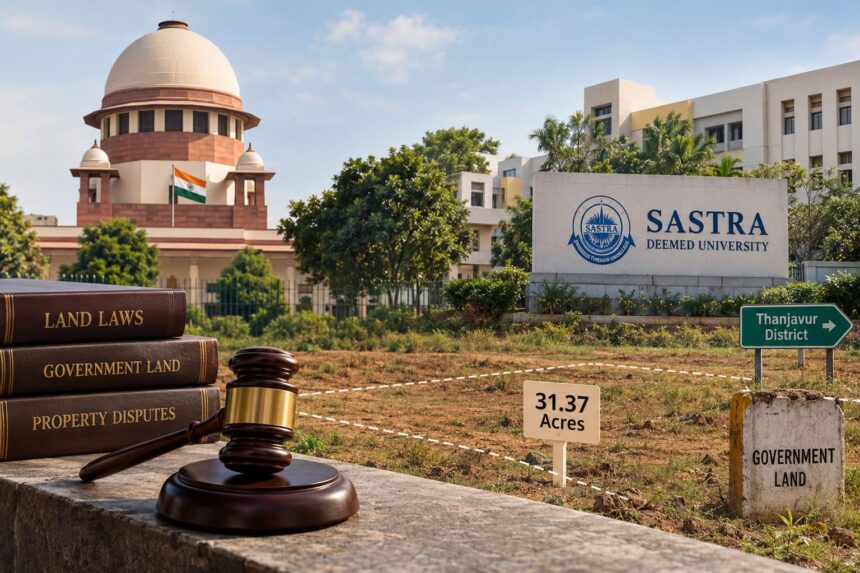
The Supreme Court has asked the Tamil Nadu government to consider an alternative land arrangement instead of evicting SASTRA Deemed University from 31.37 acres of disputed government land in Thanjavur district.
The long-running dispute concerns land at Thirumalaisamuthiram village, which was earmarked for an open-air prison. The government maintains that SASTRA has occupied the land and constructed buildings on it.
How the Land Dispute Began
The dispute dates back to 1985, when the Thanjavur Revenue Department reportedly raised an encroachment issue and issued an eviction notice. The disputed land had been allocated to the Prison Department for establishing an open-air jail, but the university’s occupation has held up the proposed project.
SASTRA challenged the eviction proceedings through legal channels. The Madras High Court subsequently ordered the recovery of the disputed land, prompting the university to approach the Supreme Court.
SASTRA Proposes Alternative Land or Compensation
During the September 21, 2026 hearing, SASTRA reportedly offered to provide alternative land approximately 5 km away or pay compensation based on the property’s market value.
The university had earlier presented three alternative land options before the Supreme Court. However, the Tamil Nadu government has raised concerns about the suitability of the proposed land and the delay in implementing the open-air prison project.
Supreme Court Seeks Government’s Response
The Supreme Court has asked the State to examine the proposal through a high-level consultation and submit its position. The Court’s consideration includes the presence of an established educational institution, the welfare of thousands of students and the possibility of receiving alternative land in exchange for the disputed property.
The matter was adjourned for four weeks. The proceedings do not amount to a final approval of a land exchange or cancellation of the eviction order.
Key Legal Issues in the Land Dispute
Government’s right to recover public land: The case raises questions about the State’s authority to recover government land allegedly occupied without valid authorization, following statutory procedures and court proceedings.
Alternative land as a settlement: The Court is considering whether a different parcel of land or monetary compensation could resolve the dispute instead of recovering the original property.
Public purpose and existing occupation: The government has earmarked the land for an open-air prison, while SASTRA operates an established educational institution on the disputed site. The proceedings bring these competing land-use considerations into focus.
Protection of public revenue: Any proposed land exchange or compensation arrangement would need to address the value and suitability of the property offered to the government.
These are the key issues arising from the reported proceedings and do not represent a final judicial determination on each matter.
What Lies Ahead in the SASTRA University Land Dispute
The next stage depends on Tamil Nadu’s response to SASTRA’s alternative-land or compensation proposal, including the suitability and valuation of the offered property. The Supreme Court’s further directions will determine whether the dispute moves towards an alternative settlement or recovery of the original land, while the future of the proposed open-air jail project also remains linked to the outcome.
Real Estate Takeaway: The case highlights the legal and administrative complexities of recovering government land and the considerations involved in resolving disputes through alternative land or compensation.