



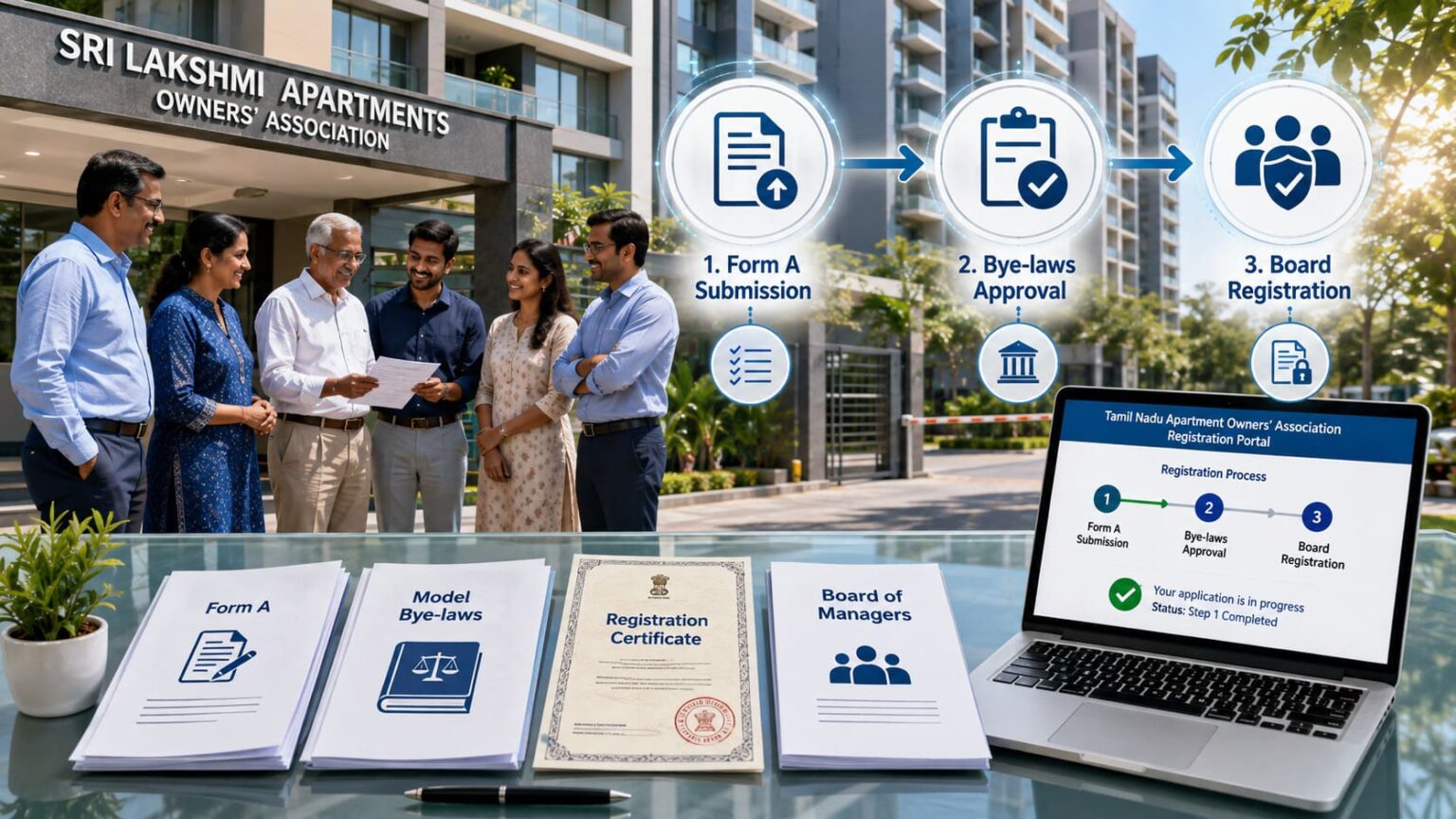
Buying an apartment is only the first step. Once people start living in the building, there needs to be a legally recognised body to manage common facilities, collect maintenance charges, represent owners, and protect the interests of residents. This body is known as the Apartment Owners’ Association or Resident Welfare Association (RWA).
To simplify this process, the Tamil Nadu Government introduced the Tamil Nadu Apartment Ownership Act, 2022 and the Tamil Nadu Apartment Ownership Rules, 2024. These laws provide a uniform procedure for registering apartment owners’ associations across the State.
If your apartment association is planning to register, here is everything you need to know in simple words.
Why should an Apartment Owners’ Association be registered?
A registered association becomes the official representative of all apartment owners. It can:
- Manage common areas and facilities.
- Collect and spend maintenance funds.
- Open and operate bank accounts.
- Enter into contracts for maintenance and services.
- Represent owners before government departments and courts.
- Ensure proper administration of the apartment complex.
Without registration, the association may face legal and administrative difficulties in carrying out these functions.
How is the registration done?
The Tamil Nadu Registration Department has introduced an online registration system for apartment owners’ associations.
The process is carried out in three sequential stages, meaning one stage must be completed before moving to the next.
Step 1: Submit Form A (Declaration)
The first stage is filing Form A, which is the statutory declaration of the apartment project.
This declaration can be submitted by:
- the promoter (builder),
- the majority of apartment owners, or
- an Adhoc Committee representing the apartment owners.
What is an Adhoc Committee?
An Adhoc Committee is a temporary committee formed by apartment owners to take charge of the association’s initial responsibilities before a formal registered association is created.
In simple terms:
- It is a provisional governing body
- It acts on behalf of all owners during the transition phase
- It helps in completing legal formalities like registration
- It is dissolved once the registered Board of Managers is formed under the Act
Why is the Adhoc Committee important here?
In many apartment complexes:
- the builder has already handed over possession, and
- there is no formal registered association yet.
In such cases, owners come together and form an Adhoc Committee to:
- collect owner consent,
- coordinate documentation,
- interact with the Registration Department, and
- initiate the registration process under Form A.
Thus, the Adhoc Committee acts as a bridge between unorganised ownership and a legally registered association.
➡Majority approval is mandatory
The law requires the support of a majority of apartment owners.
In simple terms, more than 50% of the owners must give their consent.
For example:
- If a project has 500 apartment owners, at least 251 owners must support the registration.
Important: If one person owns multiple apartments, they are still treated as one apartment owner for determining the majority under the Rules.
➡Documents required
Most of the documents required for Form A are normally available with the builder.
These include:
- Approved building plan
- Planning permission
- Building permit
- Completion Certificate (where applicable)
- Details of all apartments
- Undivided Share (UDS) details
- Common area details
- Limited common area details
- List of apartment owners
- Other statutory project documents
Because these records are essential for registration, builders are expected to provide them.
➡Government registration fee
The Tamil Nadu Apartment Ownership Rules prescribe the following fees:
| Number of Apartments | Registration Fee |
|---|---|
| 4–49 apartments | ₹5,000 |
| 50–99 apartments | ₹7,500 |
| 100 apartments and above | ₹10,000 |
Most large apartment projects therefore pay ₹10,000 as the registration fee for filing the declaration.
Step 2: Register the Bye-laws
Once Form A is accepted, the apartment owners must prepare and submit the Association’s Bye-laws.
The Government has already provided Model Bye-laws under the Tamil Nadu Apartment Ownership Rules, 2024. Apartment associations are expected to prepare their Bye-laws based on this model while making project-specific changes where necessary.
The Bye-laws generally cover matters such as:
- Membership
- Voting rights
- General Body Meetings
- Board of Managers
- Maintenance charges
- Common areas
- Elections
- Office bearers
- Accounts and audit
- Funds
- Transfer of apartments
- Maintenance responsibilities
- Dispute resolution
The Registration Department scrutinises the Bye-laws before granting approval.
A separate government fee is payable for the scrutiny of the Bye-laws.
Step 3: Constitute the Board of Managers
After the Bye-laws are approved, the Association must constitute its Board of Managers.
The Rules provide that:
- the Board should generally consist of one-third of the apartment owners, subject to
- a maximum limit of 21 members.
For large apartment projects, the Board therefore cannot have more than 21 members, irrespective of the number of apartments.
The Association must then submit the details of the President, Secretary, Treasurer and other Board Members to the Registration Department in the prescribed format.
When is the Registration Certificate issued?
The Registration Certificate is issued only after all three stages are successfully completed.
The process generally follows this sequence:
- Submit Form A.
- Obtain approval.
- Register the Bye-laws.
- Constitute the Board of Managers.
- Submit Board details.
- Receive the Registration Certificate.
How long does the process take?
There is no fixed statutory timeline.
However, in practice, the process may take around three to four months, particularly in large apartment complexes where signatures from the majority of owners have to be collected before filing the application.
Why owner participation is important
Many apartment associations face delays simply because they are unable to collect the required consent from a majority of owners.
Without sufficient owner participation:
- Form A cannot be submitted.
- The registration process cannot move forward.
- The Association cannot obtain legal recognition under the Act.
This makes the cooperation of apartment owners one of the most important factors in completing the registration successfully.
Final Thoughts
The Tamil Nadu Apartment Ownership Act, 2022, along with the Apartment Ownership Rules, 2024, has introduced a clear and transparent framework for registering apartment owners’ associations. The online process, prescribed forms, model Bye-laws, and standardised fee structure aim to ensure that every apartment complex has a legally recognised body to manage its affairs.
For apartment owners, completing this registration is more than a legal formality—it lays the foundation for better governance, transparent financial management, and the effective maintenance of their community for years to come.
Disclaimer: This article is intended for general information only and is based on the Tamil Nadu Apartment Ownership Act, 2022, and the Tamil Nadu Apartment Ownership Rules, 2024. Apartment owners should seek professional legal advice for project-specific issues or disputes.