


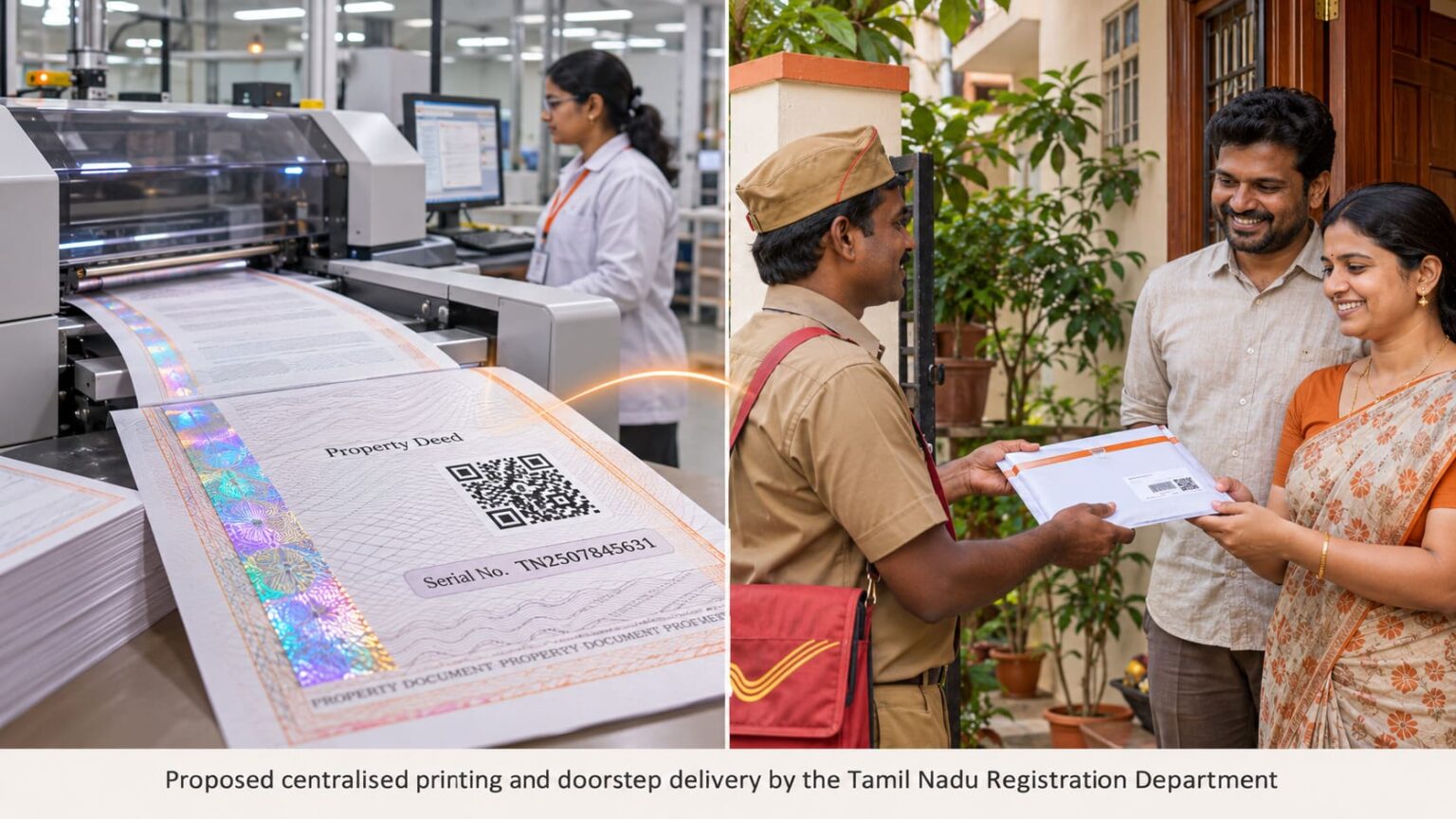
The Tamil Nadu government has issued an order approving a centralised facility to print registered property documents and deliver them directly to buyers through India Post.
The facility is planned for the 2026–27 financial year as part of the state’s Anywhere Registration initiative.
Once implemented, eligible property buyers will no longer need to visit a Sub-Registrar Office (SRO) to collect their registered documents.
Important: The government has approved the facility, but the doorstep delivery service has not yet been confirmed as operational.
Why Is Tamil Nadu Introducing Doorstep Delivery?
Tamil Nadu has already introduced presenceless registration for certain property transactions. This system allows eligible buyers to complete identity verification, biometric authentication and deed execution through digital methods.
After registration, digitally signed documents can be delivered electronically.
However, many buyers still prefer having a physical copy of their registered sale deed.
The new facility aims to address this need by delivering printed documents directly to buyers without requiring another visit to the SRO.
How Will the Doorstep Delivery System Work?
Under the proposed system, registered property documents will be printed at a centralised facility and delivered through India Post.
The process will involve:
- Property Registration: The buyer completes the eligible registration process online.
- Centralised Printing: The registered deed is printed on specialised security paper at a secure facility.
- Speed Post Dispatch: The document is placed in a sealed cover and sent through India Post.
- Doorstep Delivery: The buyer receives the registered document at their address, with postal tracking and proof of delivery.
The proposed arrangement is similar to India’s passport delivery system, where document processing and verification are handled separately from centralised printing and postal delivery.
Why Will Documents Be Printed at One Central Facility?
Instead of printing registered deeds at multiple Sub-Registrar Offices, the government plans to establish a single controlled printing facility.
A private service provider will be selected through an open competitive tender to establish and operate the facility for an initial five-year period.
The selected operator will provide the printing equipment, employees and day-to-day operational support.
Centralised printing is intended to reduce the risk of misuse of security paper, document templates and printing systems while maintaining consistent security standards across Tamil Nadu.
Will the Delivered Documents Be Secure?
The government plans to introduce several security features to protect registered property documents.
These include:
- Special security paper supplied by Tamil Nadu Newsprint and Papers Limited (TNPL).
- QR codes and serial-number verification.
- Anti-forgery features such as holograms and microprinting.
- Controlled printing and handling of registered documents.
- Sealed covers, Speed Post tracking and proof of delivery.
The Registration Department will directly procure the security paper, keeping control over its supply and use.
These measures aim to prevent document tampering, unauthorised printing and misuse of registered property documents.
Will Buyers Receive Their Sale Deeds Within 48 Hours?
The proposed delivery timelines are:
- Chennai and neighbouring districts: Within 48 hours.
- Other Tamil Nadu districts: Delivery timelines will vary depending on distance.
The 48-hour timeline is a proposed service standard and should not be treated as a guaranteed delivery period from the date of registration.
The final delivery conditions will become clearer when the facility starts operating.
Who Can Use This Facility?
The facility is initially linked to Phase I of Tamil Nadu’s Anywhere Registration initiative.
The relevant property transactions include:
- First sale of plots by promoters in approved layouts.
- First sale of flats by builders in approved apartment projects.
- Certain related home-loan mortgage documents.
For example, someone purchasing a newly constructed flat directly from a builder may qualify under the prescribed registration process.
However, doorstep delivery has not yet been confirmed for every type of property transaction, including resale properties, gift deeds and settlement deeds.
Will Buyers Have to Pay Extra?
The proposed arrangement provides for printing and postal delivery expenses to be recovered through the registration fee structure.
However, the exact charges payable by buyers have not yet been announced.
It is also unclear whether physical document delivery will be optional or compulsory for eligible transactions.
When Will the Service Start?
The government has approved the establishment of the centralised printing facility during the 2026–27 financial year.
Before launching the service, the Registration Department must:
- Select a private printing operator through a tender.
- Establish the secure printing facility.
- Arrange document collection and delivery with India Post.
- Complete the necessary operational and regulatory arrangements.
As of 18 November 2026, no confirmed public launch date has been announced.
Until then, buyers should follow the existing document collection or electronic delivery procedures applicable to their transactions.
What Does This Mean for Property Buyers?
The new system aims to make property registration easier by allowing eligible buyers to complete transactions without visiting Sub-Registrar Offices. The offices will continue verifying and approving documents, while physical deeds will be delivered through India Post.
However, a registered deed does not guarantee clear property ownership or legal status. Buyers should still verify ownership records, encumbrance certificates and necessary approvals before purchasing a property.
Note: Once the Government Order (G.O.) is officially available on the Tamil Nadu government’s website, Verified.RealEstate will post an article with the official document for readers to access and verify.