


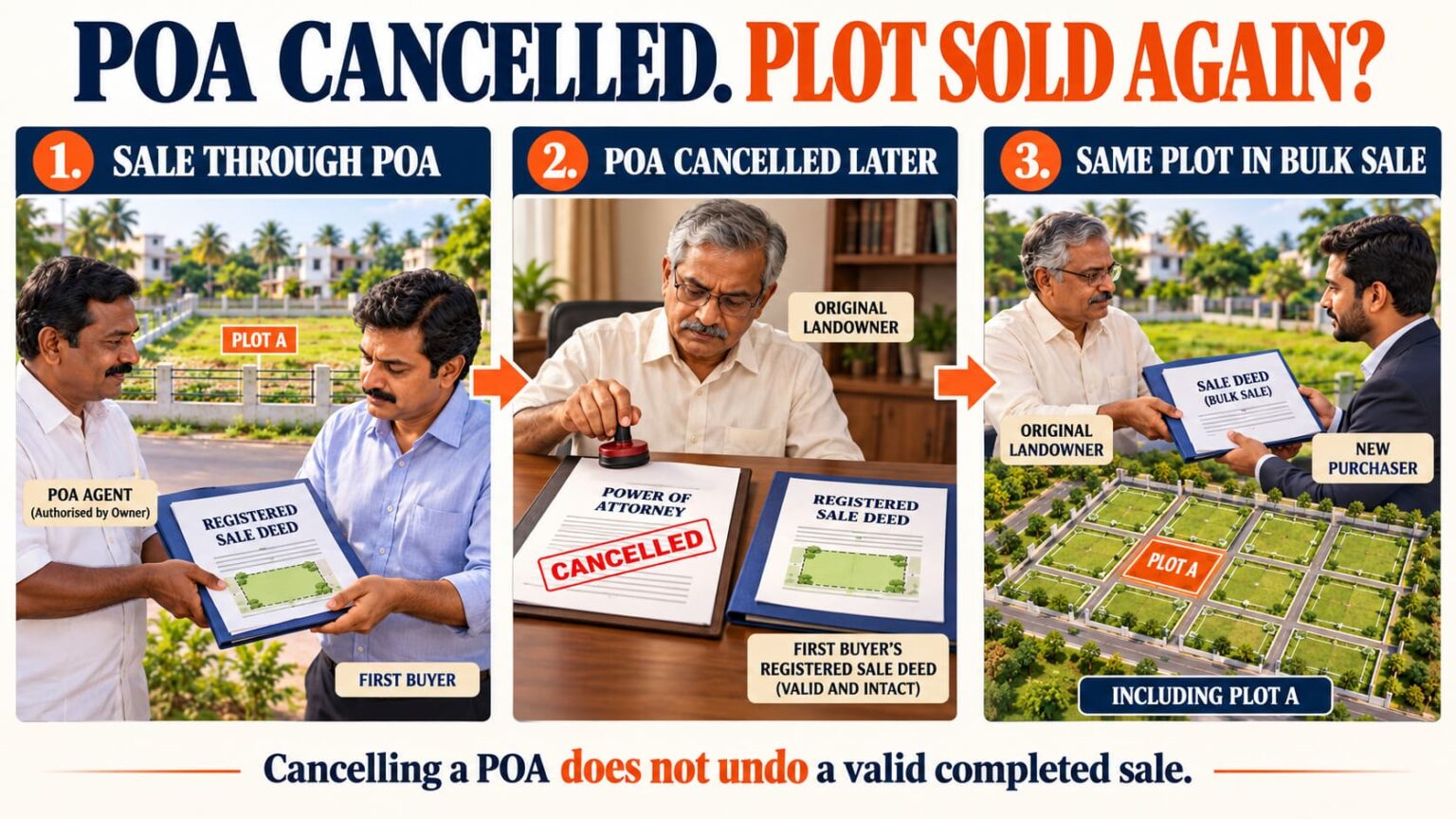
A buyer purchases a plot through a landowner’s power-of-attorney holder and receives a registered sale deed. Four years later, the landowner cancels the power of attorney. Another two years pass, and the landowner includes the same plot in a bulk sale of several properties.
The first buyer discovers the later sale while checking the Encumbrance Certificate, or EC. Does that mean the plot now belongs to someone else?
If the earlier sale deed validly transferred ownership, cancelling the power of attorney later does not reverse that sale. The buyer can challenge the competing transaction. However, the remedy depends on the documents and how the dispute arose.
Cancelling a POA does not undo a completed sale
A power of attorney, or POA, authorises another person to act for the owner. Where the agent had valid authority to sell the specified plot and completed a valid registered sale, a later withdrawal of that authority does not take away the purchaser’s ownership.
The original owner ordinarily cannot sell that plot again after transferring ownership. Including it in a later deed does not automatically give the second purchaser a better title.
This is different from a buyer holding only a POA, payment receipt or sale agreement. Those documents do not, by themselves, transfer ownership. A transaction described casually as a “POA purchase” therefore needs careful document review.
A later EC entry does not decide ownership
An EC records indexed registered transactions for the property and search period. It does not finally decide which competing ownership claim is legally valid.
The first step is to obtain the later sale deed and compare its property schedule with the earlier deed. Check the survey number, subdivision, plot number, extent and boundaries. An entry involving the larger survey number may appear even where the buyer’s particular plot was excluded from the later sale.
If the same plot was actually conveyed twice, the later document creates a competing claim that should be addressed promptly.
Can a complaint to the Registrar resolve it?
The first buyer can submit a written complaint to the Sub-Registrar and District Registrar, enclosing certified copies of the earlier sale deed, POA, revocation document and later sale deed. The complaint should identify the overlap precisely and request a written response.
However, a complaint does not itself cancel the later deed. Tamil Nadu’s Section 77-A, which introduced administrative cancellation powers in certain cases, was struck down by the Madras High Court in August 2024. Subsequent decisions have continued to apply that ruling. Buyers should therefore not assume the registration department can decide a disputed title and cancel the competing sale.
The District Registrar belongs to the Registration Department. The District Revenue Officer handles revenue matters; changing a patta or revenue entry does not itself cancel a registered sale deed.
Must the entire bulk sale deed be cancelled?
Not necessarily. If the later deed covers several plots, the first buyer’s claim would ordinarily focus on the portion affecting their own property.
Depending on the facts, a civil court may declare that the later deed does not bind the first buyer, or grant appropriate cancellation relief. Section 32 of the Specific Relief Act permits partial cancellation in a proper case, allowing the remaining parts of an instrument to stand.
The buyer cannot unilaterally cancel someone else’s deed. If all necessary parties cooperate, an appropriate registered corrective instrument may be possible after legal review. A disputed ownership claim generally requires civil-court adjudication.
What should the first buyer do next?
Collect the complete document chain, an updated EC and evidence of possession. Have a property litigation advocate assess the appropriate claim against the original owner and subsequent purchaser.
Seek an interim injunction if there is a threat of further sale, construction or interference with possession. If first buyer has alreadylost possession, recovery of possession may also be necessary. If possession has already been lost, recovery of possession may also be required. Evidence of deliberate cheating, forgery or impersonation may separately justify a police complaint.
Act Immediately. Limitation depends on the relief claimed and the relevant dates, including discovery where legally applicable. A complaint to the registration department generally does not stop the limitation clock for a civil suit.
If first buyer only paid money and received a POA or sale agreement
Thenthat person may not yet have acquired ownership. A POA authorises someone to act; it is not itself a sale deed. A sale agreement also does not, by itself, transfer ownership.
If the person has only a sale agreement, they might pursue specific performance—a court order requiring completion of the sale—or refund and compensation. Whether the later buyer must honour that agreement depends partly on whether they knew about it.
Timing is critical: specific-performance claims must be filed within three years of the agreed completion date. If no date was fixed, the period generally starts when the buyer learns that the seller refuses to complete the sale. Six years passing does not automatically mean it is too late—the documents and exact dates must be checked.
Manage Your Property Sale Directly, Even From Afar
Owners living outside Chennai or abroad can use Verified.RealEstate’s Deal Room to engage directly with prospective buyers, share documents, approve terms and track progress, with VRE expert assistance available. This reduces reliance on a POA holder for negotiations and coordination while keeping a clear record of decisions. It supports a safer, more transparent process; statutory registration requirements still apply, and no platform can guarantee a dispute-free transaction.
Read more about POA Payment Terms :
When checking an earlier POA sale, examine whether the agent had authority to receive payment and whether the buyer followed the payment conditions. Paying the owner directly through banking channels can reduce payment disputes, but it does not by itself prevent a later double sale.