


1. Introduction
In real estate transactions, one of the most important but least understood terms is the “Parent Document.” Whether you’re purchasing a newly plotted layout, an apartment, or even a resale property, understanding the parent document is key to tracing the origin and legality of the land or flat.
In Tamil Nadu, especially in areas like Chennai, Coimbatore, and Trichy, land that was once part of a larger survey number is often subdivided and resold. This makes the parent document not just relevant—but critical.
2. What is a Parent Document?
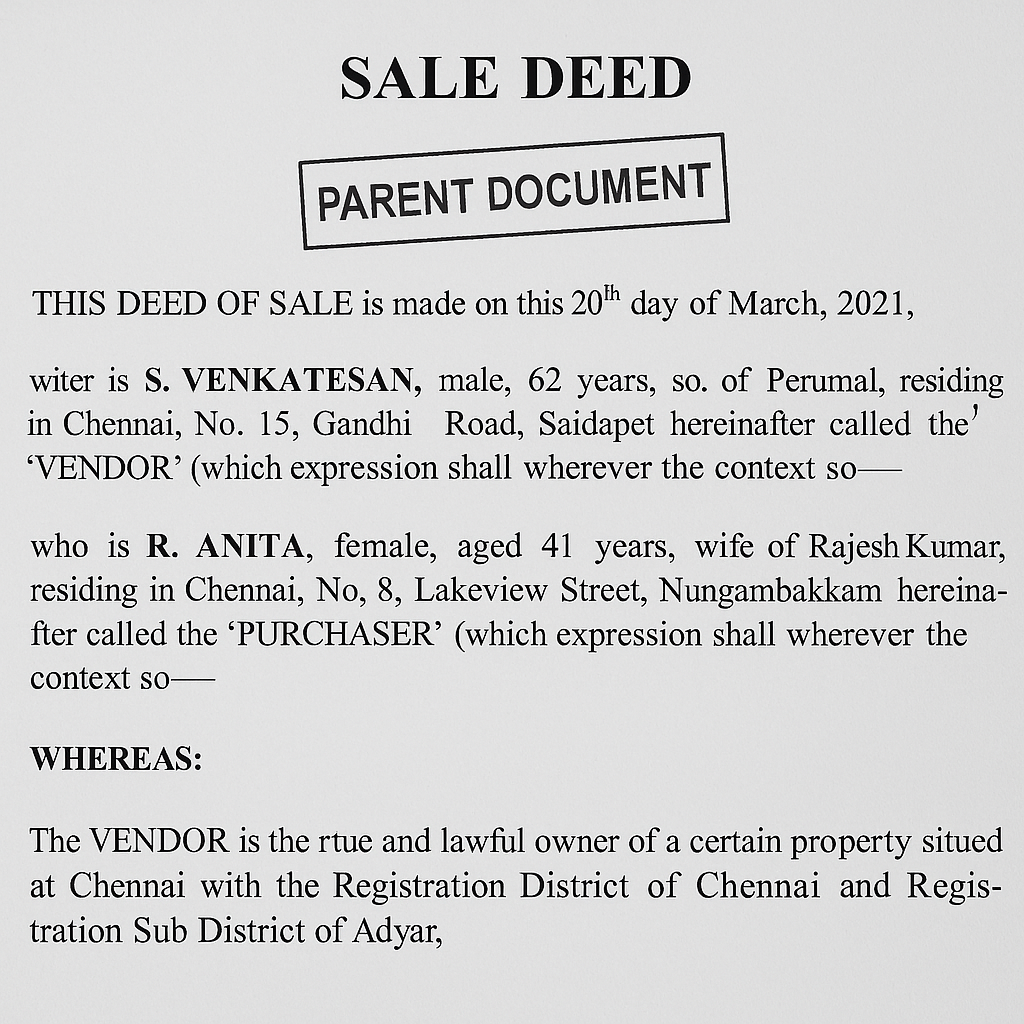
A parent document is the original registered document from which the current property ownership is derived. It could be:
- The original Sale Deed
- A Partition Deed
- A Settlement Deed
- A Gift Deed
- Or any registered document that shows how the land originally came into the seller’s hands
When the land is later subdivided and sold in parts, each new buyer gets a derived Sale Deed, but all these are rooted in one or more parent documents.
3. Why Is the Parent Document So Important?
| Reason | Why It Matters |
|---|---|
| Title verification | Proves how the seller got ownership |
| Legal traceability | Forms the base of the chain of title |
| Subdivision legitimacy | Confirms if proper partition or layout approval was done |
| Avoiding fraudulent sales | Ensures seller is not selling beyond what was originally owned |
| Mutation and tax purposes | Many Taluk offices ask for parent docs during mutation or tax transfer |
4. Types of Parent Documents
| Type | When Applicable |
|---|---|
| Sale Deed | Most common, when land is bought from another person or entity |
| Partition Deed | Family property divided among legal heirs or partners |
| Settlement Deed | Transfer made out of love/affection, often between parents and children |
| Gift Deed | Gratuitous transfer, can be within family or to third parties |
| Court Decree | Inherited or awarded via litigation or succession |
Each of these should be:
- Registered at the Sub-Registrar Office
- Available for verification through Encumbrance Certificate (EC)
5. How to Trace the Parent Document
If you’re reviewing a property:
- Check the current Sale Deed — It will usually mention the reference document number and SRO office
- Get the EC (Encumbrance Certificate) for at least 30 years — It will list all registered transactions and their document numbers
- Request a certified copy of the parent document from the Sub-Registrar Office (SRO)
This process helps build a chain of title, showing an unbroken sequence of ownership.
6. What Happens If the Parent Document Is Missing?
This is a serious red flag. Without the parent document:
- You cannot verify original ownership
- The land may be under litigation, partition dispute, or encroachment
- You may be buying land illegally converted from poramboke, OSR, or government property
In many fraud cases in Tamil Nadu, the current owner may show a Sale Deed, but the original land source is untraceable.
Always insist on seeing:
- Parent Deed (with document number and SRO seal)
- EC showing it as the origin transaction
- Mutation proof after original transaction
Your Sale Deed may be clean, but we go deeper. Check out our services right here!
7. Conclusion
Before trusting the final sale deed or EC, you must ask:
Where did this land come from originally?
The parent document is the DNA of property ownership. It ensures that what you’re buying has a legitimate, traceable history — free from encroachments, claims, or forged partitions.
Always check the base. Build only when the foundation is strong.