



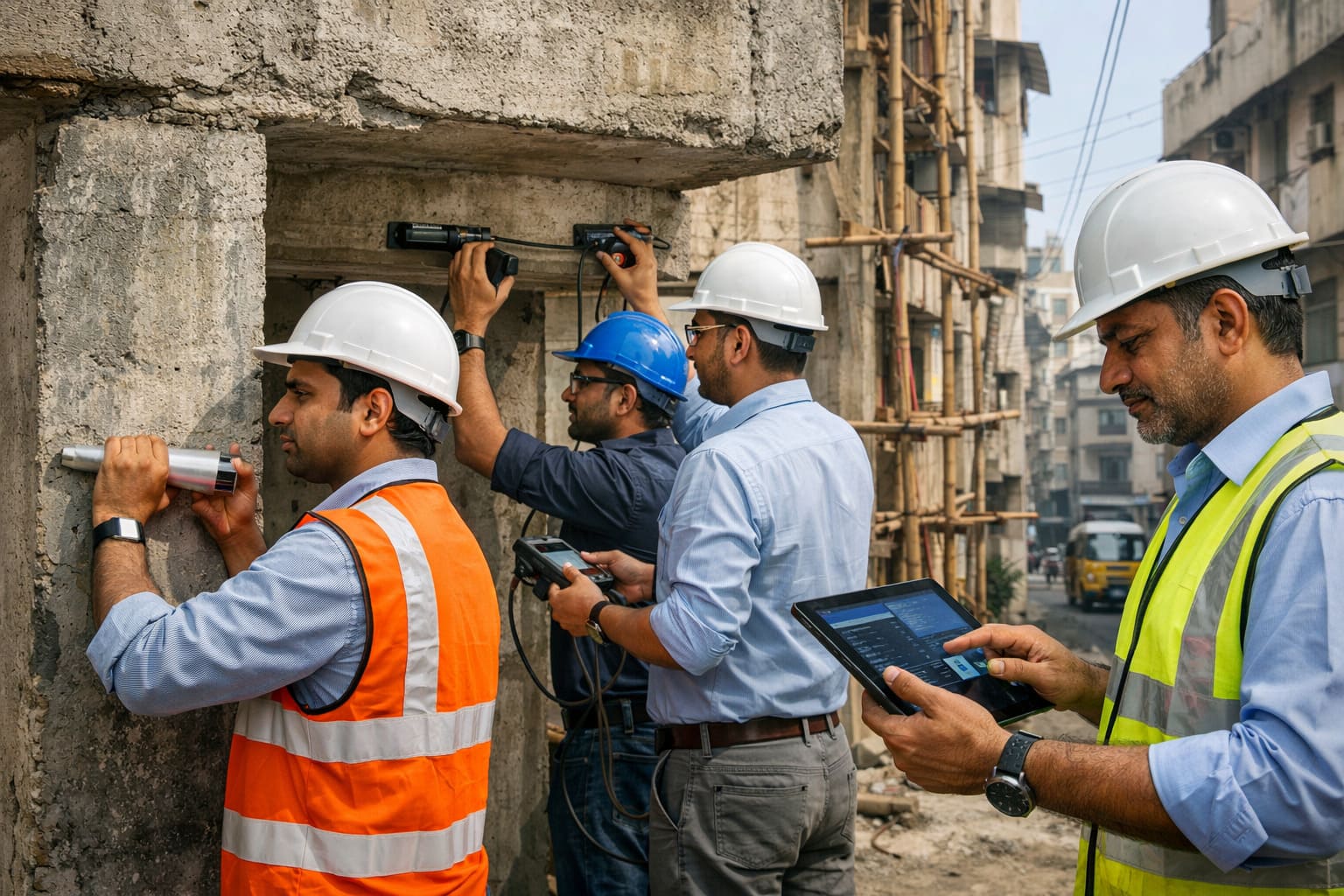
Renovating an old building without understanding its structural health is one of the most common—and costly—mistakes property owners make. Cracks, corrosion, settlement, or reduced load-bearing capacity may not be visible on the surface but can critically affect safety during renovation or change of use.
This is where Non-Destructive Testing (NDT) becomes essential. NDT allows engineers to assess the internal condition of concrete and reinforcement without damaging the structure, helping determine whether a building is safe for renovation, requires strengthening, or needs partial rebuilding.
For buildings older than 10–15 years, especially in coastal and urban environments, NDT is no longer optional—it is a structural necessity.
Key Non-Destructive Tests Used for Old Buildings
1. Rebound Hammer Test (Schmidt Hammer Test)
Purpose
- Provides a quick indication of surface concrete strength
- Identifies weak zones, poor workmanship, and honeycombing
- Used only for comparative assessment, not final strength approval
Where Applied
- Beams, slabs, columns, shear walls
- Unplastered, dry concrete surfaces preferred
How It Is Done
- Spring-loaded hammer is pressed perpendicular to the concrete surface
- Rebound number is recorded
- Minimum 10–12 readings per test location
- Average rebound index is correlated to strength
Must Be Done Along With
- Ultrasonic Pulse Velocity (UPV) test
- Core cutting (for calibration)
- Carbonation depth test
2. Ultrasonic Pulse Velocity (UPV) Test
Purpose
- Assesses internal quality and uniformity of concrete
- Detects cracks, voids, honeycombing, and segregation
Where Applied
- Beams, slabs, columns
- Suitable for thick RCC members
How It Is Done
- Two probes (transmitter & receiver) are placed on concrete.
- Grease/gel is applied for good contact.
- Ultrasonic pulse is sent through concrete.
- Travel time is measured.
- Velocity = Distance ÷ Time.
Must Be Done Along With
- Rebound hammer test
- Core cutting (if velocity < 3.5 km/s)
- Half-cell potential test
3. Core Cutting and Compressive Strength Test (Semi-Destructive but critical)
Purpose
- Determines actual in-situ compressive strength
- Confirms and calibrates NDT results
- Essential for structural strengthening decisions
Where Applied
- Preferably slabs and beams
- Columns only after careful evaluation
How It Is Done
- Cylindrical concrete core (75–100 mm diameter) extracted
- Tested in a laboratory for compressive strength
- Core hole repaired using non-shrink grout
Must Be Done Along With
- Rebound hammer and UPV
- Carbonation depth test
- Reinforcement cover measurement
4. Half-Cell Potential Test (Reinforcement Corrosion Assessment)
Purpose
- Assesses probability of corrosion in reinforcement steel
- Crucial for coastal buildings, leaking structures, or those with rust stains
Where Applied
- RCC slabs, beams, columns
- Buildings older than 15–20 years
How It Is Done
- Copper–Copper Sulphate Electrode is used
- Electrical potential difference is measured
Must Be Done Along With
- Carbonation depth test
- Cover meter test
- Visual corrosion mapping
5. Carbonation Depth Test
Purpose
- Determines loss of alkalinity in concrete
- Evaluates corrosion risk of reinforcement
Where Applied
- Exposed RCC members
- Old urban and coastal structures
How It Is Done
- Small concrete surface chipped
- Phenolphthalein solution applied
- Pink colour indicates alkaline concrete
Interpretation
- If carbonation depth ≥ reinforcement cover depth, corrosion risk is high
Must Be Done Along With
- Half-cell potential test
- Cover meter test
- Core cutting (if severe)
6. Cover Meter / Rebar Locator Test
Purpose
- Measures concrete cover thickness
- Locates reinforcement layout before retrofitting or drilling
Where Applied
- Beams, slabs, columns
How It Is Done
- Electromagnetic scanner detects steel bars
- Displays bar position and cover depth
Must Be Done Along With
- Carbonation Test
- Half-Cell Potential
- Structural drawings verification
7. Crack Width Measurement and Mapping
Purpose
- To determine whether a crack is:
- Harmless (shrinkage / plaster crack)
- Serviceability concern
- Structural / durability risk
- Crack width directly affects:
- Water ingress
- Steel corrosion
- Long-term strength loss
How it is Done
- Crack surface cleaned.
- Transparent crack gauge placed over crack.
- Closest matching line width is read.
- Measurement taken at widest point.
- Multiple readings recorded along the crack.
Must Be Done Along With
- Visual distress survey
- UPV testing
- Load history assessment
8. Load Test (Only If Absolutely Needed)
Purpose
- Confirms actual load-carrying capacity
- Used when drawings are missing or doubts persist
Where It Is Applied
- Slabs, balconies, special structures
How It Is Done
- Controlled loading (water bags / sand bags)
- Deflection measured and recovery checked
⚠ Blunt truth:
Load tests are risky, costly, and last-resort.
Must Be Done Along With
- Complete NDT package
- Structural analysis
- Engineer’s certification
Must Be Done Along With
- Carbonation test
- Half-cell potential test
Advanced Non-Destructive Tests Used in Special Renovation Scenarios
In certain renovation projects—especially high-value properties, commercial buildings, post-tensioned slabs, or structures showing unexplained distress—advanced NDT techniques are required. These tests are not routine, but are conducted when preliminary NDT results indicate specific risks or uncertainties.
1. Ground Penetrating Radar (GPR) Test
Purpose
- Non-intrusive subsurface investigation
- Detects reinforcement layout and hidden elements without drilling
Detects
- Reinforcement bars
- Voids and honeycombing
- Electrical and plumbing ducts
- Post-tension cables
- Slab thickness variation
How It Is Done (On-Site Steps)
- Antenna is rolled over the concrete surface
- Electromagnetic (EM) waves penetrate concrete
- Reflections from embedded objects are captured digitally
- Software converts signals into subsurface profiles
Time Required
- 10–15 minutes per scan
Output
- Subsurface mapping image and depth profiles
When It Is Required
- Before core cutting or retrofitting
- In post-tensioned slabs
- When drawings are unavailable or unreliable
2. Infrared Thermography Test
Purpose
- Identifies moisture ingress, voids, and delamination
- Assesses waterproofing failures without breaking finishes
How It Is Done (On-Site Steps)
- Thermal imaging camera scans walls and slabs
- Temperature variations are recorded
- Cold spots indicate moisture accumulation or voids
- Images are interpreted by trained experts
Best Time for Testing
- Early morning or evening (maximum thermal contrast)
Output
- Thermal images highlighting moisture and delamination zones
When It Is Required
- Persistent seepage issues
- Terrace and basement leakage
- Podium slabs and wet areas
3. Pull-Out / Pull-Off Test
Purpose
- Measures bond strength between concrete and repair material
- Validates retrofitting and strengthening systems
Used For
- FRP wrapping verification
- RCC jacketing quality checks
- Anchor bolt and micro-concrete bonding assessment
How It Is Done (On-Site Steps)
- Steel disc or insert is fixed to the concrete surface
- Hydraulic jack applies controlled tensile force
- Load at failure is recorded
Output
- Bond strength value (MPa or kN)
When It Is Required
- After structural retrofitting
- Before approving strengthening works
4. Chemical Tests (Chloride and Sulphate Content Analysis)
Purpose
- Evaluates chemical deterioration of concrete
- Assesses long-term corrosion and durability risks
How It Is Done (On-Site Steps)
- Concrete powder collected by controlled drilling
- Samples sealed, labeled, and sent to laboratory
- Chloride and sulphate content tested
Time Required
- 2–5 days
Output
- Chemical concentration levels
- Assessment of corrosion and chemical attack risk
When It Is Required
- Coastal buildings
- Industrial exposure zones
- Severe reinforcement corrosion cases
Why These Advanced Tests Matter
These advanced NDT tests are conducted only when preliminary NDT indicates specific risks, ensuring cost-effective yet thorough investigation. This approach ensures that renovation decisions are technically sound, cost-effective, and risk-controlled.
Recommended NDT Combinations for Renovation Decisions
| Scenario | Recommended Tests |
|---|---|
| Basic renovation | Visual survey + Rebound Hammer + UPV |
| Structural strengthening | Rebound + UPV + Core + Carbonation + Cover (+ GPR, Pull-Out/Pull-Off if retrofitting is involved) |
| Leakage or corrosion | Half-Cell + Carbonation + Cover (+ Infrared Thermography for seepage, + Chemical tests for corrosion cause) |
| Change of use or extra floors | Full NDT package + Core + Structural audit (+ GPR for rebar/PT mapping, + Chemical tests for durability) |
Verified Real Estate Supports Safe Renovation Projects
Verified Real Estate (VRE) integrates structural diagnostics with renovation-ready construction services, ensuring that renovation decisions are based on verified data—not assumptions.
VRE assists property owners and developers with:
- Coordinated NDT and structural audit through qualified engineers
- Interpretation of test results and risk-based recommendations
- Identification of mandatory strengthening or retrofitting measures
- End-to-end support for safe renovation, repair, and redevelopment planning
- Documentation support for approvals, compliance, and investor due diligence
By combining technical evaluation with execution-ready construction advisory, Verified Real Estate ensures that renovation projects are structurally safe, legally compliant, and financially sound.