



1. Introduction
When you purchase a property, registration is not the final step. Mutation of property is the next crucial stage—especially in Tamil Nadu—where ownership details are officially updated in land revenue records. Mutation ensures that the government recognizes you as the new owner for property tax, legal, and record-keeping purposes.
Failing to mutate land can lead to disputes, tax misrouting, and even denial of government services tied to ownership.
2. What Is Mutation of Property?

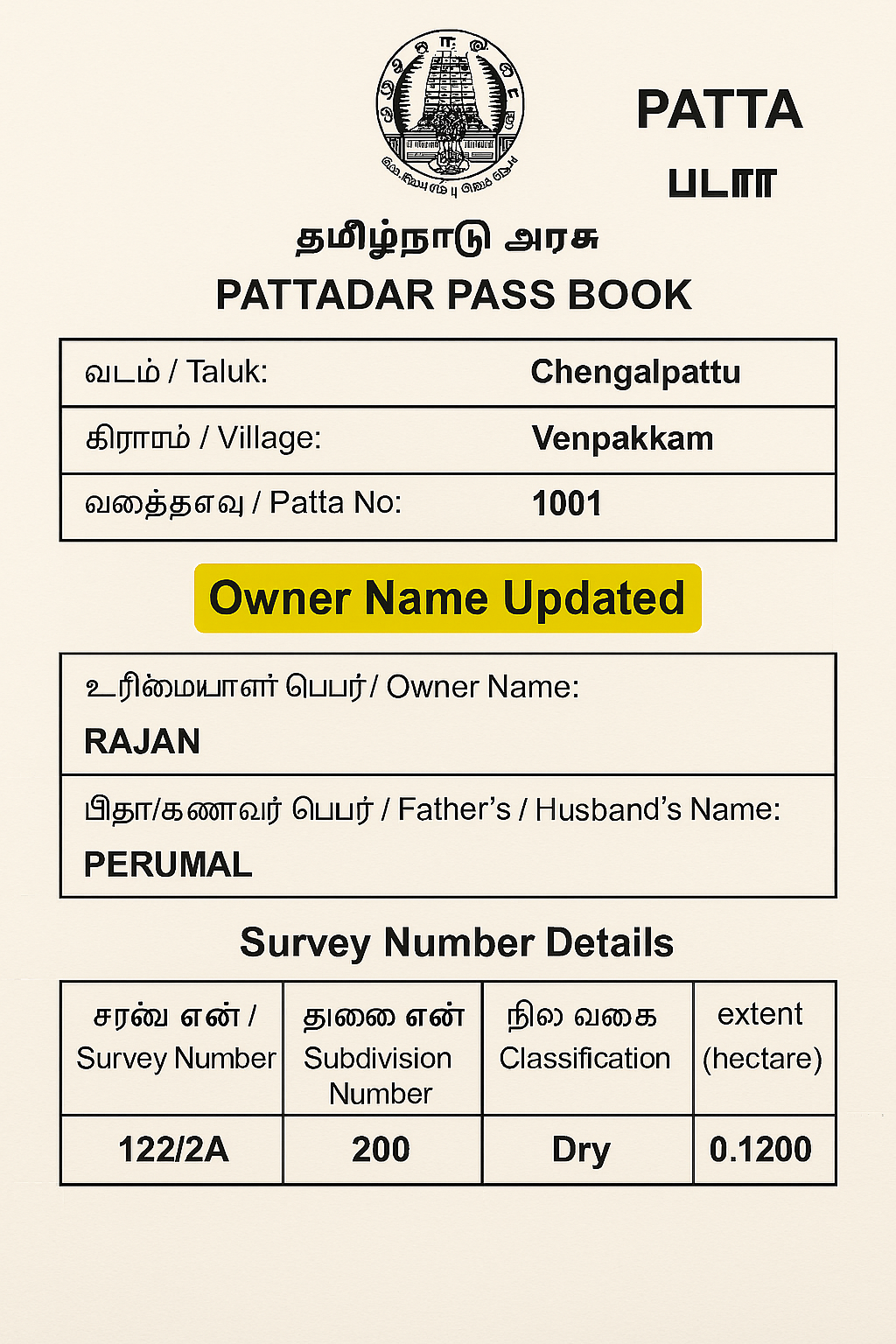
Mutation (also called ‘Patta Transfer’ in Tamil Nadu) refers to the process by which the revenue records are updated to reflect the new owner after a sale, inheritance, gift, or partition.
Once mutation is completed:
- The Patta will carry the new owner’s name
- Local authorities will send property tax notices to the new owner
- It legally confirms the transfer from the government’s perspective
3. When Is Mutation Required?
| Type of Transaction | Mutation Needed? | Notes |
|---|---|---|
| Sale of land/flat | ✅ Yes | Update revenue records with new buyer’s name |
| Inheritance (legal heir) | ✅ Yes | Requires legal heirship certificate |
| Gift or settlement deed | ✅ Yes | Must be registered first, then mutation |
| Court decree or partition | ✅ Yes | Requires court-certified documents |
4. Why Mutation Is Important
- Official ownership proof in revenue records
- Enables paying land and property tax
- Essential for applying building approvals or loans
- Prevents fraudulent resales by previous owners
- Required for selling the land in future
Even if you have a registered Sale Deed, mutation makes the government acknowledge your ownership.
5. How to Apply for Mutation in Tamil Nadu
A. If You’re Applying After a Sale Deed
- Prepare:
- Copy of Registered Sale Deed
- EC (Encumbrance Certificate) up to current date
- Copy of Aadhar card and Patta
- Visit the Taluk Office or submit via TN e-Services portal
- Fill the mutation request form
- Attach documents and submit
- Revenue Inspector/VAO may inspect the land
- Receive updated Patta in your name within 15–30 days
Fee: Usually ₹60 to ₹300 depending on area and application mode
6. Mutation for Inherited Property
For mutation after inheritance (legal heirship):
- Submit:
- Death certificate of owner
- Legal heir certificate or registered will
- EC, ID proof
- Apply at Taluk Office or e-Services
- In some cases, family members may need to sign a No Objection Certificate (NOC)
Mutation is granted after verification by the VAO and RI, and a new Patta is issued in the heir’s name(s).
7. Common Issues in Mutation
| Problem | Solution |
|---|---|
| Patta still shows old owner | Reapply with EC and Sale Deed |
| Mutation application rejected | Check if supporting docs (EC, ID, etc.) are valid |
| Disputes between legal heirs | Seek court direction or family settlement |
| Online status shows “Under Process” | Visit Taluk office for manual follow-up |
8. Mutation vs Registration vs Patta
| Factor | Registration | Mutation | Patta |
|---|---|---|---|
| What it means | Legal transfer of ownership | Revenue record update | Ownership + classification |
| Document type | Sale/Gift/Partition Deed | Mutation entry | New Patta document |
| Authority | Sub-Registrar Office | Taluk/Revenue Department | Taluk/VAO |
You must register first → then mutate → then get updated Patta.
Conclusion
Mutation may seem like a small administrative task—but it is a key proof of ownership in the eyes of the local revenue department. Without mutation, you risk tax complications, resale hurdles, and legal ambiguity.
If you’ve bought land or inherited it, get it mutated.
Ownership isn’t complete until the revenue records say so.