

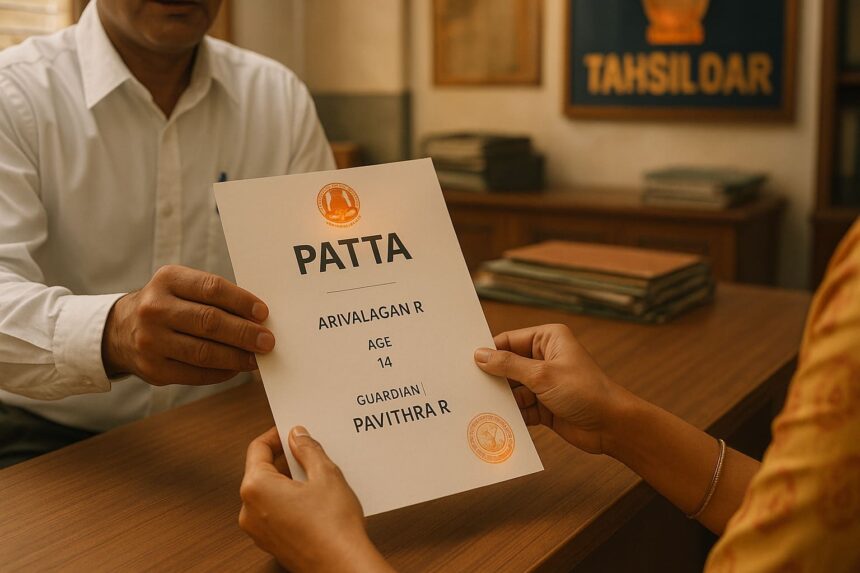
In Tamil Nadu, it’s common for parents or grandparents to register land or houses in the name of their children as a form of financial security. However, since minors (below 18 years) cannot legally enter into contracts, transferring patta or managing such property requires careful compliance with specific legal provisions.
Here’s a clear, step-by-step guide to understanding minor property ownership, guardianship rights, and patta transfer procedures under Tamil Nadu’s revenue system.
What Does the Law Say About Minors Owning Property?
According to Section 6 of the Hindu Minority and Guardianship Act, 1956, a minor can own property, but cannot sell, mortgage, or gift it.
Tamil Nadu follows the same national legal framework for defining guardianship under the Hindu Minority and Guardianship Act, 1956 and the Guardians and Wards Act, 1890. There are three main types of guardians recognized for managing a minor’s property:
Natural Guardian
Typically, the father is the natural guardian of a minor child, and after him, the mother.
In the case of an illegitimate child, the mother is the natural guardian.
The natural guardian has the right and duty to manage the child’s property, but cannot transfer or encumber it without court approval.
Testamentary Guardian
A testamentary guardian is appointed through a will by a natural guardian (usually a parent).
This person’s authority begins only after both natural guardians pass away, ensuring continuity in the protection and management of the minor’s assets.
Court-Appointed Guardian
If no natural or testamentary guardian is available, or if both are unfit to manage the property,
the District Court can appoint a guardian under the Guardians and Wards Act, 1890.
The court defines their powers, which are limited strictly to actions that benefit the minor.
Why Patta Transfer Is Important
The Patta establishes ownership in the revenue records. When property is settled, inherited, or purchased in a minor’s name, the Patta must also be transferred accordingly.
Without a valid Patta:
- The property cannot be taxed or subdivided correctly.
- The guardian cannot perform legal duties like paying land tax or protecting from encroachments.
- Sale or lease later becomes complicated.
Step-by-Step Process for Patta Transfer to a Minor’s Name
- Collect Essential Documents
- Original Settlement Deed / Gift Deed / Sale Deed registered in the minor’s name.
- Minor’s Birth Certificate or Aadhaar for age proof.
- Guardian’s ID proof (Aadhaar, PAN).
- Previous Patta / Chitta / FMB copy.
- File Application at Taluk Office or Online
- Visit the e-Sevai Centre or apply through https://eservices.tn.gov.in.
- Choose Patta Transfer – Settlement or Inheritance.
- Clearly mention the minor’s name as owner and guardian’s name for correspondence.
- Attach Guardianship Declaration
- Include a simple notarized declaration stating the guardian is acting on behalf of the minor, with the relationship and purpose clearly mentioned.
- If both parents are deceased or unavailable, obtain Legal Guardianship Certificate from the District Court.
- Revenue Officer Verification
- The VAO (Village Administrative Officer) will verify ownership, check for encumbrances, and submit the report to the Tahsildar.
- The Tahsildar will issue Patta in the minor’s name with the guardian noted.
- Court Permission for Any Sale or Lease
- If the guardian plans to sell, mortgage, or lease the minor’s property, permission from the District Court is mandatory.
- The court examines whether the transaction benefits the minor before granting approval.
Regulations & Legal Framework
- Hindu Minority and Guardianship Act, 1956 – Sections 6 & 8
- Transfer of Property Act, 1882 – Section 7
- Tamil Nadu Revenue Standing Orders (RSO 31 & 33)
- Tamil Nadu Registration Rules for settlement/gift deeds involving minors
Common Mistakes & How to Avoid Them
- Registering property without declaring minor’s age → leads to invalid Patta.
- Failing to attach guardianship declaration → delays approval.
- Attempting sale without court approval → transaction becomes voidable.
- Assuming automatic Patta update → manual application is always required.
Practical Tips
- Always keep birth certificate and guardianship declaration ready before Patta transfer.
- If the guardian changes (e.g., due to death), immediately apply for Patta correction.
- Avoid leasing or building on the land until the minor reaches 18, unless court-approved.
- Use Verified.RealEstate’s Legal Documentation Services for drafting proper settlement deeds, Patta applications, or guardianship affidavits.
Relevant Verified.RealEstate Tools & Services
If you need professional help with the process described above—verifying registered deeds, checking Patta records, preparing guardianship affidavits, or filing the Patta transfer itself—reach out directly to Verified.RealEstate.
Their Document Verification Tool allows you to instantly cross-check Patta, Chitta, and FMB consistency, while their Legal Documentation & Transfer Service provides expert support in drafting minor property applications, preparing court petitions, and ensuring every submission complies with Tamil Nadu’s legal and revenue-department standards.
Conclusion
Owning property in a minor’s name is fully legal — but it demands proper documentation and guardianship compliance. By following the Tamil Nadu Revenue Department’s Patta process and adhering to the Guardianship Act, families can ensure the child’s property is protected, validly recorded, and ready for future use without disputes