



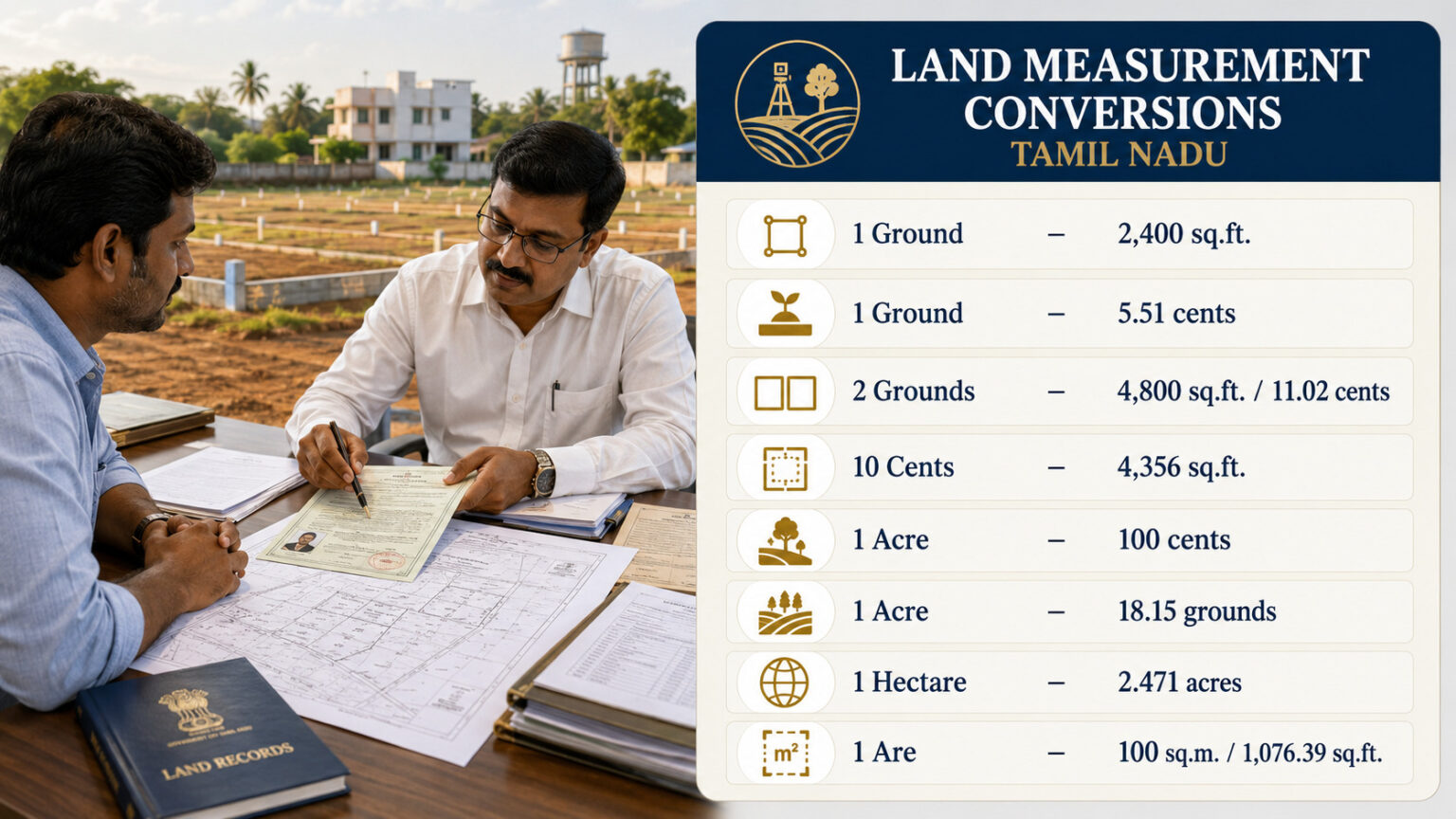
When buying or selling land in Tamil Nadu, you may hear different units such as ground, cent, acre, square feet, square metre, hectare and are.
A seller may say the plot is 1 ground, a broker may say 5.5 cents, while the Patta or government record may show the same land in hectare, are and square metre. This difference creates confusion for many buyers.
Understanding these units is important before trusting the property size, price or document details.
Common Land Measurement Units Used in Tamil Nadu
| Unit | Value | Common Usage |
|---|---|---|
| 1 Square Foot | 0.0929 sq.m. | Sale deeds, apartments, plots |
| 1 Square Metre | 10.764 sq.ft. | Building plans, official records |
| 1 Cent | 435.6 sq.ft. | Rural and semi-urban land |
| 1 Ground | 2,400 sq.ft. | Residential plots, especially Chennai |
| 1 Ground | Approx. 5.51 cents | Urban plot conversion |
| 1 Acre | 43,560 sq.ft. / 100 cents | Agricultural and large land parcels |
| 1 Hectare | 10,000 sq.m. / 2.471 acres | Government land records |
| 1 Are | 100 sq.m. | Patta, Chitta and revenue records |
Which Unit Is Used in Tamil Nadu Official Records?
In Tamil Nadu government land records, the official measurement is usually shown in the metric system, mainly:
Hectare, Are and Square Metre
For example, a Patta or A-Register may show land extent as:
0 hectare, 2 are, 50 square metres
This means:
250 square metres
It does not mean 2 acres.
That is why buyers should understand the difference between Are and Acre.
Where Can You See These Measurements?
Patta / Chitta – Land ownership, survey number, classification and extent. Usually shown in hectare, are and square metre.
A-Register Extract – Revenue record showing survey details, land type, tax and extent.
FMB Sketch – Shows land shape, boundaries and subdivision measurements.
TSLR Extract – Used in town and urban survey records.
Sale Deed – Often mentions land in square feet, ground, cent or acre.
Building Plan Approval – Usually uses square metre and square feet for plot area, built-up area, setbacks and FSI.
Local Slang Used in Tamil Nadu
In daily conversations, people may say:
| Local Term | Meaning |
|---|---|
| Oru ground | 1 ground / 2,400 sq.ft. |
| Ara ground | Half ground / 1,200 sq.ft. |
| Mukkal ground | Three-fourth ground / 1,800 sq.ft. |
| Pathu cent | 10 cents / 4,356 sq.ft. |
| Oru acre | 100 cents / 43,560 sq.ft. |
| Ma, Kuzhi, Veli | Traditional local units; value may vary by region |
Traditional terms like Ma, Kuzhi and Veli should be treated carefully because their value can differ based on local usage. For legal or purchase decisions, always rely on official records and survey documents.
Simple Example: Converting Ground to Cent
In Tamil Nadu:
1 Ground = 2,400 square feet
1 Cent = 435.6 square feet
So:
1 Ground ÷ 1 Cent = 2,400 ÷ 435.6 = 5.51 cents approximately
That means:
| Grounds | Approx. Cents | Square Feet |
|---|---|---|
| 0.5 Ground | 2.75 cents | 1,200 sq.ft. |
| 1 Ground | 5.51 cents | 2,400 sq.ft. |
| 1.5 Grounds | 8.26 cents | 3,600 sq.ft. |
| 1.815 Grounds | 10 cents | 4,356 sq.ft. |
| 2 Grounds | 11.02 cents | 4,800 sq.ft. |
| 3 Grounds | 16.53 cents | 7,200 sq.ft. |
So when someone says “2 grounds”, it is not simply “10 cents”. It is actually around 11 cents.
Common Mistakes to Avoid
Many buyers wrongly assume that 1 ground = 5 cents, but the correct value is approximately 5.51 cents.
Another common mistake is thinking 10 cents = 2 grounds. In reality, 10 cents is 4,356 sq.ft., while 2 grounds is 4,800 sq.ft.
Also, Are and Acre are not the same. Are is a smaller metric unit used in official records, while Acre is a much larger land unit.
Why Square Feet and Square Metre Both Matter
Many buyers focus only on square feet because real estate prices are usually quoted as:
₹ per square foot
But government and planning records may use square metre. This matters in:
Building plan approval
FSI calculation
Setback calculation
Plot coverage
Planning permission
Official survey measurements
Apartment built-up and carpet area references
For easy understanding:
1 square metre = 10.764 square feet
1 square foot = 0.0929 square metre
So if an official record says:
200 square metres
Then the approximate square feet value is:
200 × 10.764 = 2,152.8 square feet
This conversion is especially important when comparing government records, planning approvals and market price.
Other Important Conversions Buyers Should Know
| If Seller Says | Actual Approximate Value |
|---|---|
| 1 Acre | 100 cents |
| 1 Acre | 18.15 grounds |
| 1 Hectare | 2.471 acres |
| 1 Are | 100 sq.m. / 1,076.39 sq.ft. |
Common Mistakes in Tamil Nadu Land Measurement
Mistake 1: Thinking 1 Ground = 5 Cents
Actually, 1 Ground is approximately 5.51 cents, not 5 cents.
Mistake 2: Thinking 10 Cents = 2 Grounds
Actually, 10 cents = 4,356 sq.ft., while 2 grounds = 4,800 sq.ft.
Mistake 3: Ignoring Metric Extent in Patta
Official records may not always show land in ground or cent. Buyers must learn to read hectare, are and square metre.
Mistake 4: Trusting Local Slang Without Document Check
Traditional terms like Ma, Kuzhi and Veli can vary by region. Never finalize a transaction based only on local speech.
Mistake 5: Not Checking FMB
FMB helps confirm land shape, boundary and subdivision context. This is important because land extent alone does not prove that the land is physically usable in the way the buyer expects.
Why Verification Matters
Land measurement confusion is one of the most common reasons for mistakes in property transactions. A buyer may understand the price, but not the actual extent, survey details or boundary reality.
Through Verified.RealEstate, buyers can check important land-related records such as Patta / Chitta, FMB, TSLR, A-Register references, guideline value, survey number details and other verification layers before making a decision.
For safer property buying, land measurement should not be treated as a rough number. It should be verified through documents, survey records and physical boundaries.