

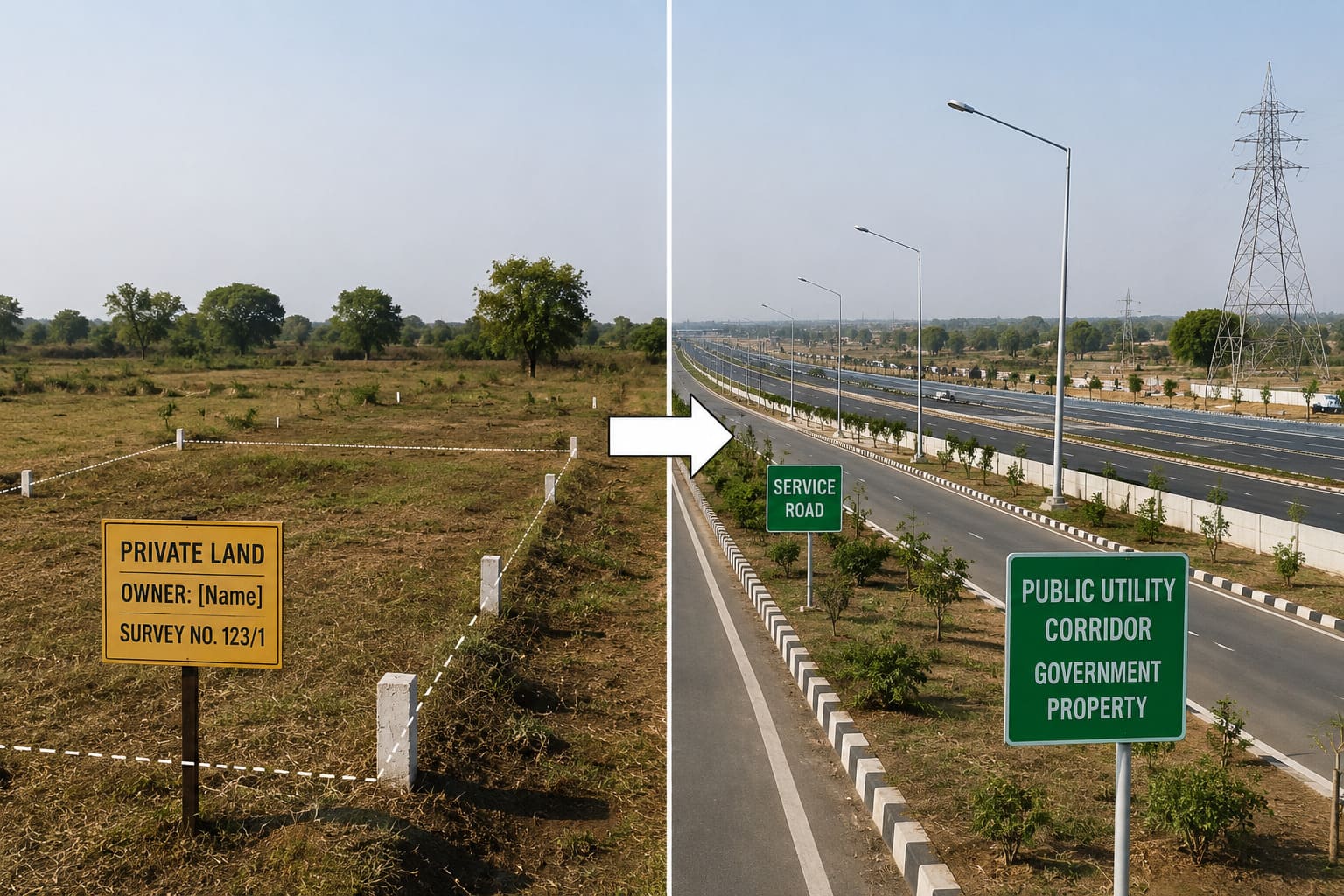
Bombay High Court rules that landowners must be compensated even when acquired land is reserved for service roads, open spaces, or public amenities.
Land acquisition for Government Projects, disputes often arise due to disagreements over how much compensation should be paid. A recent Bombay High Court judgment has clarified an important principle that could impact thousands of landowners across India.
In Youvraj Khaladkar v. National Highways Authority of India (2026), the Court held that authorities cannot deny compensation merely because a portion of acquired land is earmarked for service roads, open spaces, or other public utility purposes.
What Was the Case About?
The dispute arose from the acquisition of land belonging to Youvraj Khaladkar and his family in Osmanabad, Maharashtra, for the widening of National Highway 211 (Dhule–Solapur Road).
The acquisition proceedings were initiated under the National Highways Act, and an award was passed in November 2014.
The authorities determined compensation of:
- ₹54.47 lakh towards the acquired land
- ₹9.62 lakh towards a residential structure
- Total compensation of ₹64.09 lakh
However, when the landowners approached the authorities to receive the compensation, a significant portion of the amount was withheld.
Why Was Compensation Withheld?
The authorities argued that:
- Only 432 sq.m. of the acquired land was being directly used for the highway.
- The rest ,around 2,168 square metres had been reserved for a service road and public utility purposes.
- Since this land would be used for public amenities, compensation was allegedly not payable for that portion.
As a result, compensation amounting to nearly ₹45 lakh was withheld.
The landowners challenged this decision before the Bombay High Court.
What Was the Government’s Argument?
The Town Planning authorities relied on planning regulations and development control rules to contend that:
- Service roads are public amenities.
- Open spaces are reserved for public use.
- Land earmarked for such purposes need not attract compensation.
According to the authorities, these portions were required to be surrendered for public benefit and therefore compensation was not payable.
A Crucial Development During the Case
While the case was pending, a fresh award was passed under the Right to Fair Compensation and Transparency in Land Acquisition, Rehabilitation and Resettlement Act, 2013 (RFCTLARR Act).
The revised award included:
- Enhanced market value calculations
- Multiplication factors
- 100% solatium
The landowners therefore sought compensation based on the revised award as well.
The Question that The Court Had to Answer
The central issue before the Court was simple:
Can authorities refuse compensation merely because acquired land is being used as a service road, open space, or public utility area?
The Court answered this question in the negative.
The Court’s Answer:
The Court relied on several landmark judgments, including the Supreme Court’s decision in Pt. Chet Ram Vashist v. Municipal Corporation of Delhi.
The Supreme Court had earlier held that:
- Reserving land for roads, parks, schools, or public amenities serves a public purpose.
- However, such reservation does not automatically transfer ownership to the government free of cost.
- Once ownership rights are taken away from the common man, compensation must be paid.
The Bombay High Court observed that a public authority may manage land for public benefit, but it cannot deprive the owner of compensation merely because the land will be used for public purposes.
Why Is This Judgment Important?
This ruling reinforces a fundamental principle of land acquisition law:
Public Purpose Does Not Mean Free Acquisition
Authorities cannot take the position that: “Since the land will be used for a service road or open space, compensation is not payable.”
If the landowner loses ownership rights due to acquisition, compensation becomes payable irrespective of the eventual public use of the land.
Impact on Future Acquisitions
The judgment have implications for:
- National Highway projects
- Ring road developments
- Industrial corridor projects
- Urban expansion schemes
- Township developments
- Layout approvals involving amenity spaces
The ruling may also be relied upon by landowners facing disputes involving compensation deductions for internal roads, service roads, open spaces, parks, and public utility reservations.
Final Verdict
The Bombay High Court allowed the writ petition and directed the authorities to:
- Pay the compensation due to the landowners.
- Complete payment within two months.
- Pay consequential benefits along with the compensation.
- Face costs of ₹50,000 if payment is delayed beyond the stipulated period.
The Court categorically held that denying compensation for land reserved for service roads and public utility purposes was arbitrary and unsustainable in law.
What Property Owners Should Know
If your land is being acquired for a public project, authorities generally cannot deny compensation simply because a portion of the land is earmarked for:
- Service roads
- Open spaces
- Public amenities
- Utility corridors
- Community facilities
The key consideration is whether ownership rights have been taken away. If they have, compensation is ordinarily payable in accordance with the applicable land acquisition laws.
Verified Realestate, can help property owners, identify whether a property falls within the path of proposed infrastructure projects, road widening plans, or potential land acquisition zones. Verified Real Estate’s specialized legal team can help property buyers assess potential land acquisition risks, verify title documents, and ensure clear ownership before investing in a property.
Key Takeaway
The Bombay High Court has reaffirmed that land acquired for service roads, open spaces, and other public amenities cannot be taken without compensation merely because the land serves a public purpose.