



Every time you stream a video, make a digital payment, tap into an AI tool, or save a file to the cloud, you are using a data centre. These are not ordinary office buildings. They are highly specialized industrial facilities packed with powerful computers, massive cooling systems, and heavy-duty fiber optic cables.
By the middle of 2026, data centres have officially become one of the fastest-growing property investments in India. The country’s operational capacity has reached a massive 1.6 GW (Gigawatts). To put that in perspective, there are now more than 200 operational data centres across the country, making India the second-largest data centre market in the entire Asia-Pacific region.
Why We Measure Data Centres in GW/MW:
Unlike traditional real estate, which is valued by physical square footage, data centres are judged entirely by power capacity because space is cheap, but electricity is everything. A massive building is useless if the local grid cannot supply the heavy electrical load required to run thousands of enterprise servers continuously. Furthermore, with the intense rise of AI and high-density cloud computing, modern server racks pack exponentially more processing power into much smaller physical spaces. As a result, data centres are shrinking in footprint while exploding in electricity consumption, making Megawatts (MW) and Gigawatts (GW) the only true metrics of their actual operational capacity and investment value
Why Is the Need for Data Centres Exploding?
India’s digital growth is moving faster than the physical buildings can keep up. Capacity is growing rapidly because facilities are packing more powerful, high-density hardware into every square foot.
Several big trends are driving this boom:
- The AI and Cloud Rush: Tech giants and businesses need massive computing power to run artificial intelligence programs and cloud storage.
- Data Localisation Rules: Government laws require certain sensitive personal and financial data to be stored physically inside India.
- Massive Digital User Base: Millions of people using 5G, online banking, e-commerce, and social media create waves of data every single second.
City-by-City Breakdown: Where the Power Is Concentrated
Just like the office market, data centre growth is concentrated in a few key cities, primarily driven by access to underwater internet cables (submarine cables) and stable power grids.
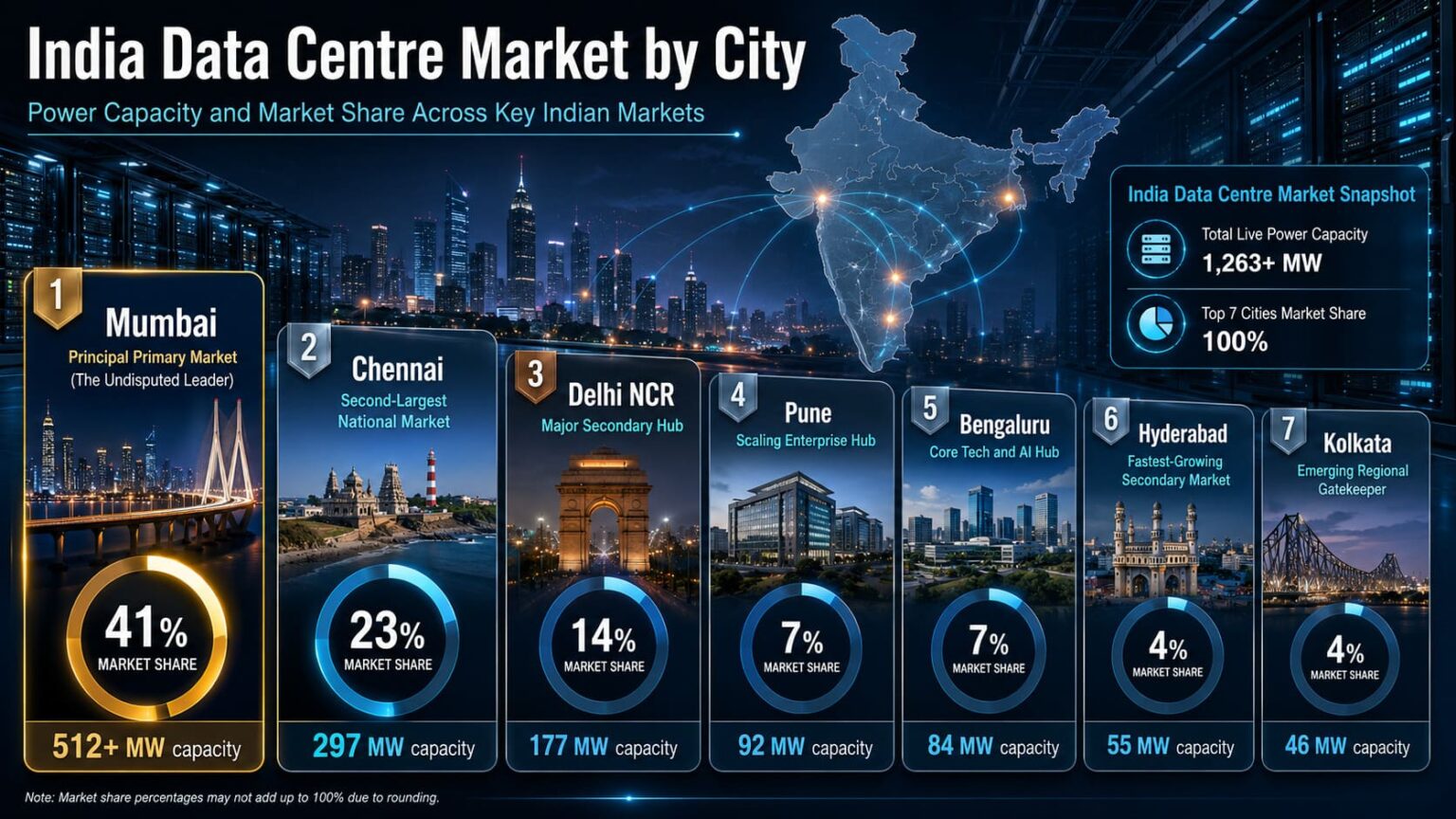
Mumbai
- Market Position: Principal Primary Market (The Undisputed Leader).
- The Numbers: Over 512 MW of power capacity, holding a massive 41% share of the entire national market.
- Why It Leads: Mumbai is the main landing point for international submarine internet cables. It is expected to cross the 1 GW milestone alone by the end of 2026, fueled by huge demand from banks and global cloud giants.
Chennai
- Market Position: Second-Largest National Market.
- The Numbers: 297 MW of capacity, controlling about 23% of the market.
- Why It Leads: Chennai is the leading coastal alternative to Mumbai. Its position is protected by multiple underwater cable systems, top-tier power infrastructure, and a massive base of enterprise and corporate clients.
Delhi NCR
- Market Position: Major Secondary Hub.
- The Numbers: 177 MW of capacity, holding a 14% market share.
- Why It Leads: Huge data centre campuses are expanding rapidly in Noida and Greater Noida to handle the cloud requirements of Northern India and government systems.
Pune
- Market Position: Scaling Enterprise Hub.
- The Numbers: 92 MW of capacity, holding about 7% market share.
- Why It Leads: Pune is growing fast because it offers “geographic backup.” Companies build here so that if an emergency hits Mumbai, their systems keep running safely nearby.
Bengaluru
- Market Position: Core Tech and AI Hub.
- The Numbers: 84 MW of capacity, holding a 7% market share.
- Why It Leads: While Bengaluru is the king of tech offices, it ranks lower for data centres because it lacks coastal cable connections. However, its massive focus on AI engineering is creating a huge need for local data processing.
Hyderabad
- Market Position: Fastest-Growing Secondary Market.
- The Numbers: 55 MW of capacity, holding a 4% market share.
- Why It Leads: Hyderabad is jumping up the global rankings quickly. It is winning major projects because local authorities provide excellent power infrastructure and plenty of available land for giant cloud campuses.
Kolkata
- Market Position: Emerging Regional Gatekeeper.
- The Numbers: 46 MW of capacity, holding a 4% market share.
- Why It Leads: It is gradually expanding to act as the primary cloud data gateway for Eastern India.
The Next Wave: Reaching Smaller Cities
The digital boom is outgrowing India’s main metropolitan areas. Today, smaller Tier-II and Tier-III cities make up about 6% of the country’s total capacity.
Among these emerging hubs, Vijayawada leads the pack, holding a massive 50% of this regional share. Other cities like Mohali (16%), Jaipur (9%), Ahmedabad (5%), and Nashik (5%) are also growing quickly due to local 5G rollouts and lower land costs.
Spotlighting Tamil Nadu: Driving India’s Coastal Data Capital
Tamil Nadu has firmly established itself as a cornerstone of India’s digital infrastructure strategy. While Chennai anchors the state as its primary data gateway, massive new investments are paving the way for a more distributed expansion across its Tier-2 cities.
The Key Hubs & Office Corridors
- The Chennai Epicenter (Siruseri & Ambattur): More than half of the state’s data centres are highly concentrated here. Siruseri and Ambattur have evolved into high-density digital zones. Tech providers choose these specific hubs for corporate offices and data parks due to direct submarine cable landing stations and the massive surrounding IT parks.
- Coimbatore (The Emerging Tier-2 Alternative): Recognized as the state’s secondary focus point, Coimbatore is fast becoming a destination for edge data centres and satellite tech offices. Global investors are targeting the city to escape high land costs in primary cities, drawing on its robust technical workforce and active enterprise demand.
- Madurai (The Decentralized Growth Engine): As part of the state’s proactive shift to decentralize digital growth beyond Chennai, Madurai has entered the map. The government is actively steering infrastructure investments here to create regional hubs that cater to localized data processing and corporate back-offices.
Investment & Infrastructure Power
Why the State Wins: Tamil Nadu offers a perfect triple benefit: direct international link-ups via underwater sea cables, steady enterprise demand from local automotive and tech GCCs, and a strong renewable energy network to help global tech companies hit their green energy goals
The Power Pipeline: Chennai is on track to heavily scale its operational capacity. While its footprint stood at 108 MW, ongoing construction projects are scheduled to deliver another 134 MW of capacity covering 2.6 million square feet.
The ₹18,600 Crore L&T Investment: Engineering and tech titan Larsen & Toubro (L&T) signed a landmark deal with the Tamil Nadu government. This multi-crore package is designed to establish major electronics manufacturing and advanced data centre projects across these core urban zones.
Blackstone’s Hyperscale Hub: Private equity giant Blackstone is executing a proposed investment exceeding ₹10,000 crore to build a cutting-edge digital infrastructure hub, securing the state’s status as a top global destination for hyperscale developers.
Behind the Scenes: The Real Challenges
While the pipeline looks incredible, building a data centre is a high-stakes, expensive challenge. Experts warn that looking only at planned projects can be misleading because of serious road blocks:
The Cost of Power: Electricity is the single biggest expense, eating up 40% to 60% of a data centre’s daily running costs.
Furthermore, developers face 15% to 25% supply chain inflation on imported cooling systems, microchips, and copper cables. There is a massive 10.5 GW pipeline sitting at the early “land-buying stage” that will take years of heavy funding, regulatory approvals, and massive power grid upgrades before they can ever turn on a single computer.
The Strategic Outlook
The data from the first half of 2026 shows that India’s digital runway is expanding at an unbelievable pace, with total operational capacity expected to clear 2 GW shortly.
As Global Capability Centres (GCCs) bring more high-tech AI jobs to India, the reliance on top-tier data centres will only intensify. They are two halves of the same coin: GCCs represent the brilliant minds developing the software, while data centres provide the heavy physical muscle required to run it.
Securing the Ground: The Data Centre Diligence Challenge
Because data centres are multi-crore, long-term assets, choosing a location requires a completely different strategy than buying standard office space. Industry experts like Verified.RealEstate emphasize that the real challenge lies in ground-level security and access. Before any capital is deployed, developers must clear strict hurdles: verifying clear land titles, securing heavy power infrastructure alignments, checking close proximity to fiber networks, and navigating complex local zoning approvals. For global investors, thorough technical and legal verification is the only way to successfully de-risk these massive digital hubs.
Disclaimer: The infrastructure numbers and investment pipelines cited are based on industry reports from early 2026. Data centre developments face strict execution risks, including power grid allocations, supply chain timelines, and local regulatory clearances. References to specific firms, platforms, or projects do not constitute direct investment endorsements.