

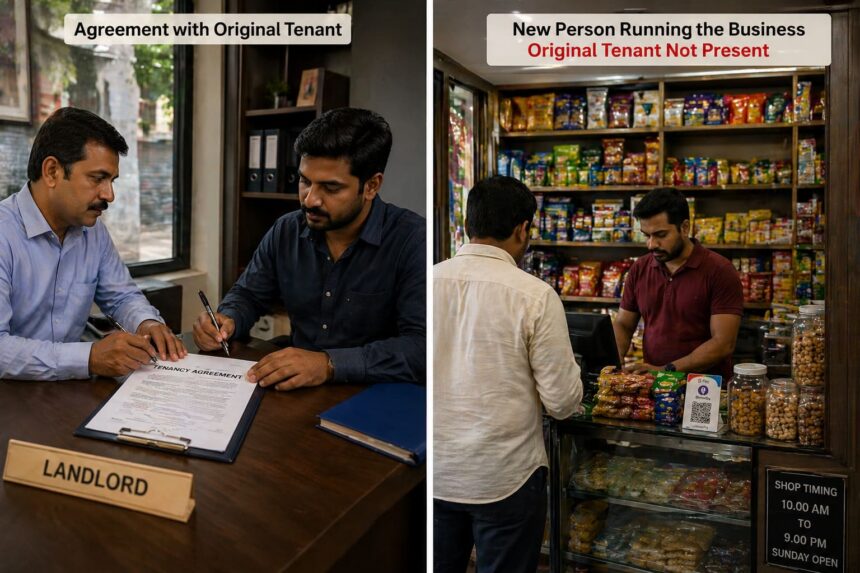
In a powerful ruling, the Supreme Court of India made it clear:
👉 You cannot hide illegal sub-letting behind a partnership agreement.
The case of Sri M.V. Ramachandrasa vs M/s Mahendra Watch Company cuts through common real estate tricks and focuses on one simple truth —
👉 Who is actually in control of the property?
📌 Case Background: What Happened?
A shop in Bengaluru was leased to Mahendra Watch Company (a partnership firm) under a strict clause prohibiting sub-letting without consent. Over time, original partners disappeared from actual control, and new persons started running the business.
The landlord claimed:
- This is illegal sub-letting (possession transferred)
The tenant claimed
- This is just a change in partnership, not sub-letting
The landlord challenged this — and the dispute reached the highest court.
⚖️ Court Journey: From Confusion to Clarity
🧾 Trial Court
- Found that control had shifted to third parties
- Ordered eviction
⚖️ High Court
- Treated it as a valid partnership change
- Reversed eviction
🔥 Supreme Court
- Corrected the error
- Restored eviction
- Emphasized:
👉 Courts must look at actual possession, not labels
📌 Final Outcome
- High Court judgment → Set aside
- Trial Court eviction → Restored
- Tenants given 3 months to vacate
🧠 What the Supreme Court Clarified
1️⃣ Revision is Not an Appeal
Referring to principles from Hindustan Petroleum Corporation Ltd. v. Dilbahar Singh:
👉 High Courts cannot act like appellate courts in revision. It cannot
- Re-examine all facts
- Act like a fresh trial
It only checks if the law was applied correctly.
2️⃣ Sub-letting Depends on Control, Not Documents
👉 If the tenant has parted with possession, it is sub-letting
👉 Even if documents say “partnership”
3️⃣ Burden of Proof
- Landlord shows: tenant is not in control
- Then tenant must prove: arrangement is genuine
4️⃣ Courts Can Lift the “Partnership Veil”
Courts can go beyond documents and examine ground reality
👉 If partnership is used to:
- hide transfer of possession
- collect indirect rent
➡️ Partnership cannot be used as a “cloak” to hide unlawful possession. Courts will ignore the paperwork and expose reality
📖 What is Sub-letting?
Sub-letting happens when a tenant:
- gives possession or control of a rented property to someone else
- without the landlord’s permission
👉 It doesn’t matter if:
- it’s called a partnership
- money flows indirectly
➡️ If the original tenant is not in real control, it becomes illegal sub-letting
🛡️ Legal Awareness: What Each Party Must Know
🔴 For Landlords
- Always track who is actually occupying and running the property
- If:
- tenant disappears from operations
- unknown persons take over
👉 You can initiate eviction for sub-letting
- Courts will support you if:
- possession has clearly shifted
👉 Ground reality matters more than agreements
🔵 For Tenants
- You cannot:
- transfer control to others
- run the shop through proxy persons
👉 Even if you:
- create a partnership
- modify internal agreements
➡️ If you lose control, it can be treated as illegal sub-letting
⚠️ “Passive partner” is risky:
- Passive but in control → usually okay
- Passive and irrelevant → illegal
⚠️ For Persons Entering Through Sub-letting (Third Parties)
This is where most people make costly mistakes.
👉 If you entered the property through a tenant:
- You may have no legal rights if:
- landlord did not approve
- lease prohibits sub-letting
Even if:
- you paid money
- you signed a partnership agreement
- you invested in the business
➡️ You can still be:
- evicted immediately
- left without compensation
👉 Your only remedy may be against the tenant — not the landlord
🚨 Why This Case Matters Today
This judgment is highly relevant in India where:
- Partnership structures are often used to:
- bypass lease conditions
- informally transfer possession
👉 The Supreme Court has clearly shut this down.
🛡️ How to Stay Protected
Before entering or modifying any tenancy:
- Verify:
- who actually controls the property
- lease restrictions on sub-letting
- Ensure:
- landlord consent for any changes
- Avoid:
- informal or disguised arrangements
Platforms like Verified.RealEstate help detect:
- possession mismatches
- hidden tenancy risks
- legal red flags early
👉 This ensures safer, dispute-free transactions.
✨ Final Takeaway
👉 If control leaves the tenant, the law treats it as sub-letting — no matter what you call it.