



What Is a High-Rise Building (HRB)?
Under the Tamil Nadu Combined Development and Building Rules, 2019, buildings exceeding 18.30 meters in height are generally classified as High-Rise Buildings (HRBs).
Once a building crosses this height threshold, stricter regulations begin to apply. Authorities start examining:
- road width,
- setbacks,
- fire safety,
- parking,
- sewage systems,
- and evacuation planning.
This is because taller buildings place greater pressure on:
- traffic movement,
- emergency response,
- water systems,
- and urban infrastructure.
HRB Approval Is More Than Just Building Permission
One of the biggest misconceptions in real estate is that HRB approval depends only on:
- land ownership,
- CMDA approval,
- or planning permission.
In reality, HRB approval is closer to: a full public safety and infrastructure evaluation.
Authorities examine whether:
- fire engines can access the site,
- roads can handle higher density,
- sewage systems can support the project,
- and occupants can safely evacuate during emergencies.
Where High-Rise Buildings Are Allowed
- In Chennai Metropolitan Area (CMA) → only in designated zones (Annexure XIX)
- In rest of Tamil Nadu → allowed everywhere except prohibited zones declared in plans or by authorities
👉 In simple terms:
High-rise buildings are generally allowed, but location restrictions apply.
The Legal Requirements to Get Approval
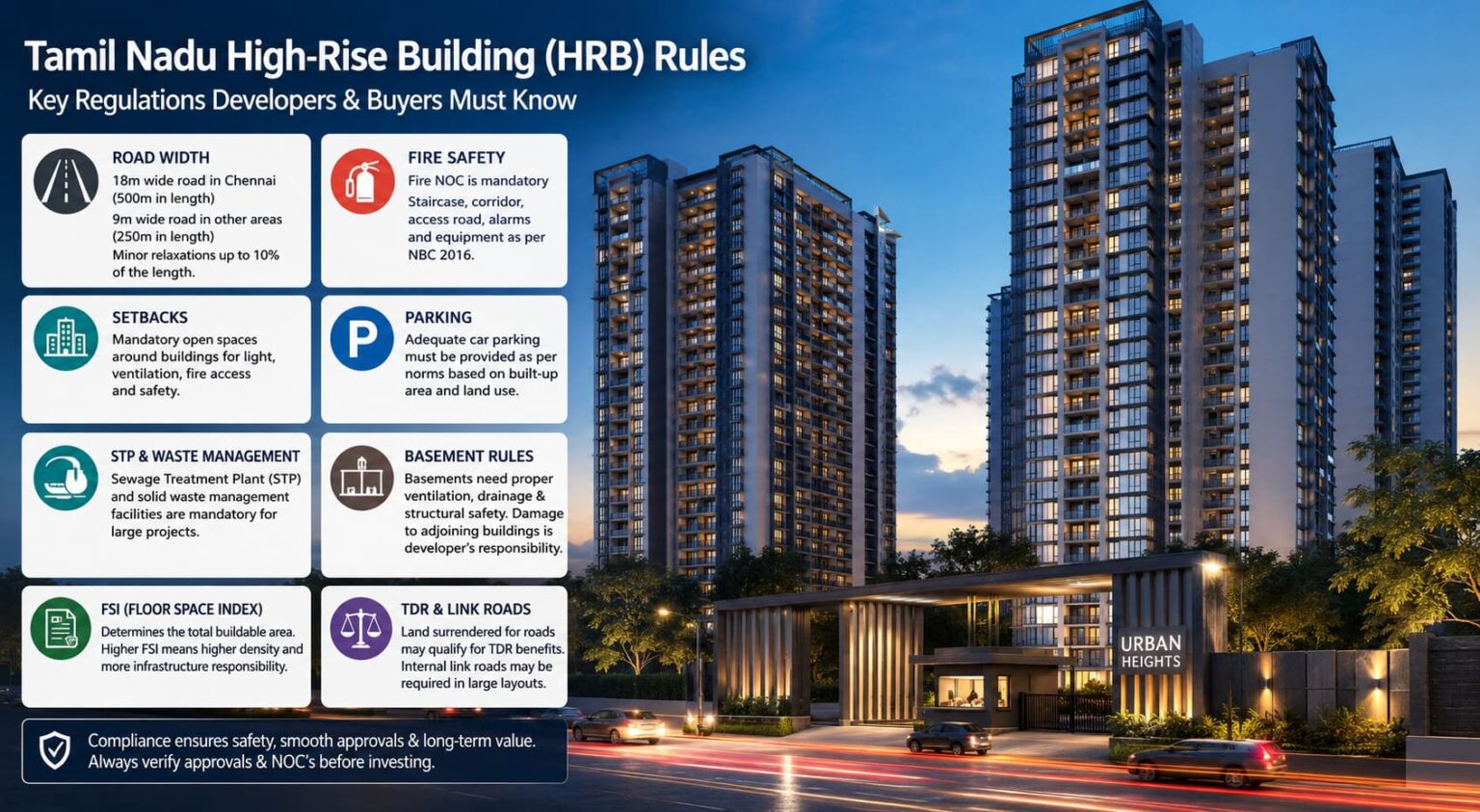
1. Minimum Road Width Requirement
- Ideal requirement → 18 meters road width
- Relaxation allowed:
- 15 m road → FSI up to 2.5
- 12 m road → FSI up to 2.0
👉 Key condition:
- Road width must be available for:
- 500 m (cities like Chennai)
- 250 m (other areas)
👉 If small stretches are narrower:
- Max 10% deviation allowed, but average width must still qualify.
2. Core Planning Parameters
📐 FSI (Floor Space Index)
- 12 m road → FSI 2.0
- 15 m road → FSI 2.5
- 18 m road → FSI 3.25
🧱 Site Coverage
- Max 50% of site can be built on
3. Setback Rules
For buildings up to 30m height:
- Minimum setback → 7 meters
Above 30m:
- For every +6m height → +1m setback
- Maximum setback → 20m
👉 Applies to:
- Boundary setbacks
- Spacing between multiple blocks
4. Gate Pillars & Entrance Arch
- Allowed in setback space
- Conditions:
- Minimum headroom: 5.5 m
- Minimum width: 3.5 m
- Must maintain 7 m clear setback from main building
👉 This is the exact legal source for entrance arch rules.
5. Parking & Internal Roads
- Parking must be provided within site
- Internal road width → minimum 7.2 m
- Must be:
- Open to sky
- No projections above
6. Basement Rules
- Height above ground → max 1.2 m
- Minimum headroom → 2.4 m
- Can extend beyond building line (with conditions)
- Must support fire engine load
7. Fire Safety (Critical Compliance)
- Must follow National Building Code (NBC) 2016
- Requirements:
- Fire detection systems
- Alarm systems
- Firefighting systems
- NOC from Fire Department
8. Mandatory Building Services
Each high-rise must have:
- Lifts (as per NBC)
- Standby generator
- Electrical room
- Meter rooms (based on number of units)
9. Sewage & Waste Management
- 50 dwelling units → Sewage Treatment Plant (STP) mandatory
- <50 units → Septic tank allowed
- 100 units → Solid waste storage system required
10. Sustainability Requirements
- Rainwater harvesting → mandatory
- Solar energy → where applicable
11. Land Reservation & Road Requirements
Authorities can require:
- Land for:
- Parks
- Roads
- Link roads
- Must be:
- Given free via registered gift deed
- Eligible for TDR (Transfer of Development Rights)
12. Security Deposit
- Developer must pay:
- 50% of infrastructure charges
- Refundable after completion (if compliant)
13. Display Board Rule
- Project details must be displayed on-site
- Deposit ₹10,000 (refundable)
14. Special Compliance
Must follow:
- Accessibility rules (disabled-friendly)
- Hospital-specific rules (if applicable)
15. Affordable Housing Benefit
- Smaller units get:
- Relaxed FSI charges (no premium FSI)
The Most Common HRB Issues in Chennai
Some of the biggest approval problems include:
1. Non-Qualifying Road Width
The approach road often fails the continuous width requirement.
2. Fire NOC Delays
Projects may require multiple redesigns for compliance.
3. Incorrect FSI Calculations
FSI mistakes can affect project viability.
4. Setback Violations
Balconies and projections inside setbacks create issues.
5. Basement Excavation Disputes
Neighboring property damage claims are becoming common.
6. Road Alignment Land Loss
Future road widening plans may reduce buildable area.
Why Compliance Matters
For Developers:
- Necessary for approvals from CMDA, DTCP, local bodies, and Fire Department
- Road width, setbacks, fire safety, parking, STP, and NBC compliance directly affect project approval
- Violations may lead to approval delays, redesign costs, penalties, or legal disputes
For Buyers:
- Check whether the project has proper approvals and Fire NOC
- Verify setback compliance, parking, emergency access, and infrastructure facilities
- Helps avoid unsafe projects, legal complications, and future regulatory issues
Final Thoughts
Tamil Nadu’s HRB regulations are not merely technical building rules.
They are part of a larger effort to balance:
- urban growth,
- infrastructure capacity,
- public safety,
- environmental sustainability,
- and emergency preparedness.
Ultimately, HRB approval is not just about:
how tall a building can be.
It is about:
whether the surrounding city infrastructure can safely support that building and its future population.
Abbreviations
- CMDA-Chennai Metropolitan Development Authority
- DTCP -Directorate of Town and Country Planning
- STP – Sewage Treatment Plant
- NBC – National Building Code
- NOC – No Objection Certificate.