



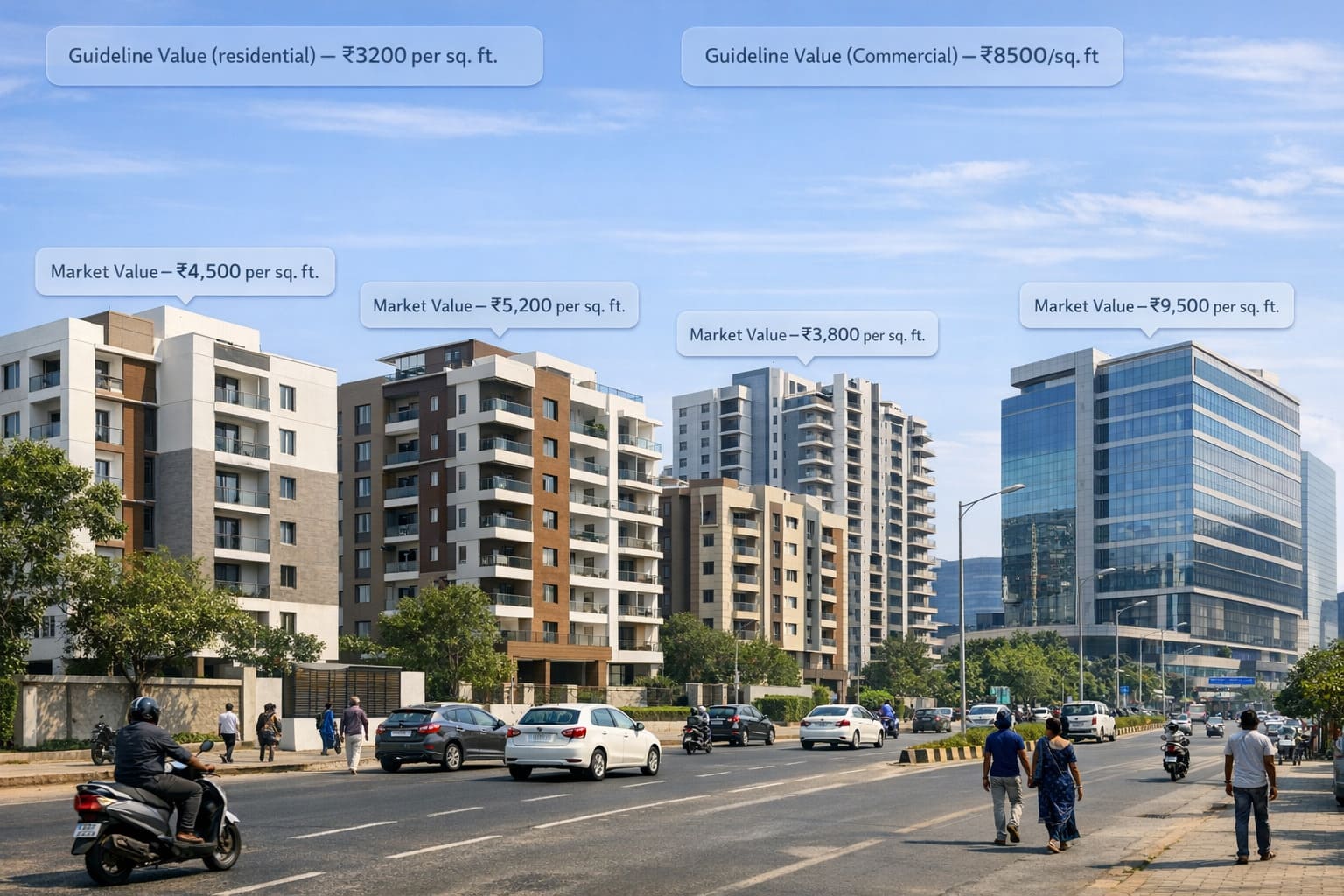
When buying or selling a resale apartment, one of the most misunderstood topics is the difference between Guideline Value (GV) and Market Value. Many property owners wrongly assume both are the same. They are not.
In practice, registration happens on Guideline Value, while price discovery and negotiation happen on Market Value. Failing to understand this distinction can lead to registration hurdles, loan shortfalls, or incorrect pricing decisions.
Guideline Value should be treated strictly as a statutory compliance benchmark, not as a reflection of what a property is actually worth in the open market.
Guideline Value (GV) for Resale Apartments
Guideline Value is the minimum value fixed by the Tamil Nadu Registration Department for calculating stamp duty and registration charges.
For resale apartments, Guideline Value is not the sale price.
It is computed using a predefined formula.
Guideline Value Formula for Apartments
Guideline Value = (UDS × Land Guideline Rate) + Depreciated Building Value
This calculation has two independent components:
- Land value (based on your undivided share)
- Building value (after applying age-based depreciation)
Step-by-Step Guideline Value Calculation
1. Undivided Share of Land (UDS)
UDS represents your legal ownership share of land in the apartment project.
Formula
UDS = (Your flat built-up area ÷ Total project built-up area) × Total land area
UDS is a legal metric, not a negotiable one. It directly impacts registration value.
2. Land Guideline Rate
Land guideline rates are:
- Street-wise
- Survey-number-wise
- Not uniform across a locality
Even two apartments in the same building can have different land guideline values if survey details differ.
Example calculation:
Land GV assumed: ₹4,000 per sq.ft
Land value = 480 × 4,000
➡️ Land value = ₹19.2 Lakhs
Always verify the exact land guideline rate before finalising an agreement.
3. Building Value (With Depreciation)
The government uses Public Works Department (PWD) Schedule of Rates and applies depreciation based on building age.
Typical depreciation slabs
| Building Age | Depreciation Range |
|---|---|
| 0–5 years | 5–10% |
| 5–10 years | 15–25% |
| 10–20 years | 30–45% |
If a building has 25% depreciation, only 75% of its original construction value is considered for guideline calculation.
Example:
Construction rate (govt benchmark): ₹2,000 per sq.ft
Built-up area: 1,200 sq.ft
Building age: 10 years (25% depreciation) .
➡️Building value = 1,200 × 2,000 × 75% = ₹18 Lakhs
4. Land Value vs Building Value – Side-by-Side Calculation
| Particulars | Land Value (UDS Component) | Building Value (Depreciated Component) |
|---|---|---|
| Basis of calculation | Undivided Share of Land (UDS) | Built-up area |
| Formula used | (Flat area ÷ Total project built-up) × Total land area | Built-up area × Construction rate |
| Step 1 | (1,200 ÷ 60,000) × 24,000 | 1,200 × ₹2,000 |
| Intermediate result | UDS = 480 sq.ft | Original building value = ₹24,00,000 |
| Rate applied | Land GV: ₹4,000 / sq.ft | Depreciation (10 years): 25% |
| Final calculation | 480 × ₹4,000 | ₹24,00,000 × 75% |
| Final value considered | ₹19.20 Lakhs | ₹18.00 Lakhs |
5. Total Guideline Value (As Considered for Registration)
| Component | Amount |
|---|---|
| Land Value | ₹19.20 Lakhs |
| Building Value | ₹18.00 Lakhs |
| Total Guideline Value | ₹37.20 Lakhs |
👉 Stamp duty and registration charges are calculated on the higher of Sale Value or Guideline Value.
Land Value vs Building Value – Conceptual Comparison
| Aspect | Land Value Component | Building Value Component |
|---|---|---|
| Based on | Undivided Share of Land | Built-up area |
| Rate source | Government land guideline rate | PWD construction rates |
| Depreciation | ❌ Not applicable | ✅ Applicable |
| Increases over time | Often yes | Always no |
Final Guideline Value Rule
👉 Stamp duty and registration charges are calculated on the higher of:
- Declared Sale Value
- Calculated Guideline Value
Under-reporting below GV is not permitted. Though it can be done under special circumstances .
Market Value of Resale Apartments
Market Value is the price a buyer is actually willing to pay.
It is driven by:
- Demand and supply
- Rental yield
- Infrastructure development
- Livability and builder reputation
- Buyer sentiment
Market value has no direct connection with guideline value.
What Influences Market Value in Resale Apartments
1. Location Factors
- Connectivity to employment hubs
- Access to metro, highways, and arterial roads
- Social infrastructure (schools, hospitals, retail)
2. Apartment-Specific Factors
- Gated community vs standalone
- Builder credibility
- Floor level, ventilation, orientation
- Parking type and availability
- Maintenance quality and age of the building
(Properties under 10 years usually command a premium)
3. Demand Dynamics
- Rental demand
- Investor interest
- Absorption rate of nearby projects
Why Guideline Value and Market Value Differ So Much
| Aspect | Guideline Value | Market Value |
|---|---|---|
| Set by | Government | Buyers & sellers |
| Purpose | Registration compliance | Actual transaction |
| Basis | Land + depreciated building | Comparable sales |
| Updates | Periodic, conservative | Continuous, dynamic |
In most urban micro-markets, market value can be multiple times higher than guideline value.
Practical Advice for Sellers
- Ensure the agreement value is never below guideline value
- Overpricing beyond comparable sales slows down resale
- Large cash components increase legal and tax exposure
- Keep documentation clean for buyer loan approval
Practical Advice for Buyers
- Base negotiation on:
- Recently registered sale deeds (last 6–12 months)
- Bank valuation reports
- Do not rely on advertised prices
- Always check whether the agreed price aligns with bank funding norms
How to Check Exact Guideline Value
Use the Guideline Value Search on Verified.RealEstate
Search using:
- District
- Registration zone
- Village
- Street name or survey number
⚠️ Guideline values can vary sharply even within the same neighbourhood.
Reality Hits
Guideline Value controls registration legality — not resale reality.
Resale decisions must always be driven by market data, while GV should be treated strictly as a compliance benchmark.
Making the Right Resale Decision
In resale transactions, clarity beats assumptions. Using tools like Guideline Value Search, Apartment Composite Value, and Stamp Duty & Registration Calculator helps buyers and sellers stay compliant. For those planning valuation, resale, redevelopment, or upgrades, structured services around legal verification, approvals, and construction planning reduce risk.
Platforms like Verified.RealEstate bridge the gap between regulation and real pricing, enabling confident, compliant, and informed property transactions.