


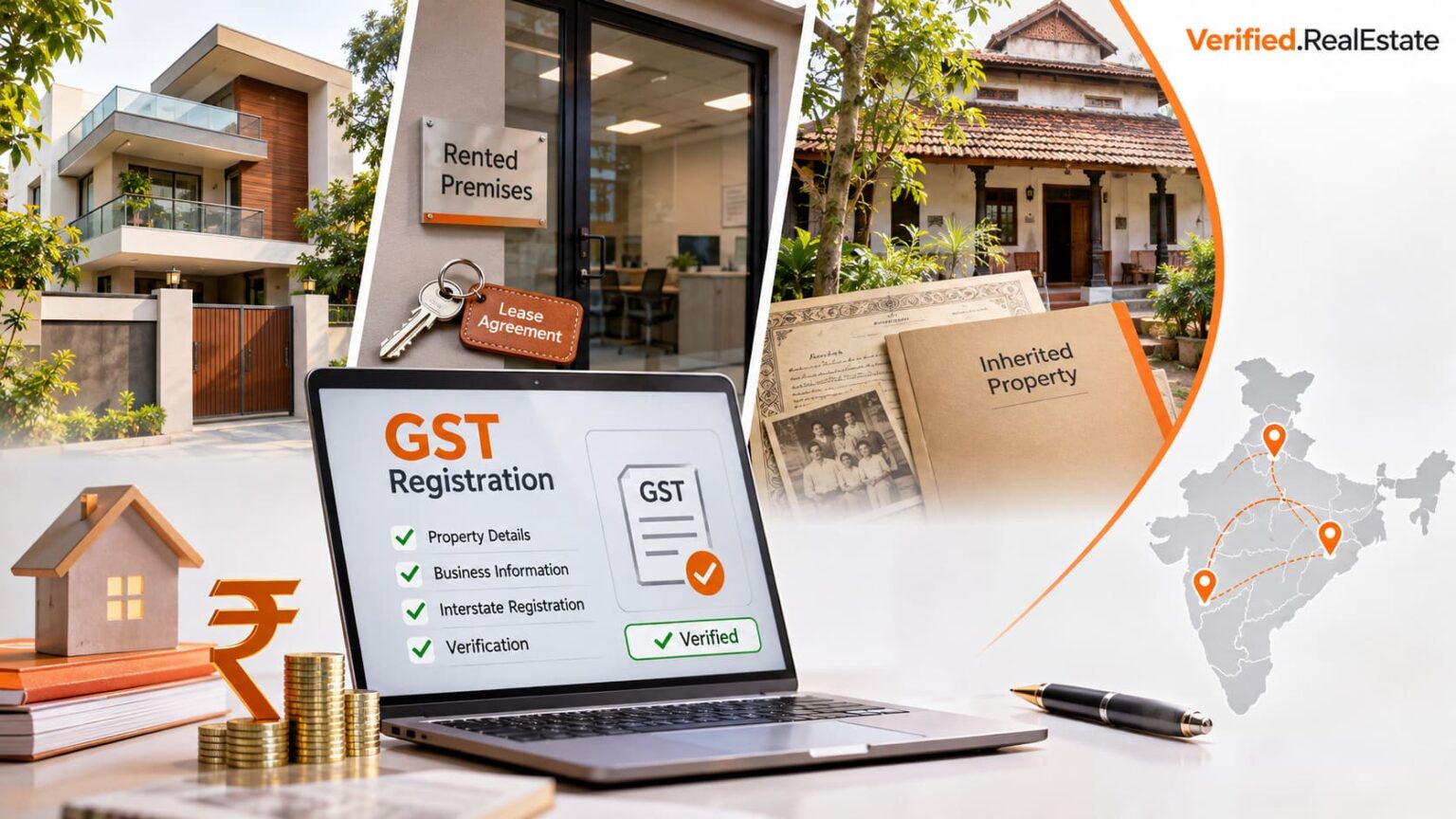
Entrepreneurs, freelancers and small businesses need not necessarily rent an independent commercial office to obtain GST registration.
The Central Board of Indirect Taxes and Customs (CBIC), through Circular No. 257/03/2026-GST, dated 26 October 2026, has clarified the documentation requirements for businesses operating from self-owned, residential, family-owned, rented and inherited properties.
The circular also addresses businesses seeking GST registration in a state different from their place of residence.
Can Residential Property Be Used for GST Registration?
Yes. Businesses can use residential premises as their principal or additional place of business, subject to applicable legal and documentation requirements.
This is particularly beneficial for freelancers, consultants, online sellers, home-based businesses and startups.
As per the circular, GST officers should not raise subjective objections merely because a business operates from residential premises.
However, GST registration does not override local zoning regulations, building usage restrictions or applicable licensing requirements.
GST Registration Using Self-Owned Property
If the property belongs to the applicant, any one of the following documents can be submitted as premises proof:
- Latest property tax receipt.
- Municipal Khata (where applicable, such as Karnataka).
- Property identification document.
- Latest electricity bill.
- Latest water bill.
The document must be in the applicant’s name and contain the complete address matching the GST registration application.
All five documents are not required. Any one of the prescribed documents is sufficient.
Can You Use Your Parents’ or Family-Owned Property for GST Registration?
Yes. Applicants can use properties belonging to their parents, spouse, siblings or other family members with the owner’s consent.
Similarly, a company or partnership firm can use premises belonging to its directors or partners.
However, such premises should not be declared as self-owned property. The appropriate category, such as consent, rented or shared premises, must be selected.
Documents required
| Document | Requirement |
|---|---|
| Owner’s consent letter | Signed by the property owner on plain paper in the prescribed format |
| Supporting property proof | Any one of the prescribed property documents in the owner’s name |
| Jointly owned property | Consent from all co-owners |
The consent letter must identify the owner, applicant, property address and relationship between the parties.
Example: A freelancer operating from their father’s house in Chennai can apply for GST registration using the father’s signed consent letter and latest property tax receipt.
GST Registration Using Inherited Property
In many cases, inherited properties continue to remain in the name of a deceased parent or grandparent because the property records have not been updated.
As per the circular, applicants can use such premises for GST registration by submitting the prescribed documents.
| Document | Requirement |
|---|---|
| Death certificate | Death certificate of the deceased ancestor |
| Affidavit | Affidavit in the prescribed format |
| Supporting property proof | Any one of the prescribed premises documents in the deceased ancestor’s or applicant’s name, as permitted by the main circular |
This provides a documentation route for applicants who have inherited property but have not yet updated the ownership records.
Note: There is a discrepancy between the main circular and its documentation checklist regarding whose name must appear on the supporting property document. Applicants relying on documents solely in the deceased ancestor’s name must seek clarification from the GST authorities.
However, GST registration does not establish inheritance rights, transfer ownership or resolve disputes between legal heirs.
GST Registration for Rented or Leased Properties
The documents required depend on whether a rental agreement is available and whether its registration is legally mandatory.
| Type of rental arrangement | Documents required |
|---|---|
| Registered rental or lease agreement | Valid registered rental or lease agreement |
| Unregistered rental agreement | Valid rental agreement and any one prescribed property document in the landlord’s name, where registration is not legally mandatory |
| Electricity or water connection in the tenant’s name | Valid agreement and latest utility bill may substitute for the landlord’s premises proof |
Where applicable state laws require registration of a rental or lease agreement, applicants must comply with those requirements.
Can You Obtain GST Registration Without a Rental Agreement?
Yes. The circular provides an alternative documentation procedure for tenants who do not have a written rental agreement.
The applicant must submit an undertaking in the prescribed format, along with evidence of lawful possession, such as an electricity or water bill in the tenant’s name.
The undertaking should contain details of the landlord, business premises, lawful occupation and responsibility for utility payments and business-related tax liabilities.
However, this provision does not exempt landlords or tenants from applicable tenancy laws and mandatory rental agreement registration requirements.
Can You Obtain GST Registration in Another State?
Yes. As per the circular, an applicant’s residential address need not be in the same city, district or state as the business premises.
For example, an entrepreneur residing in Chennai can obtain GST registration for a business operating from Bengaluru, provided the business has a genuine, verifiable premises in Karnataka with the required supporting documents.
| Business arrangement | GST registration requirement |
|---|---|
| Residing in Tamil Nadu and operating a business in Karnataka | GST registration in Karnataka, subject to applicable requirements |
| Operating multiple offices within Tamil Nadu | Single registration with additional business premises or separate registrations, subject to applicable conditions |
| Operating businesses from Tamil Nadu and Karnataka | Separate state-wise registrations where liable |
| Operating from Tamil Nadu and supplying goods or services to customers in other states | Separate registration is not required merely because customers are located in other states |
GST officers should not raise unnecessary objections solely because an applicant, director or authorised signatory resides in another state.
Special Economic Zones (SEZs)
An SEZ unit or developer must submit the applicable approval or permission from the competent SEZ authority.
A separate GST registration is compulsory for the SEZ business even when the applicant already holds a non-SEZ registration in the same state or union territory
Prescribed Affidavit, Undertaking and Consent Letter Formats
The circular provides standard document formats for specific property arrangements.
| Document | Applicable situation | Reference |
|---|---|---|
| Affidavit | Inherited property remaining in the deceased ancestor’s name | Page 35 of the circular |
| Undertaking | Rented premises without a rental agreement | Page 36 of the circular |
| Consent letter | Family-owned or other consent-based premises | Pages 37–38 of the circular |
The inherited property affidavit must be executed on non-judicial stamp paper of a minimum value of ₹100 before an authorised magistrate or notary. The owner’s consent letter can be prepared on plain paper.
Applicants should use the prescribed formats available in the original circular.
Checklist Before Choosing a Property for GST Registration
- Verify property ownership and your lawful right to occupy the premises.
- Obtain consent from all property owners, wherever applicable.
- Ensure rental agreements comply with applicable state laws.
- Check whether the intended business activity is permitted at the premises.
- Ensure property documents contain accurate and consistent address details.
- Keep supporting documents updated, complete and readable.
- Ensure the premises are accessible for physical verification, if required.
What Do These Guidelines Mean for the Real Estate Sector?
The 2026 GST registration guidelines provide greater flexibility for entrepreneurs to operate from residential, family-owned, inherited or rented properties without necessarily investing in independent commercial offices.
For property owners and tenants, maintaining valid property documents and legally compliant occupancy arrangements can help avoid unnecessary GST registration delays and rejections.
Official Sources and Related Articles
CBIC Circular No. 257/03/2026-GST, dated 26 October 2026
Download the official circular and prescribed document formats
For a comprehensive understanding of GST registration procedures, documentation requirements and approval timelines, read our detailed article: New GST Registration Guidelines 2026: Everything Businesses Need to Know.
Legal Disclaimer
This article is intended for general informational purposes only and does not constitute legal or tax advice. GST registration does not establish property ownership, validate inheritance rights or override applicable tenancy, zoning and building usage regulations.