



📜 Historical Classification of Land in Tamil Nadu
The entire land system of Tamil Nadu, dating back to the Chola period, was divided into structured classifications under the Ryotwari system. One of the key classifications is Poramboke land.
- Poramboke lands are:
- Lands set apart for public or communal purposes
- Generally incapable of cultivation
- Not assessed for revenue (though theoretically taxable)
- The four classifications of land:
- Assessed land
- Unassessed land
- Poramboke land
- Reserved land
👉 Importantly:
- Freehold ownership of these categories vests with the Government
🚫 Strictly Protected Poramboke Lands:
- Lakes
- Rivers
- Grazing grounds
- Forests
- Hills
👉 These cannot be privately enjoyed or occupied
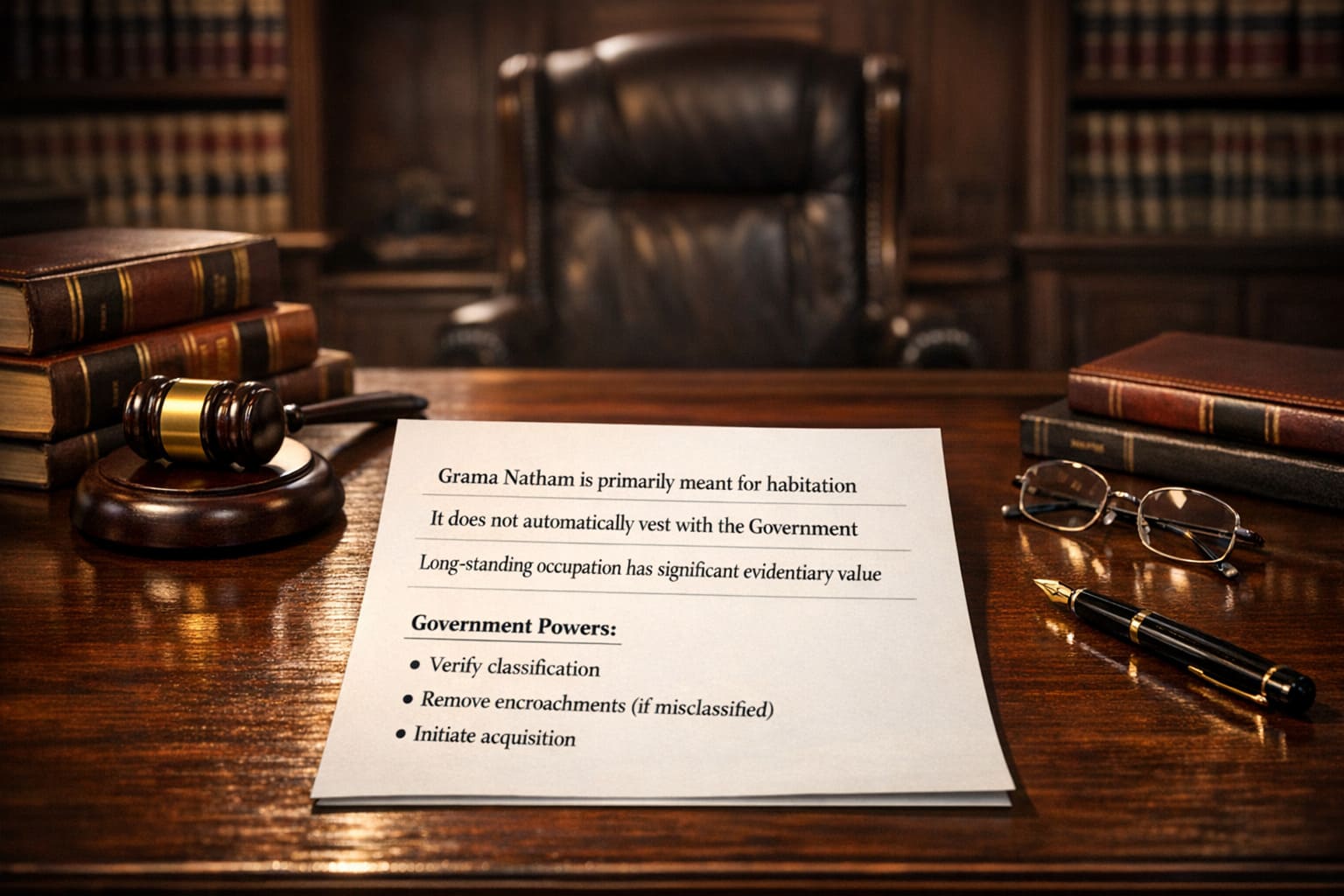
🏡 Grama Natham
Amidst these classifications, a critical exception exists:
👉 Grama Natham (or Natham land)
Defined as:
“Land set apart for village habitation — sites where houses may be built and village life is carried on.”
Key Characteristics:
- Used for:
- Residential houses
- Cottage industries
- Village livelihood activities
- Not assessed for land revenue
- Meant for private occupation by villagers
👉 This Grama Natham land has long been a subject of legal ambiguity in Tamil Nadu. While traditionally treated as village habitation land, recent disputes have raised critical questions:
- Does Grama Natham belong to the Government?
- Can long-term occupants claim ownership?
- Can authorities evict occupants without due process?
⚖️ Crucial Distinction:
| Category | Ownership | Use |
|---|---|---|
| Poramboke (general) | Government | Public/common use |
| Grama Natham | Not vested with Government | Private habitation |
👉 This distinction is the root of most legal disputes
⚖️ Case Analysis 1: W.P. No. 18754 of 2005 (2013)
🧾 Facts
- Petitioners were in long-standing possession of Grama Natham land
- Authorities attempted:
- Interference
- Treating land as Government property
Arguments by Petitioners’ Advocates
1. Grama Natham is Not Government Land
- Counsel argued:
- It is habitation land
- It never vested with the State
2. Possession Creates Legal Rights
- Continuous occupation by:
- Petitioners + ancestors
👉 Establishes:
- Strong possessory and ownership claim
3. Misclassification by Authorities
- Authorities treated it as:
- Poramboke
❌ Petitioners clarified:
- Grama Natham ≠ Poramboke
4. Eviction Without Due Process is Illegal
- Title dispute exists
👉 Therefore:
- Summary eviction is impermissible
⚖️ Outcome
- Court protected:
- Petitioners’ possession
- Reinforced:
- Limits on Government interference
⚖️ Case Analysis 2: W.P. No. 25608 of 2023
🧾 Facts
- Land classified as Grama Natham
- Petitioners:
- Derived title from original occupants
- Transferred land to a charitable trust
- Authorities:
- Cancelled pattas
- Attempted eviction
Arguments by Petitioners’ Advocates
1. Grama Natham Never Vests with Government
- Based on:
- Lexicons
- Prior judgments
👉 Argument:
- Ownership lies with occupants, not State
2. Original Occupants = Absolute Owners
- First occupiers:
- Acquire ownership rights
👉 Petitioners (successors) hold valid title
3. Commercial Use Does Not Defeat Title
- Trust used land for:
- Income generation
❌ Authorities claimed misuse
✔️ Petitioners argued:
- Purpose change ≠ loss of ownership
4. Patta Cancellation is Arbitrary
- Administrative action cannot override:
- Existing legal title
5. No Summary Eviction in Title Disputes
- Must follow:
- Proper adjudication
⚖️ Court’s Final Position (Very Important Balance)
✔️ Strong Pro-Owner View:
- Original occupants = Owners
- Title continues despite:
- Transfer
- Commercial use
- Trust ownership
⚠️ But Court Also Clarifies:
Government Power Still Exists:
If land is required for:
- Public purpose
👉 Government can:
- Acquire the land legally
Compensation Protection:
- Petitioners agreed:
- To surrender possession
👉 Only:
- With proper compensation
⚖️ Final Orders:
- Government orders → Quashed
- Petitioners’ rights → Upheld
- Acquisition → Permitted with due process
🔍 Combined Legal Principles from Both Cases
1. Grama Natham ≠ Government Land
- It is:
- Village habitation land
- Capable of private ownership
2. Possession + Classification = Key
- Long possession alone is not enough
- Must align with:
- Proper land classification
3. Government Cannot Act Arbitrarily
Authorities cannot:
- Cancel pattas randomly
- Evict without due process
4. Title Disputes Require Legal Adjudication
- Summary eviction is illegal
5. Government Retains Limited Sovereign Power
- Can:
- Regulate: Control how the land is used according to law
- Verify classification: Check what type of land it is in official records
- Acquire land with compensation: Take the land for public use by paying proper compensation
⚠️ Critical Practical Insight
👉 The confusion arises because:
- Poramboke → Government land
- Grama Natham → Not Government land
BUT:
👉 Government still has:
- Regulatory authority
- Acquisition powers
📢 Conclusion
The rulings in W.P. No. 18754 of 2005 and W.P. No. 25608 of 2023 reaffirm a crucial legal position—courts protect genuine occupants of Grama Natham and reject arbitrary State interference, while still maintaining constitutional balance through the Government’s power of regulation and acquisition.
👉 Grama Natham land does not automatically belong to the Government and can become private property of occupants; however, such ownership is not automatic and must be supported by long and continuous possession, recognition through records like patta or revenue entries, and the absence of any contrary classification such as poramboke or public-use land. These rights are protected only when supported by proper classification and legal recognition.
In essence, Grama Natham can give ownership rights—but only when legally proven, and always subject to the Government’s power to regulate and acquire the land with due process and compensation.