



Whether you’re buying land in rural Kanchipuram or a flat in urban Chennai, the Encumbrance Certificate (EC) is one of the first documents experts recommend checking. But while the EC is a critical legal document, many misunderstand its scope—and its limits. This in-depth guide explains what the EC does, what it doesn’t, how to apply for it, and why it must be only the first step in your title verification.
1. What Is an Encumbrance Certificate?
An Encumbrance Certificate (EC) is a legal document issued by the Sub-Registrar’s Office (SRO) that records all registered transactions related to a property within a given time frame. This includes sales, mortgages, leases, releases, and gifts. In simple terms, it shows whether a property is “financially clean” or “burdened” with loans or prior claims.
An EC is typically needed for:
- Property resale or purchase
- Bank loans
- Legal clearances for construction
- Succession planning or partition
Meaning of “Encumbrance”
In legal terms, an “encumbrance” is any registered liability or claim on a property. This could be:
- A bank mortgage
- A registered lease
- A gift deed
- A sale or resale
- A release deed (from a co-owner)
If the EC shows no such transactions, it will be issued as a “NIL Encumbrance Certificate” for that time period.
2. What Does an EC Look Like?
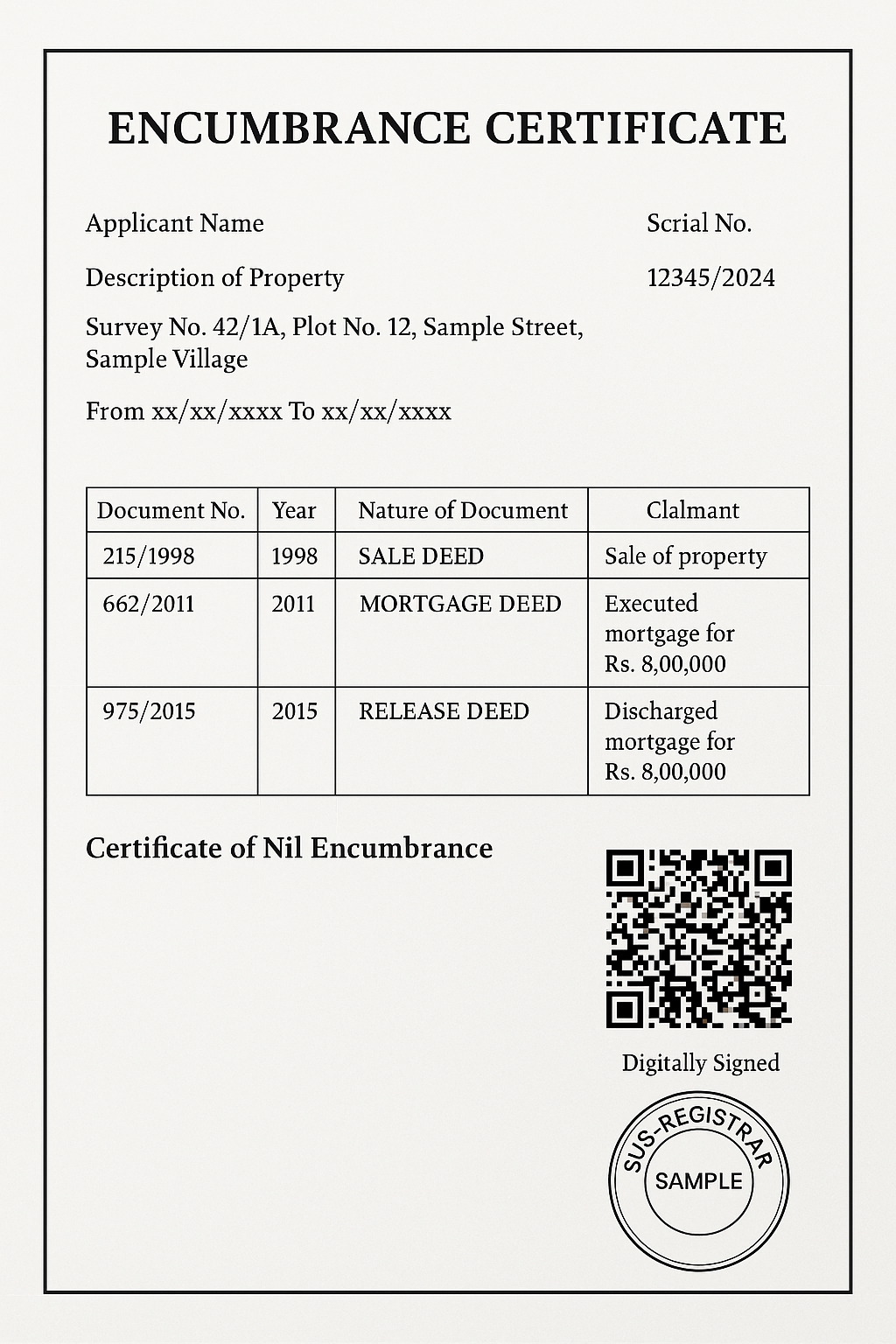
Here’s what a typical EC will show:
Sample Entry Format:
| Document No | Year | Nature of Document | Executant | Claimant | Property Details |
|---|---|---|---|---|---|
| 1112/2007 | 2007 | Sale Deed | Mr. Ramesh | Mr. Suresh | Plot 16A, Survey 144/3B |
| 554/2019 | 2019 | Mortgage Deed | Mr. Suresh | ICICI Bank | Same |
NIL Certificate Example: If no transaction exists between 1990–2024, the certificate will state:
“No registered transactions found in the above-mentioned period.”
3. Example Image of an EC (Sample Format)
4. Why Is the EC So Important?
The EC is a critical safeguard in Tamil Nadu real estate. Here’s what it helps with:
| Purpose | How EC Helps |
|---|---|
| 💰 Loan Sanctions | Proves the property isn’t under prior mortgage |
| 🏡 Buying Property | Reveals if seller is actual owner or if others are involved |
| 🧾 Avoiding Fraud | Detects hidden sales, gifts, or leases |
| 🧑⚖️ Legal Documentation | Essential for verifying title chain before registration |
| 🏗️ Building Approvals | EC is often needed for CMDA/DTCP applications |
5. How to Apply for an EC in Tamil Nadu (Step-by-Step)
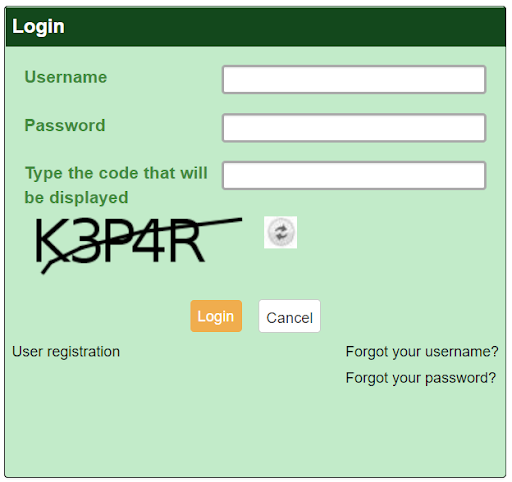
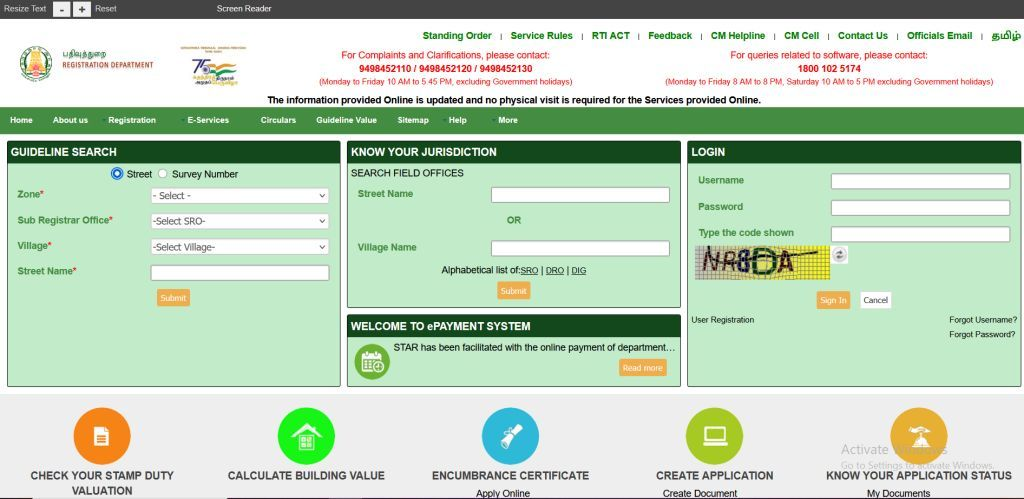
✅ Step 1: Go to TNREGINET Portal
Use the official Government of Tamil Nadu site.

✅ Step 2: Select “Encumbrance Certificate” under “E-Services”
You’ll be taken to the application form.


✅ Step 3: Choose Search Type
- Document-wise: If you know the deed number
- Property-wise: Recommended — lets you search by survey number, door number, etc.

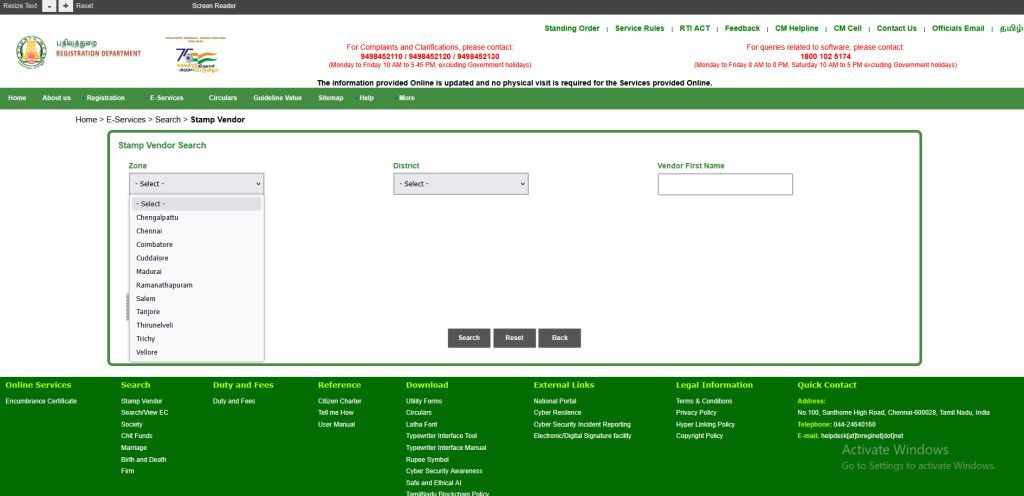
✅ Step 4: Enter Details
- District
- Sub-Registrar Office
- Survey Number / Door Number
- Plot details (Village, Taluk, Extent)
- Year Range (e.g., 1990–2024)

✅ Step 5: Submit and Authenticate
- Enter the CAPTCHA
- Provide mobile number for OTP
- Submit the request
✅ Step 6: View / Download
Your EC will be shown online. You can:
- Save it as a PDF
- Print it for verification or submission
Pro Tip: Always apply for at least 30 years of EC history. Anything less can miss earlier mortgages or fraudulent sales.
What We Offer (Service Insert)
At Verified Real-estate, we offer complete EC assistance: Don’t just download the EC. Let us verify it for you. Click Here!
6. What the EC Does NOT Show
Despite its usefulness, the EC has critical blind spots. You must never rely on it alone to validate property title.
Unregistered transactions – oral gifts, family settlements, or illegal POA misuse
Court disputes or pending litigations
Duplicate Patta or mutation errors
Poramboke land illegally sold
Encroachments on government/temple/inam land
Unauthorized layout or unconverted agricultural land
EC shows “registered” truth, but not the full ground reality.
7. Case Example: Hidden Mortgage Discovered via EC
Mr. Arjun planned to buy a 1-ground plot in Tambaram. The seller had Patta and Chitta in their name. When Arjun pulled the EC, he found a 2016 mortgage with a private finance company, which was never cleared. Without this check, Arjun would’ve bought land already pledged as collateral.
7. Combine EC With Other Records
| Document | What It Shows |
|---|---|
| Patta/Chitta | Ownership, land type |
| A-Register | Cultivation, encumbrance in revenue records |
| TSLR | Urban land classification and building use |
| Book 3 | POA misuse, settlement, hidden claims |
EC is essential. But not sufficient.
8. Conclusion
The Encumbrance Certificate is a cornerstone document for any real estate transaction in Tamil Nadu. It proves whether a property is free from legal claims, mortgages, or registered complications. However, EC must be read in context — alongside Patta, TSLR, A-Register, and legal due diligence. That’s the only way to ensure you aren’t inheriting someone else’s financial or legal mess.