

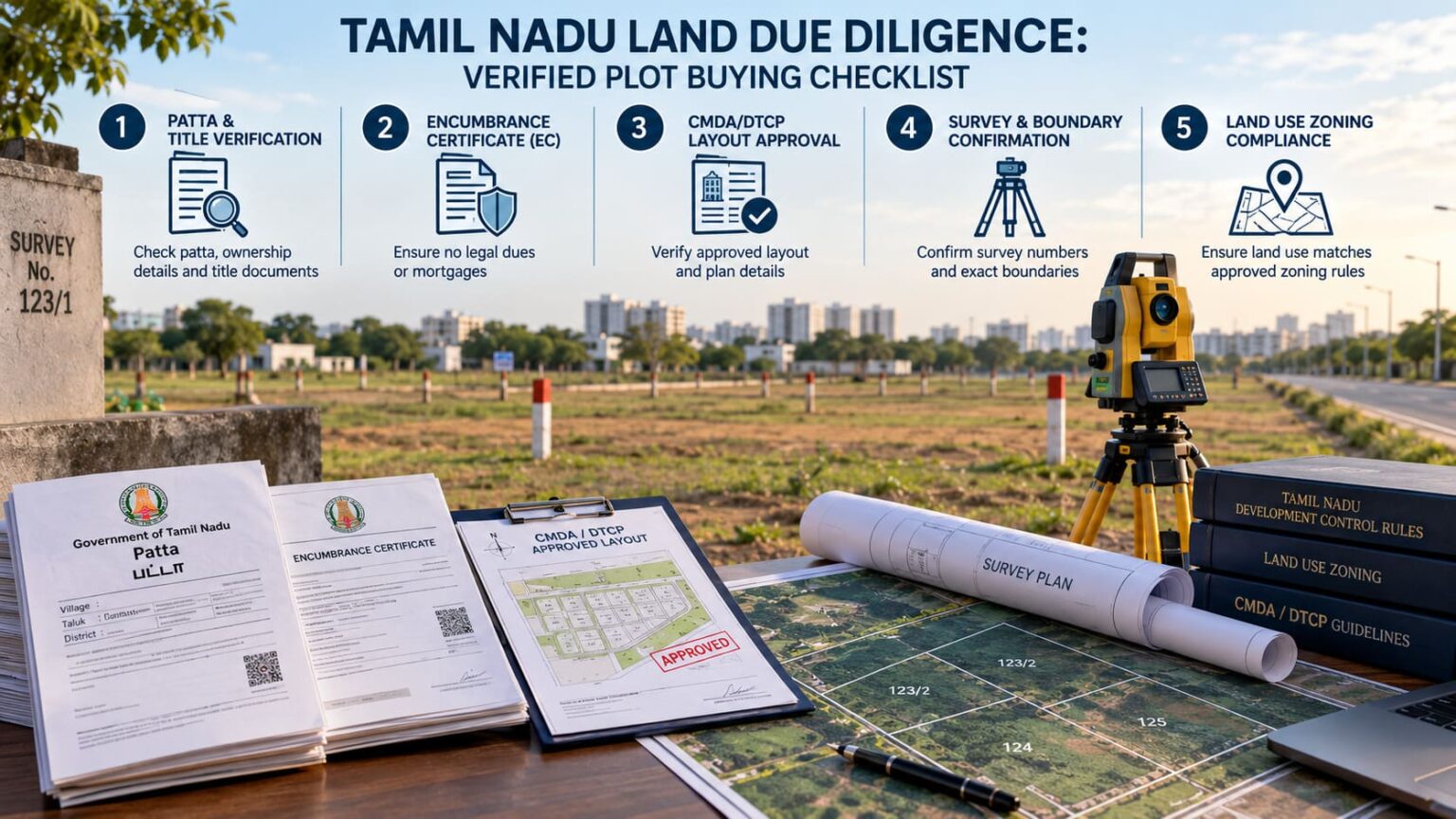
Buying a plot of land is one of the biggest investments you will ever make. Whether you plan to build your dream home or hold the land for long-term growth, owning property brings security and pride. However, land transactions can quickly turn into a nightmare if you skip mandatory legal checks.
In Tamil Nadu, thousands of homebuyers face legal disputes, demolished structures, or loss of money simply because they bought plots in unapproved layouts, signed papers with unclear ownership, or ignored warning entries in government records. This clear, easy-to-read legal checklist ensures you buy a 100% safe, legally sound plot in Chennai and across Tamil Nadu.
1. Verify the Seller’s Ownership Rights (Title Deed)
Before paying an advance, make sure the person selling the land is the true legal owner.
- Parent Documents: Ask for original title deeds and all previous sale agreements going back at least 30 years. This proves a clean line of ownership.
- Inherited Land Checks: If the seller inherited the land, request a Legal Heir Certificate or a court-approved Probate of Will.
- Legal Opinion: Always hire a qualified property lawyer to review all ownership papers before signing any contract.
2. Check the Patta and Watch for Red Flag Names
A Patta is an official government revenue record proving land ownership. Always verify that the Patta is registered in the seller’s name with the exact survey number, village name, and plot size matching at the local Taluk Office.
Red Flag Words and Names in Patta Records:
- Poramboke Lands (Eri, Kuttai, Thoppu, Salai Poramboke): Government or community land set aside for water bodies, lakes, roads, or orchards. Buying water body land carries a 100% risk of demolition.
- Grama Natham / Natham Poramboke: Traditional village housing land. Commercial layouts on Natham land carry high legal risks and are frequently litigated.
- Anadheenam (அனாதீனம்): Unclaimed or abandoned land controlled strictly by the government Revenue Department.
- DK Patta / D-Form Patta: Government-granted land given to landless poor or specific communities. Selling this land to private parties is strictly forbidden by law.
- 2-C Patta: Grants rights only to collect fruits or use trees on government land—gives zero ownership over the ground.
- Temple / HR&CE / Wakf Board Names: Indicates religious trust property. Buying this without official state government permission is illegal.
- Kootu Patta (Joint Patta): Shows multiple co-owners on one document. Buying a plot from just one seller on a Kootu Patta without an official sub-division survey and registered split deed means you are buying an unseparated share.
- Deceased Person’s Name: If the Patta still names a deceased relative, the seller cannot legally sell it until the Patta is transferred into the living legal heirs’ names.
3. Check the Encumbrance Certificate (EC) and Warning Words
Apply for a 30-year EC online through the official Tamil Nadu Registration Portal (TN Reginet) or visit the Sub-Registrar Office (SRO). The EC shows all past legal transactions on the land.
Warning Words to Watch For in the EC:
- MODT / Memorandum of Deposit of Title Deeds: The land is currently mortgaged to a bank for a loan. Look for a registered Release Deed; without it, the bank holds primary claim over the plot.
- Court Attachment (நீதிமன்ற ஜப்தி): A court order stopping the sale of land due to unpaid debts or lawsuits.
- Injunction Order (தடை உத்தரவு): A court stay order freezing all sales on the property.
- Agreement to Sell (கிரைய உடன்படிக்கை): An active contract between the seller and a third party. It must be officially cancelled before you buy.
- Power of Attorney (POA): If buying through an agent, check if a Revocation Deed exists. Also verify if the original land owner is alive, as a POA becomes invalid immediately upon the owner’s death.
4. Check CMDA or DTCP Approval Status
Never buy an unapproved plot. In Tamil Nadu, buying land in unapproved layouts makes it impossible to get building permits, electricity connections, or home loans.
- CMDA (Chennai Metropolitan Development Authority): Handles layouts inside the Chennai Metropolitan Region. Look for a valid CMDA layout number (e.g.,
P.P.D/L.O No.). You can obtain official copies from CMDA for a nominal fee. - DTCP (Directorate of Town and Country Planning): Covers all regions outside CMDA limits (tier-2 cities like Coimbatore, Madurai, Trichy, and expanding suburbs). Verify layout drawings on the official TN DTCP website.
5. Confirm Road and Park Handover (Gift Deed Check)
A layout is only complete when common areas are handed over to the public.
- Gift Deed: Check if the developer executed and registered a formal Gift Deed transferring all internal roads and Open Space Reservation (OSR) park areas to the local body (Corporation, Municipality, or Village Panchayat).
- Road Ownership: Confirm that the road touching your plot is designated as a public road and is actively maintained by the local government authority.
6. Check Land Use Zone in the Master Plan
Even if land looks empty, government zoning rules decide what you can build on it.
- Check the official CMDA or DTCP Master Plan maps to ensure your plot falls under a Residential Zone (Primary or Mixed Residential).
- Avoid buying land marked as Agricultural (Nanjai/Punjai), Industrial, Water Body (Kulam/Kuttai), or Coastal Regulation Zone (CRZ) unless formal government conversion approvals are attached.
7. Boundary & Survey Verification (FMB / TSLR)
Land survey checks are a mandatory part of physical due diligence. In Tamil Nadu, title deeds prove ownership rights, but government survey sketches confirm exact boundaries and dimensions on the ground:
- Rural Plots (FMB Sketch): Check the Field Measurement Book (FMB) sketch via the revenue portal to verify field boundaries (F-lines) and survey sub-divisions.
- Urban Plots (TSLR Sketch): For plots inside municipal limits, obtain the Town Survey Land Register (TSLR) sketch to confirm ward, block, and town survey dimensions.
- On-Site Survey: Have a licensed surveyor measure the plot against the official FMB/TSLR sketch before paying an advance to catch neighbor encroachments, missing square footage, or road overlaps.
8. Crucial Extra Checks for Plots Outside CMDA Limits
If your plot falls outside Chennai under rural Panchayat or DTCP limits, keep these extra points in mind:
| Verification Step | Why It Is Important |
| Panchayat Sanction | Panchayat Presidents cannot approve layouts on their own. Ensure the layout has a primary DTCP approval followed by a local Panchayat resolution. |
| Agricultural Conversion | Ensure agricultural dryland (Punjai) or wetland (Nanjai) has been officially converted to non-agricultural residential use by the Revenue Department. |
| Water Body Buffers | Verify that the plot maintains a statutory safety buffer (15m to 30m) from nearby lakes, rivers, or government water channels. |
9. Building Permits and Completion Certificates
When you are ready to construct your house or if you are buying a plot with an existing building:
- Plan Approvals: Get a registered architect to draft building plans that follow the Tamil Nadu Combined Development and Building Rules (TNCDBR) for setbacks, height limits, and coverage.
- Planning Permission: Obtain official Planning Permission from CMDA/DTCP and a Building Approval Permit from your local municipal body before starting work.
- Completion Certificate (CC): For existing structures, verify the CC to ensure the building was constructed strictly according to the sanctioned plan.
⚠️ Warning Against Unauthorized Construction:
Building without approved plans or making illegal structural deviations will lead to strict enforcement actions, including fine penalties, locking and sealing of property, or total demolition by CMDA and local bodies under the Tamil Nadu Town and Country Planning Act.
Final Checklist Summary for Plot Buyers
- Obtain and review 30-year parent ownership deeds.
- Verify 30-year Encumbrance Certificate (EC) for words like MODT, Attachment, or Injunction.
- Verify Patta details and reject lands marked Poramboke, Anadheenam, DK Patta, or Kootu Patta.
- Confirm CMDA or DTCP layout approval numbers.
- Verify registered Gift Deed for layout roads and OSR spaces.
- Cross-check land zoning on official Master Plan maps.
- Use digital tools and expert on-site inspections for total peace of mind before paying any advance.
Smart Property Verification via LandLens One & VRE
The LandLens One platform by Verified.RealEstate (VRE) is a pro version that simplifies land due diligence across Tamil Nadu.
Powered by its AI engine, Veritas, it analyzes
- 30-year Encumbrance Certificates (EC),
- Ownership details
- Patta ownership trails,
- sub-divisions, and
- zoning rules to flag risks like water-body classifications,
- mortgages, or unapproved layouts.
To complement the digital checks, Verified.RealEstate’s expert team conducts on-site property inspections to physically inspect plot boundaries, verify abutting road access, evaluate physical terrain, and cross-check real-world site details against official government layout plans.