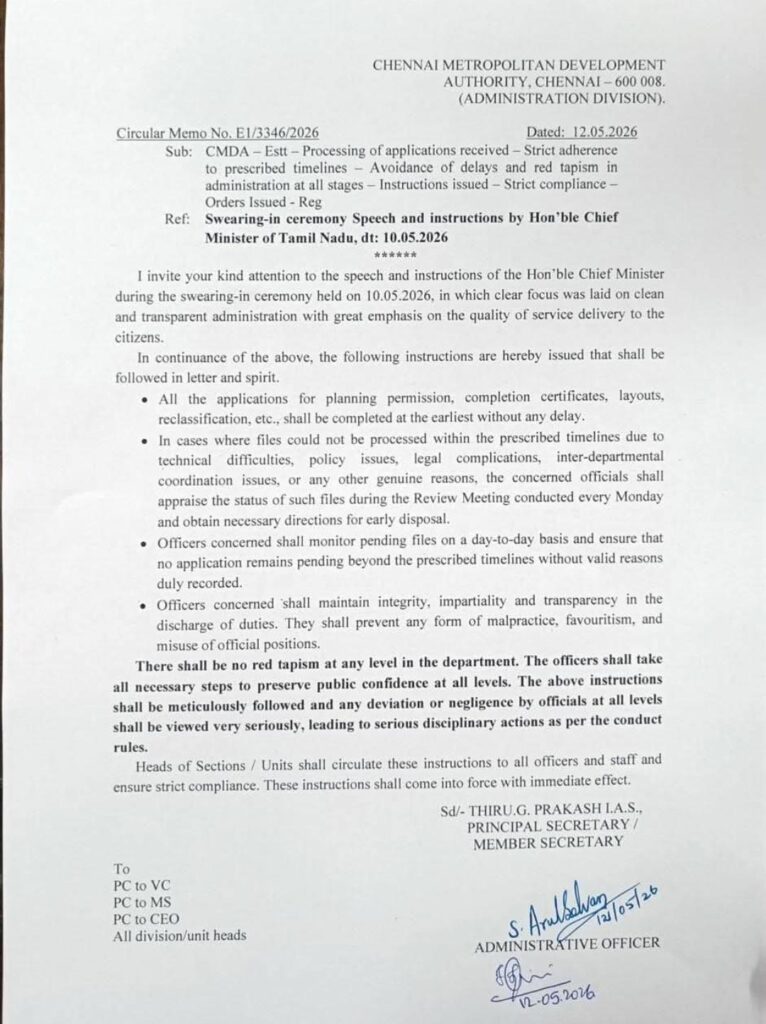
The Chennai Metropolitan Development Authority has issued a strict circular memo directing officials to avoid unnecessary delays and red-tapism while processing public applications related to planning permission, completion certificates, layouts and reclassification proposals.
The circular memo, dated 12.05.2026, refers to the Chief Minister’s swearing-in ceremony speech dated 10.05.2026, where emphasis was placed on clean and transparent administration and quality service delivery to citizens.
For Chennai’s real estate ecosystem, this is an important development. Approvals and file movement are not just administrative matters. They directly affect project timelines, property transactions, developer commitments, buyer confidence and investment decisions.
What the CMDA Circular Memo Says
The memo specifically covers applications related to:
Planning permission
Completion certificates
Layout approvals
Reclassification proposals
Other related public applications
The key instruction is clear: applications should be completed at the earliest without delay.
CMDA has also directed officers to monitor pending files on a day-to-day basis. If an application cannot be processed within the prescribed timeline due to technical difficulties, policy issues, legal complications, inter-departmental coordination issues or any other genuine reason, the concerned officials must place the file before the review meeting conducted every Monday and obtain necessary directions for early disposal.
This means files cannot remain pending casually. If there is a genuine reason for delay, that reason must be recorded.
“No Red-Tapism at Any Level”
One of the strongest lines in the circular memo is:
“There shall be no red tapism at any level in the department.”
The memo further states that any deviation or negligence by officials at any level shall be viewed very seriously, leading to serious disciplinary action as per conduct rules.
Officers have also been instructed to maintain integrity, impartiality and transparency in the discharge of duties and to prevent malpractice, favouritism and misuse of official position.
This is not only about faster approvals. It is also about administrative discipline and public confidence.
Why This Matters for Chennai Real Estate
Chennai’s real estate market depends heavily on regulatory clarity. Whether it is an apartment project, plotted development, commercial building, institutional property or land conversion, approvals play a major role in deciding whether a project can move forward safely.
Delays in planning permission can affect project launches.
Delays in completion certificates can affect handovers and occupancy.
Delays in layout approvals can affect land development and sales.
Delays in reclassification proposals can affect the future use and value of land.
For builders and developers, faster file movement can improve planning and execution.
For buyers and investors, it can create more confidence in regulated projects.
For landowners, it can reduce uncertainty when trying to develop, sell or convert their property.
But there is one important point: faster processing does not mean automatic approval.
Faster Approvals Do Not Replace Due Diligence
This circular memo is an administrative instruction. It does not remove the need for proper verification, compliance checks or legal due diligence.
Even if approval processing becomes faster, buyers and developers still need to verify:
Title history
Encumbrance details
Patta and revenue records
Land use and zoning
CMDA or DTCP approval status
Road widening impact
Reclassification requirements
CRZ, waterbody, wetland or other restriction zones
Mortgage or charge details
Document authenticity
Completion certificate and planning permission validity
A faster system is useful only when the underlying documents and compliance position are clear.
For example, if a land parcel has title issues, road widening impact, zoning restrictions or missing approvals, faster movement of files alone will not solve the risk. It may only reveal the issue sooner.
That is why proper verification remains essential.
What Builders Should Do Now
Builders and developers should treat this as a good opportunity to clean up documentation before submission.
Applications should be complete, properly supported and technically clear. Incomplete files may still face delays if clarification is required.
Before applying for planning permission, layout approval or reclassification, developers should check whether the land records, ownership documents, zoning position, access road details and statutory restrictions are in order.
The circular memo may reduce avoidable administrative delay, but it cannot compensate for weak documentation.
What Buyers Should Understand
For buyers, this is a positive governance signal. It shows that the authority is pushing for faster and more accountable processing.
But buyers should not assume that every project with movement in approval files is automatically risk-free.
Before buying an apartment, plot, land parcel or commercial property, buyers should still ask:
Is the title clear?
Are the approvals valid?
Does the land use permit the proposed development?
Is there any pending reclassification issue?
Has the completion certificate been obtained where required?
Are there any legal, revenue or planning risks?
Real estate decisions should not be based only on promises, brochures or verbal assurances. They should be based on verified records.
A Step Towards Better Governance
CMDA’s circular memo is a welcome step for Chennai’s real estate sector. If implemented seriously, it can improve transparency, reduce unnecessary delays and create better confidence among citizens, developers and investors.
The most important part is the shift towards recorded reasons and review-based monitoring. When files are tracked regularly and delays require valid reasons, the system becomes more accountable.
For a growing city like Chennai, this matters.
Urban development needs speed.
Real estate needs certainty.
Citizens need transparency.
And every stakeholder needs trust.
Final Takeaway
The CMDA circular memo against red-tapism is a positive move for Chennai real estate. It can help improve file movement for planning permissions, completion certificates, layout approvals and reclassification proposals.
But faster processing should go hand in hand with stronger verification.
Before buying, selling, developing or investing in real estate, check the documents, approvals, title, zoning and hidden risks.
Before anything in real estate, think Verified.RealEstate.
Source: CMDA Circular Memo No. E1/3346/2026, dated 12.05.2026