

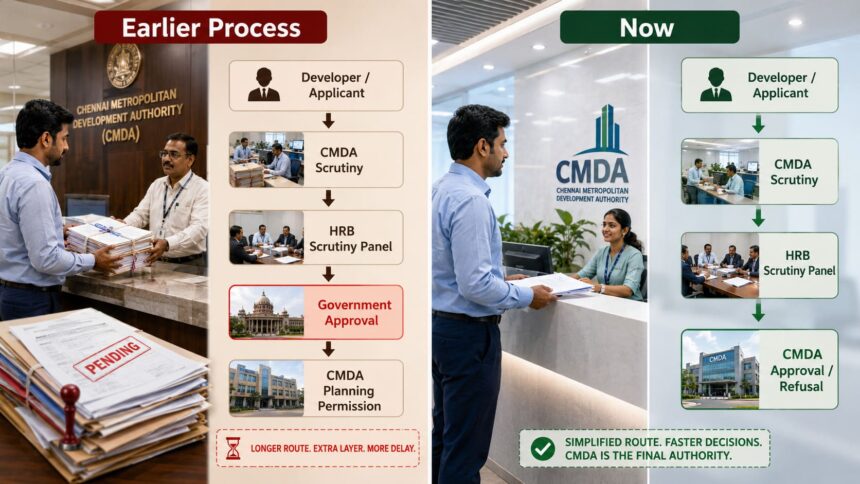
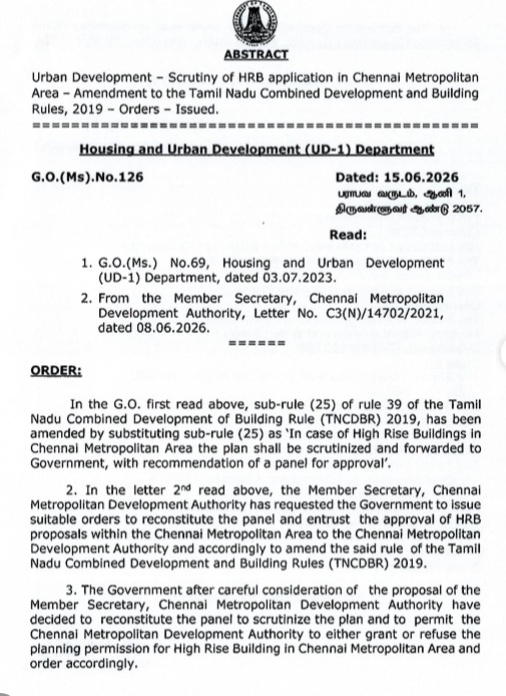
The approval process for High Rise Buildings (HRB) in the Chennai Metropolitan Area (CMA) has seen an important change. As per the recently circulated G.O.(Ms).No.126, Housing and Urban Development Department, dated 15.06.2026, the power to approve or refuse HRB planning permission has now been entrusted to the Chennai Metropolitan Development Authority (CMDA).
Earlier, even after CMDA scrutiny and recommendation by the HRB panel, the proposal had to be forwarded to the Government for final approval. Now, CMDA can directly issue or refuse planning permission based on the scrutiny panel’s recommendation.
This change is especially important for developers, builders, architects and landowners planning high-rise residential, commercial or mixed-use projects in Chennai.
What Is a High-Rise Building?
Under the Tamil Nadu Combined Development and Building Rules, buildings above 18.30 metres are generally treated as High Rise Buildings.
These projects require stricter scrutiny because they involve higher public safety and infrastructure concerns, including:
- Fire safety access
- Road width
- Setbacks
- FSI compliance
- Parking requirements
- Structural safety
- Water and sewerage feasibility
- Electricity load and TANGEDCO-related requirements
- Environmental and other department NOCs, wherever applicable
So, the new change does not mean HRB rules have been relaxed. It only changes the approval authority and process flow.
What Was the Earlier HRB Approval Process?
Previously, the HRB approval route in Chennai was longer.
The usual process was:
Developer / Applicant → CMDA scrutiny → HRB Scrutiny Panel → Government approval → CMDA planning permission
This meant that even after technical scrutiny and panel recommendation, the file still had to move to the Government for final approval. Only after that could CMDA issue planning permission.
For developers, this created an additional waiting period and made project timelines less predictable.
What Is Permitted Now?
Now, CMDA has been permitted to directly approve or refuse HRB planning permission within the Chennai Metropolitan Area.
The revised process is:
Developer / Applicant → CMDA scrutiny → HRB Scrutiny Panel → CMDA approval / refusal
This means the final approval stage has shifted from the Government to CMDA.
In simple terms, CMDA is now the direct approving authority for High Rise Building planning permission in CMA, subject to scrutiny and compliance.
The key point is clear: scrutiny remains, but the final approval power has moved to CMDA.
Why This Matters for Developers
This change can benefit developers in several practical ways.
1. Faster Approval Movement
Earlier, the file had to move beyond CMDA even after technical scrutiny. Now, once the HRB panel reviews the proposal, CMDA can take the final decision.
This can reduce unnecessary administrative delay.
2. Better Project Timeline Planning
High-rise projects involve major investment, consultant coordination, financing, marketing and construction planning. A shorter approval route can help developers plan launch and execution timelines better.
3. Reduced Approval Uncertainty
When approval depends on multiple levels, file movement becomes harder to track. With CMDA as the final approving authority, the process may become more direct and easier to monitor.
4. Helpful for Redevelopment and Large Projects
Chennai is seeing increased interest in redevelopment, vertical housing and mixed-use projects. This change can support genuine projects that are already compliant with planning and safety norms.
HRB Compliance and Pre-Approval Checks
The new approval process does not make HRB approvals automatic. CMDA can still refuse planning permission if a project does not comply with applicable regulations, including land use, road width, FSI, setbacks, height restrictions, fire safety, parking, structural safety, required NOCs, and documentation standards.
To avoid delays, objections, or rejection, developers should conduct a thorough pre-approval compliance review before submitting their application. Key checks include verifying land ownership and title, Encumbrance Certificate records, land use classification, road width and access, FSI feasibility, setback requirements, NOC requirements, and overall HRB eligibility.
For developers planning high-rise projects in Chennai, Verified.RealEstate can assist in checking whether the proposed building is compliant with CMDA rules and regulations. They also provide support in reviewing project documents, identifying compliance gaps, and assisting developers through the CMDA approval process to help improve approval readiness and reduce potential delays.
Final Thoughts
CMDA can now directly approve or refuse High Rise Building (HRB) planning permissions in the Chennai Metropolitan Area, eliminating the earlier Government approval stage. This may help streamline the approval process for developers.
However, compliance with CMDA norms, FSI, setbacks, road width, safety requirements and necessary NOCs remains mandatory. Developers should conduct a pre-approval compliance check to identify potential issues before submission