

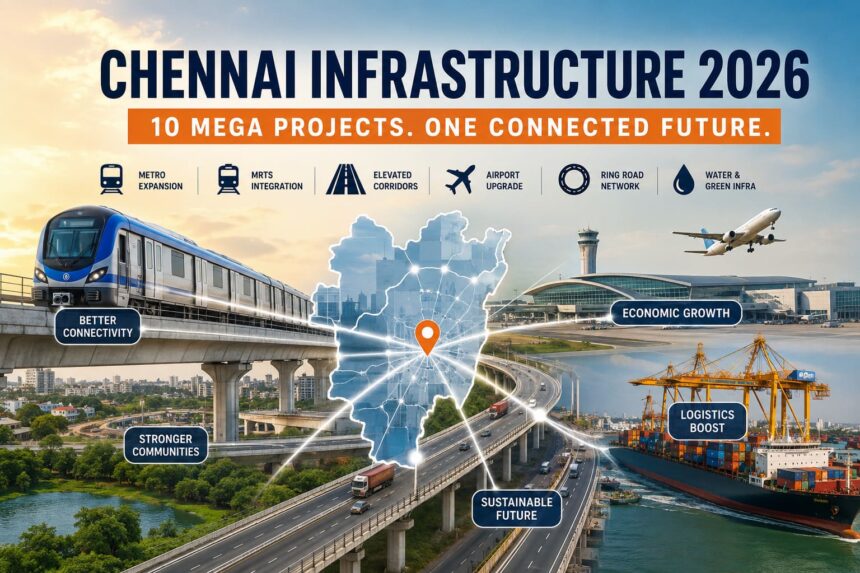
Chennai is entering a new phase of infrastructure development. The focus is no longer limited to building individual flyovers or widening congested roads. Instead, the city is gradually developing a larger metropolitan network combining Metro, MRTS, highways, airport infrastructure, logistics, water supply and environmental projects.
This shift is important for residents as well as the real-estate sector. As connectivity improves between the core city and peripheral areas, locations that were once considered distant from Chennai could increasingly become part of the city’s mainstream development zone.
Take a moment to examine your surroundings and the infrastructure projects unfolding around you.
The 10 infrastructure developments that warrant close attention in 2026 and beyond are:.
1. Chennai Metro Phase II: The Backbone of the Next Chennai
The Chennai Metro Phase II is the largest mass-transit expansion currently underway in the city. The project covers 118.9 km with 128 stations across three corridors:
- Madhavaram–SIPCOT
- Lighthouse–Poonamallee Bypass
- Madhavaram–Sholinganallur
Construction is progressing across the network, with both elevated and underground sections being developed.
Why it matters
Phase II is designed to connect some of Chennai’s most important residential and employment centres, including OMR, SIPCOT, Porur, Poonamallee, Madhavaram and Sholinganallur.
For real estate, the important factor is not simply the Metro line itself but the network effect created when multiple corridors and interchange stations become operational.
Real-estate impact
Areas with direct station access could benefit from:
- Better commuting options
- Increased commercial activity around stations
- Greater attractiveness for residential projects
- Improved connectivity to employment hubs
🎈Chennai Metro Phase II is almost four times longer than Phase I, making it a transformational expansion rather than merely an extension of the existing network.
2. MRTS–Metro Integration Could Give Older Rail Corridors a New Lease of Life
Chennai’s MRTS has existed for decades, but its potential has not always been fully utilised. The integration of MRTS with Chennai Metro Rail Ltd. (CMRL) could change that.
The MRTS corridor passes through several strategically located areas, including:
- Velachery
- Taramani
- Perungudi
- Thiruvanmiyur
- Mylapore
- Chennai Beach
The objective is to create a more integrated public-transport system rather than operating Metro and MRTS as largely separate networks.
Why it matters
Better integration can improve:
- Interchange between Metro and MRTS
- Station access
- Passenger convenience
- Last-mile connectivity
- Multimodal transport planning
Real-estate angle
This could be particularly significant for Velachery, Perungudi, Taramani and Thiruvanmiyur, where the presence of rail infrastructure has historically not translated into its full potential.
🎈Chennai’s MRTS was the first elevated suburban railway system in India, making its integration with the newer Metro network particularly significant from an urban-transport perspective.
3. Chennai Port–Maduravoyal Elevated Corridor: A Freight Highway Above the City
One of Chennai’s most strategically important road projects is the Chennai Port–Maduravoyal elevated corridor.
The project is designed as a double-tier elevated corridor of more than 20 km, providing a dedicated connection between Chennai Port and the western side of the metropolitan region.
Key areas & localities that are to be covered along the route
- Chennai Port & Beach Area: Begins at Gate 10 / War Memorial and passes along Kamarajar Salai and Sivananda Salai.
- Central Chennai & Egmore Belt: Passes close to Choolaimedu, Egmore, Spur Tank Road, Sterling Road, and Shastri Bhavan / College Road.
- Central-West Stretch: Covers Chetpet, Kilpauk, and Aminjikarai along the Cooum River alignment.
- Anna Nagar & Arumbakkam: Runs adjacent to Anna Nagar and Arumbakkam near the Cooum and Poonamallee High Road junction.
- Koyambedu: Crosses the Koyambedu junction / grade separator area.
- Western Suburbs: Extends through Alapakkam and Vanagaram before terminating at the Maduravoyal Cloverleaf Interchange (connecting to the Chennai Bypass and NH 48 towards Bengaluru)
Unlike a conventional flyover designed primarily for commuters, this project has a major logistics objective.
The idea is simple:
Port → dedicated elevated route → western road network
This can allow heavy vehicles transporting cargo to avoid competing with ordinary city traffic for road space.
Why it matters
The corridor could:
- Improve port connectivity
- Reduce freight travel time
- Improve logistics efficiency
- Reduce heavy-vehicle congestion on city roads
- Strengthen Chennai’s industrial and logistics belt
Commercial activities in areas such as Maduravoyal, Vanagaram and Poonamallee could expand significantly as the logistics corridor grows and regional connectivity improves.
🎈The project is being developed as a two-level elevated structure, with different levels serving different traffic movements — making it considerably more complex than a conventional urban flyover.
4. Chennai Airport Expansion: Preparing for More Passengers
Chennai Airport is also undergoing a major transformation.
The modernisation programme includes the development of additional terminal infrastructure and is aimed at increasing the airport’s annual passenger-handling capacity to around 35 million passengers.
The expansion includes improvements to:
- Check-in facilities
- Immigration
- Baggage handling
- Passenger processing
- Aircraft-handling capacity
Why it matters
A larger airport strengthens Chennai’s role as a:
- Business destination
- IT and services hub
- Manufacturing centre
- Tourism gateway
- International connectivity hub
But the airport’s impact is not limited to Meenambakkam.
When combined with Metro, GST Road and other transport improvements, its influence can spread across the Pallavaram–Tambaram–GST Road corridor.
Real-estate impact
Better airport connectivity can increase demand for:
- Hotels
- Serviced apartments
- Commercial properties
- Warehousing and logistics
- High-end residential developments
🎈Chennai Airport is one of India’s oldest continuously operating commercial airports, having evolved from the city’s early aviation infrastructure into a major international gateway.
5. Kilambakkam Is Evolving into Chennai’s Southern Transport Gateway
The Kalaignar Centenary Bus Terminus at Kilambakkam was built to handle the city’s long-distance bus traffic, but the larger infrastructure plan is turning the location into something more significant — a multimodal transport hub.
The wider plan involves improving connections between:
Bus + suburban rail + Metro + road transport
The proposed Metro connectivity towards Kilambakkam and further planning towards Chengalpattu could strengthen this network.
Why it matters
Kilambakkam’s location on GST Road makes it strategically important for southern Chennai and the wider metropolitan region.
Better connectivity could benefit:
- Vandalur
- Urapakkam
- Guduvanchery
- Kilambakkam
- Chengalpattu
Real-estate impact
The corridor could see increased demand for:
- Residential developments
- Retail
- Commercial establishments
- Hospitality
- Transit-oriented developments
🎈The Kilambakkam bus terminus was conceived partly to move long-distance bus operations away from the congested Koyambedu area, effectively shifting Chennai’s southern gateway further towards the metropolitan periphery.
Longer-Term Projects That Could Reshape Chennai
The next five projects are particularly important because their full impact will emerge over a longer period.
6. Chennai Peripheral Ring Road: Creating a Bigger Chennai Network
The Chennai Peripheral Ring Road (CPRR) is a 133 km, 6-lane access-controlled expressway designed as Chennai’s fourth and outermost ring road to bypass city traffic and connect major industrial hubs directly to ports intended to create a large orbital road network around the metropolitan region.
Starting & Ending Points
- Northern Starting Point: Ennore Port / Kattupalli Port
- Southern Ending Point: Poonjeri Junction near Mamallapuram (Mahabalipuram) on East Coast Road (ECR)
Rather than forcing traffic through Chennai’s core, the corridor is designed to connect peripheral areas and major highways.
It will improve connections involving parts of:
- Chengalpattu
- Kancheepuram
- Tiruvallur
- Northern Chennai
- Western industrial areas
Why it matters
The CPRR could become particularly important for industrial and logistics traffic.
It could also encourage development outside the traditional city core.
Instead of Chennai functioning as a city where almost everything revolves around the central areas, infrastructure such as CPRR could support a polycentric metropolitan region.
That means multiple areas can develop as independent employment, residential and commercial centres.
Real-estate impact
The biggest beneficiaries may be locations where CPRR intersects with:
- Existing highways
- Industrial clusters
- Logistics parks
- Metro corridors
- Large residential catchments
🎈The real significance of a ring road is not merely the kilometres of road constructed. Its biggest value comes from the connections it creates between other roads and economic centres.
7. Airport–Kilambakkam Metro: Connecting Chennai’s Two Major Gateways
One of the most closely watched proposed Metro extensions is the Airport–Kilambakkam corridor.
The concept would connect the existing Metro network at the airport with the major transport hub at Kilambakkam.
That would potentially create a continuous public-transport spine along the southern growth corridor.
The potential chain:
Airport → Pallavaram → Tambaram → Vandalur → Kilambakkam
The longer-term vision could eventually extend the network towards Chengalpattu.
Why it matters
GST Road already has:
- Suburban railway
- Major highways
- Bus infrastructure
- Industrial and residential development
Adding Metro connectivity would create a much stronger multimodal corridor.
Real-estate impact
The biggest potential beneficiaries would be locations where Metro + rail + road + employment converge.
This is why the southern Chennai belt deserves close monitoring over the next decade.
8. Poonamallee–Sriperumbudur–Sunguvarchatram: Chennai’s Industrial Growth Corridor
The western side of Chennai is becoming increasingly important because Sriperumbudur and its surrounding areas form a major manufacturing and industrial cluster.
🎈Improved Metro connectivity towards this belt could connect workers more efficiently with industrial employment centres.
Why it matters
The impact could extend beyond commuting.
Better transport can encourage:
- Residential development
- Warehousing
- Industrial support services
- Retail
- Hospitality
- Commercial development
This could strengthen the broader Poonamallee–Sriperumbudur corridor as an integrated economic zone.
Real-estate angle
For developers, the key opportunity is the possibility of employment-led residential growth.
Instead of residential projects being developed simply because land is available, infrastructure can create a stronger reason for people to actually live closer to these employment centres.
🎈Sriperumbudur is not simply a Chennai suburb. It is one of Tamil Nadu’s most important manufacturing clusters, making western connectivity strategically important for the state’s industrial economy.
9. Chennai’s Ring Main Pipeline: Infrastructure Beneath the City
One of the less visible but highly important infrastructure proposals is the Ring Main Pipeline system for Chennai’s water supply.
The project is intended to connect major water sources and distribution infrastructure through a more integrated network.
This includes connections between:
- Reservoirs
- Desalination plants
- Water distribution stations
- Major supply networks
Why it matters
Transport infrastructure gets the headlines, but water is a fundamental constraint on urban expansion.
A city cannot sustainably add millions of square feet of residential and commercial development without reliable water infrastructure.
The ring-main approach could help:
- Improve supply reliability
- Reduce dependence on individual supply routes
- Distribute water more efficiently
- Support future metropolitan expansion
Real-estate impact
For the property market, this is an important reminder:
Infrastructure value is not always visible.
🎈A Metro station may increase accessibility, but reliable water supply can determine whether an area can sustain large-scale development in the first place.
10. East Coast Road (ECR) Widening: Supporting Tourism and Regional Connectivity
The East Coast Road (ECR) is undergoing expansion from a two-lane road into a four-to-six-lane highway towards Mamallapuram and Pondicherry.
The project includes
- road widening,
- improvements to junctions and intersections,
- upgraded drainage systems,
- strengthened bridges and culverts, and
- enhanced safety features such as medians, signage, lighting, and pedestrian facilities.
Why it matters:
- Improves regional connectivity
- Reduces congestion
- Supports weekend tourism and commercial traffic
- Improves access to key destinations, residential and industrial areas, and port facilities
- Reduces travel times between Chennai and coastal towns
Real estate impact:
- Improved road capacity and shorter travel times could increase the attractiveness of residential, commercial, hospitality, and logistics developments along the corridor.
- Better access to Chennai, coastal destinations, industrial areas, and port-related facilities may:
- Support land-value appreciation.
- Encourage new project launches.
- Expand development beyond established urban centers.
What These Projects Mean for Chennai’s Real Estate Market
The most interesting aspect of Chennai’s current infrastructure expansion is that several projects overlap geographically.
Consider the southern corridor:
Airport + Metro + GST Road + suburban railway + Kilambakkam + future Chengalpattu connectivity
Or the western corridor:
Poonamallee + Metro + Sriperumbudur + industrial development + CPRR + Port connectivity
These combinations can be more powerful than any individual project.
The locations worth watching
South Chennai
- Pallavaram
- Tambaram
- Vandalur
- Kilambakkam
- Guduvanchery
- Chengalpattu
West Chennai
- Porur
- Poonamallee
- Kuthambakkam
- Sriperumbudur
- Sunguvarchatram
OMR and South-East Chennai
- Perungudi
- Thoraipakkam
- Sholinganallur
- SIPCOT
- Navalur
North and North-West Chennai
- Madhavaram
- Maduravoyal
- Vanagaram
- Ennore and the wider logistics belt
The Bigger Picture: Chennai Is Becoming a Metropolitan Network
The most important takeaway from these projects is that Chennai is no longer developing only as a central city.
The infrastructure being planned and built is creating multiple economic corridors:
North: Port and logistics
West: Manufacturing and industrial development
South: Airport, GST Road and regional transport
South-East: OMR and the IT corridor
Periphery: Ring roads and regional connectivity
This could gradually transform Chennai into a polycentric metropolitan region, where people do not necessarily need to travel into the traditional city centre for employment, shopping or essential services.
For real estate, that could be a major structural change.
What to Watch Next
The most important question is no longer simply “Where is the next infrastructure project coming up?”
Locations where Metro + highways + rail + employment + commercial development come together are likely to have greater long-term significance than locations benefiting from a single infrastructure announcement.
Chennai’s growth corridors expand, Verified.RealEstate’s LandLens helps buyers, investors and developers assess land through Price Map and Verify My Land—covering market value, ownership, legal risks, zoning and development restrictions.