

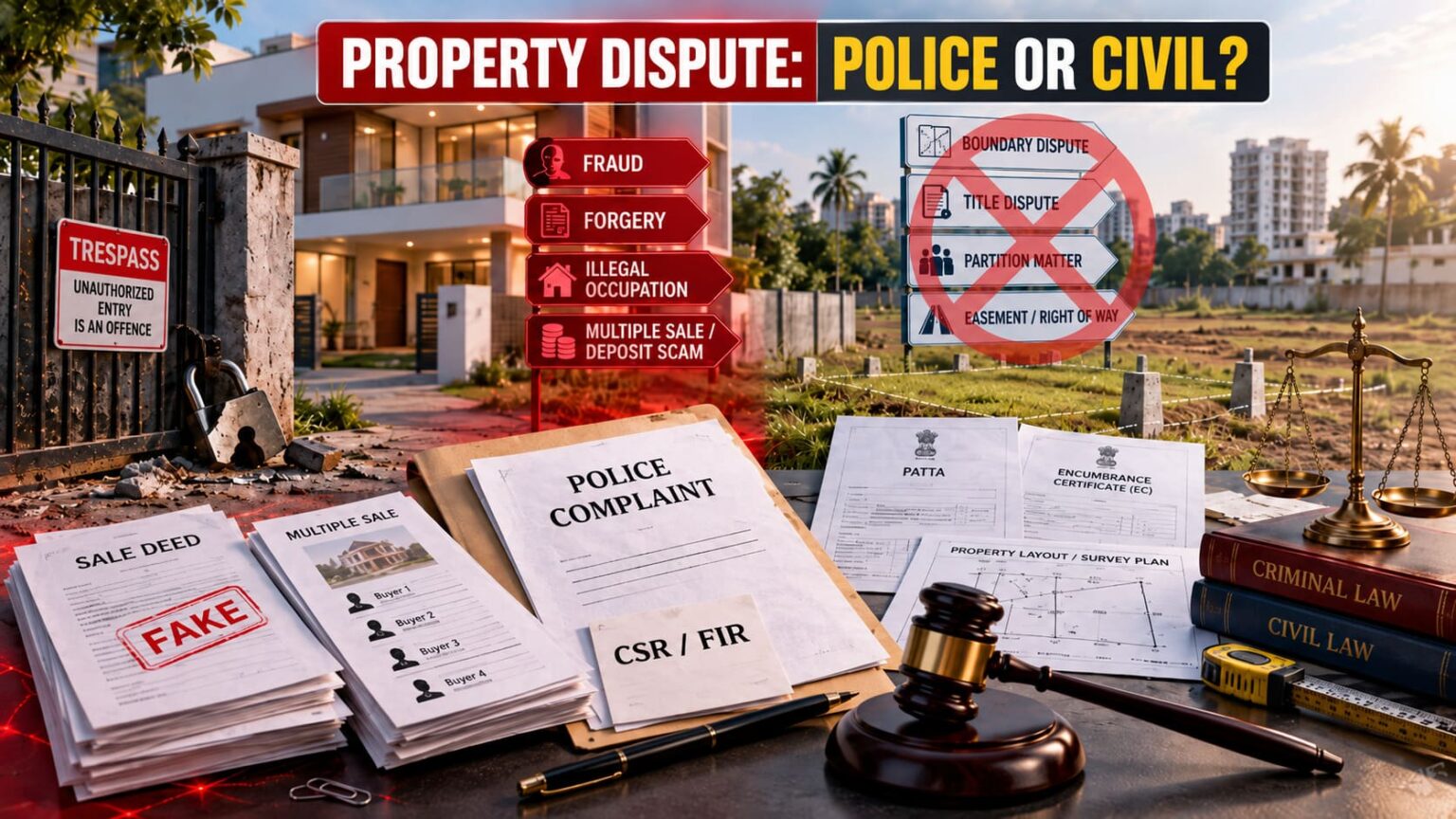
Property disputes are very common in India. They may involve land ownership, boundary issues, family partition, tenants, sale agreements, fake documents, encroachment, illegal occupation, or forceful possession.
But one important point must be clear: not every property dispute can be solved by the police.
Police can take action only when there is a criminal offence involved. If the issue is only about title, ownership, partition, boundary measurement, or agreement interpretation, it usually has to be handled through the civil court, revenue department, registration department, or legal notice process.
When Can You File a Police Complaint for a Property Dispute?
You can file a police complaint if the property issue includes a criminal act such as cheating, forgery, trespass, threat, violence, impersonation, illegal occupation, or dishonest collection of money.
1. Fake Documents or Forgery
If someone creates or uses a fake sale deed, fake Power of Attorney, fake patta, fake will, fake signature, fake legal heir certificate, or false property document, it can become a police matter.
Forgery is serious because fake documents can be used to sell, mortgage, transfer, lease, or occupy a property illegally.
2. Cheating in Property Sale
If a seller takes money by hiding important facts, sells the same property to more than one person, hides a mortgage, or sells property without proper ownership, it may amount to cheating.
In such cases, the buyer can file a complaint if there is clear fraud or dishonest intention.
3. Threats, Violence, or Intimidation
If the opposite party threatens you, brings rowdies, stops you from entering your own property, damages the property, or uses force, you can approach the police.
A property dispute becomes serious when there is fear, violence, intimidation, or risk to personal safety.
4. Land Grabbing, Lock-Breaking, or Forceful Possession
If someone tries to illegally occupy land using force, fake documents, political pressure, or intimidation, a police complaint can be filed.
If someone breaks open the lock, enters the property, changes the lock, places security guards, or prevents the true owner from entering, it can become a police matter.
This is not merely a civil issue when force, threat, or illegal occupation is involved. In such cases, the complaint should clearly mention the criminal act, not just say “property dispute.”
5. Collecting Lease Deposits from Multiple People for the Same Property
If a person knowingly collects lease advances or security deposits from multiple tenants for the same property while promising possession to each of them, it may amount to cheating.
For example, if a landlord collects a lease deposit from Family A, Family B, and Family C for the same house and promises possession to all three, it is not just a normal lease dispute. If there was dishonest intention from the beginning, it can become a criminal complaint.
Tenants should keep proof such as lease agreements, payment receipts, bank transfer details, WhatsApp messages, online listings, and call records.
6. Selling the Same Property to Multiple Buyers
If the same land, house, flat, or plot is sold to more than one buyer, it may become a cheating and fraud case.
This is especially serious when the seller accepts advance amounts or sale consideration from multiple buyers while hiding earlier sale agreements or transactions.
7. Fake Owner, Impersonation, or Fake Property Documents
If someone pretends to be the real owner, legal heir, power agent, or authorised representative and collects money or signs documents, it can become a police complaint.
The same applies if fake patta, fake EC, fake building approval, fake layout approval, fake Power of Attorney, or forged revenue records are used to mislead a buyer. These frauds are common in vacant land, ancestral property, NRI-owned property, and properties where the real owner is not actively present.
8. Fake Power of Attorney Sale
A fake, cancelled, expired, or misused Power of Attorney can create serious problems in property transactions.
If someone uses such a Power of Attorney to sell, lease, mortgage, or transfer a property without proper authority, it may have a criminal angle.
9. Fake Legal Heir Documents
Property fraud can also happen through fake legal heir certificates, fake death certificates, false family tree details, or suppression of actual legal heirs.
If a person uses false heirship documents to sell or claim a property, the affected party can approach the police with supporting proof.
10. Damage to Property
Police complaint may also be possible if someone damages the property during a dispute.
This may include:
- Breaking compound walls
- Damaging gates
- Cutting trees
- Removing name boards
- Damaging construction materials
- Demolishing structures
- Destroying fencing or boundary stones
When property damage happens along with threat, trespass, or illegal occupation, the complaint becomes stronger.
11. Fake Rental Listings and Advance Scams
Fraudsters may post another person’s property online, pretend to be the owner or agent, collect token advance, and disappear.
This type of fake rental listing scam can be reported to the police, especially when payment records, chat messages, listing screenshots, and contact details are available.
12. Builder Collecting Money Without Proper Rights or Approvals
Builder issues usually go to RERA, consumer forum, or civil court when they involve delay, refund, compensation, defects, amenities, or agreement violations.
Police complaint may apply only if there is fraud, such as fake approvals, false RERA claims, no legal right to sell, forged documents, or dishonest collection of money.
13. Hiding Mortgage, Bank Loan, or Legal Restriction
If a seller hides an existing mortgage, bank loan, court attachment, bank possession notice, or legal restriction and still collects money from the buyer, it may become cheating if dishonest intention is shown.
Buyers should always verify EC, CERSAI, bank loan details, court cases, and possession notices before paying money.
14. Broker Fraud
If a broker collects advance, brokerage, or deposit using false promises, fake owner details, duplicate listings, or fake documents, police complaint may be possible.
The complaint should clearly show how the broker deceived the buyer, tenant, or property owner.
15. Tenant Issues with Criminal Elements
A normal tenant eviction issue is usually a civil matter. Police generally cannot remove a tenant just because the owner wants possession back.
But police involvement may be possible if the tenant:
- Threatens the owner
- Damages the property
- Creates fake documents
- Illegally sublets the property using fraud
- Blocks the owner through intimidation
- Uses the property for illegal activities
So, the key question is whether there is a criminal act beyond the normal landlord-tenant dispute.
16. Encroachment with Force or Threat
A normal boundary disagreement is usually civil. But if a neighbour or third party puts up a fence, shed, board, wall, or construction by force or threat, police complaint can be considered.
Photos, videos, survey records, patta, FMB sketch, and witness details can support the complaint.
How to File a Police Complaint
Prepare a written complaint with:
- Your name and contact details
- Property address and survey number
- Your ownership documents
- Sale deed, patta, EC, tax receipts, approval papers, and court orders, if any
- Details of the opposite party
- Date and time of the incident
- Clear explanation of the criminal act
- Photos, videos, messages, witness names, payment proof, or other evidence
Submit the complaint at the police station where the property is located and ask for a CSR (Community Service Register) receipt. If the matter is serious and clearly criminal, request registration of an FIR (First Information Report).
What Property Disputes Cannot Usually Be Taken to the Police Station?
Some property disputes are mainly civil in nature. Police usually cannot decide these matters:
| Property Issue | Where It Usually Has to Be Taken |
|---|---|
| Ownership dispute between two parties | Civil court |
| Family partition dispute | Civil court / family settlement |
| Legal heir or inheritance dispute | Civil court / revenue department |
| Boundary measurement dispute | Survey department / revenue department / civil court |
| Pathway or easement dispute | Civil court |
| Disagreement over sale agreement terms | Civil court / legal notice |
| Delay in registration after agreement | Civil court / legal notice |
| Tenant-landlord rent dispute without threat or violence | Rent court / civil court |
| Builder delay without cheating or fraud | RERA / consumer forum / civil court |
| Patta transfer or revenue record correction | Revenue department |
| Dispute over share in ancestral property | Civil court |
| Question of whether a document is legally valid | Civil court |
| Pure title dispute where both sides claim ownership | Civil court |
| Possession dispute without force, threat, trespass, or violence | Civil court |
For these issues, the proper route is usually a civil court, revenue office, registration department, legal notice, mediation, RERA, consumer forum, or a lawyer’s advice, depending on the nature of the dispute.
Important Warning Before Filing a Police Complaint.
A police complaint should not be filed merely because there is a property disagreement.
Police usually cannot decide,
- who is the real owner,
- who has better title,
- how a property should be partitioned,
- whether a boundary measurement is correct, or
- whether one party has a better civil right.
Police involvement is more appropriate only when there is a clear criminal element such as cheating, forgery, criminal trespass, threat, violence, impersonation, damage to property, illegal occupation, or dishonest collection of money.
The complaint should clearly explain the criminal act and attach proof such as documents, payment records, WhatsApp messages, photos, videos, and witness details.
The safest approach is to preserve all evidence, file a clear written complaint, collect the CSR receipt, and take legal advice if the matter also requires civil court action.
Point To Be Noted
Do not simply write, “There is a property dispute.”
Instead, clearly explain the criminal act. For example:
“The accused trespassed into my property, threatened me, and attempted to take illegal possession using fabricated documents.”
Or:
“The accused collected lease deposits from multiple people for the same property by falsely promising possession and has refused to return the money.”
This makes a big difference. Police may not interfere in a normal civil dispute, but they can act when there is forgery, cheating, criminal trespass, threat, violence, impersonation, property damage, or dishonest collection of money.
Avoid Property Disputes Before They Start.
Many property disputes start because buyers, tenants, and owners do not verify the property properly before paying money or signing documents.
Verified.RealEstate helps by checking important property risks such as title history, EC, patta, ownership details, approvals, land use, legal risks, and other red flags through AI-powered tools and on-ground verification support.
Before paying any advance or lease deposit, verify that the owner has the legal right to lease the property and confirm whether the property has already been leased or committed to someone else. Proper due diligence can help prevent such frauds.