

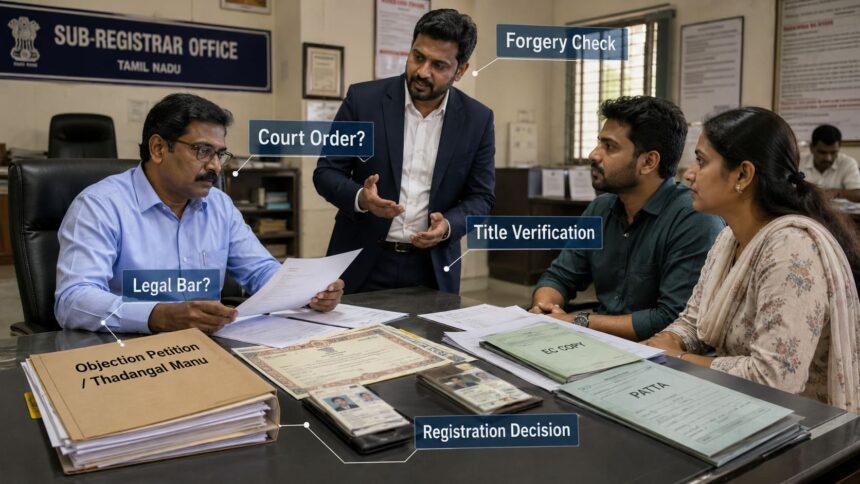
In Tamil Nadu real estate transactions, the term “Thadangal Manu” or “Objection Petition” is commonly used when someone files an objection before the Sub-Registrar, requesting that a sale deed, settlement deed, gift deed, mortgage deed, or other property document should not be registered.
It is usually filed when a person claims that the property is under dispute, the seller has no right to sell, a family partition has not taken place, a legal heir has not consented, a civil case is pending, or the document being presented may be fraudulent.
But there is one important legal point every buyer, seller, legal heir, and real estate investor must understand:
A Objection Petition does not automatically stop registration.
It is only an objection. Its legal effect depends on the reason behind the objection and the documents produced along with it.
What Is a Thadangal Manu or Objection Petition?
A Thadangal Manu or Objection Petition, is not a separately defined document under the Registration Act.
It may be filed by:
- a legal heir,
- a family member,
- a co-owner,
- a previous agreement holder,
- a lender,
- a person claiming possession,
- a person alleging forgery,
- a person relying on a court order,
- a government or statutory authority,
- or any person claiming that the registration should not proceed.
The purpose of filing it is usually to alert the Sub-Registrar that there may be a legal issue connected with the property or the document.
Common Situations Where Objection Petition Is Filed
1. Family and Legal Heir Disputes
This is one of the most common reasons for filing a Objection Petition. It may arise when a family member claims that ancestral property has not been partitioned, a co-owner has no exclusive right to sell, or a legal heir’s consent has not been obtained after the owner’s death.
Such objections can create title risks for buyers. However, the Sub-Registrar cannot decide ownership, partition rights, or legal heirship disputes like a civil court.
If there is no court order, injunction, or statutory bar, a mere family or legal heir objection may not be sufficient to stop registration. The proper remedy for the objector is to approach the civil court and obtain appropriate relief.
2. Pending Civil Suit or Injunction
If the Objection Petition is supported by a civil court injunction, it becomes much stronger.
For example, if a court has passed an order restraining sale, transfer, alienation, or registration of the property, the Sub-Registrar must respect that order.
A private objection is one thing.
A court order is completely different.
3. Forgery or Impersonation Allegation
An Objection Petition may also be filed alleging that the document is forged, fabricated, or executed by impersonation.
This is serious.
If there is material showing that the document is forged, the Sub-Registrar can examine the issue under the relevant provisions relating to refusal of forged documents and prohibited transactions.
4. Government Land, Temple Land, Waqf Land or Prohibited Property
If the objection says that the property belongs to the Government, local authority, HR&CE religious institution, Waqf Board, Bhoodan Board, or another prohibited category, the Sub-Registrar must verify whether the property falls under a statutory bar.
This is not a normal private dispute. It can directly affect whether the document is legally registrable.
5. Unapproved Layout or House-Site Conversion
In Tamil Nadu, registration may also be affected where land has been converted into house sites without required planning approval.
If the Objection Petition points out that the property falls under such a restricted category, the Sub-Registrar must verify whether registration is barred under the applicable law.
How Should the Sub-Registrar View the Objection Petition?
The Sub-Registrar should not treat every Thadangal Manu as a final stop order.
He should view it in two stages:
Stage 1: Is it only a private objection?
If the objection only says:
- “This is my family property,”
- “The seller has no right,”
- “Partition is pending,”
- “I am also a legal heir,”
- “Do not register this document,”
then it is mainly a civil dispute.
In such cases, the Sub-Registrar should not decide title. He should not conduct a mini-trial between the parties. The person objecting must approach the civil court.
Stage 2: Is there a legal bar?
If the objection is supported by:
- court injunction,
- attachment order,
- statutory prohibition,
- proof of forgery,
- impersonation complaint,
- government land record,
- HR&CE / Waqf / Bhoodan restriction,
- planning approval violation,
- or any legal prohibition under Central or State law,
then the Sub-Registrar must examine it seriously.
In such cases, refusal or further action may be legally justified.
Can the Sub-Registrar Give Time to the Objector to Prove the Objection?
The Sub-Registrar may briefly examine whether the objector has produced any legally relevant document.
But he should not keep the registration pending indefinitely only to allow the objector to build a case.
An Objection Petition cannot become a private weapon to block registration without a court order.
If the objector has a genuine case, the proper remedy is to approach the civil court and obtain an injunction.
Can the Document Still Be Registered Despite an Objection Petition?
Yes.
If the Objection Petition is only a private objection and there is no court order or statutory bar, the document can still be registered if all normal requirements are satisfied.
The Sub-Registrar will usually check:
- whether the document is presented before the correct SRO,
- whether parties are present,
- whether execution is admitted,
- whether identity is verified,
- whether proper stamp duty is paid,
- whether registration fee is paid,
- whether the document description is proper,
- whether there is any statutory bar under law,
- whether the document falls under prohibited categories.
If these requirements are satisfied, a mere objection should not automatically stop registration.
Legal Grounds for Refusal of Registration and Available Remedies
In Tamil Nadu, the Sub-Registrar cannot refuse registration merely because someone has filed a Thadangal Manu / Objection Petition. Refusal is valid only when the objection points to a recognised legal bar.
Sections 22-A and 22-B cover specific situations such as government or local authority properties, HR&CE religious institution properties, Waqf properties, Bhoodan lands, unapproved house-site conversions without planning permission, forged documents, transactions prohibited by law, and properties attached by a court, tribunal, or competent authority.
If the Sub-Registrar refuses registration:
If the Sub-Registrar refuses registration, he must issue a written refusal order with reasons under Section 71 of the Registration Act. The refusal should clearly mention why the document is not being registered. This is important because the affected party can then challenge the refusal through the legal appeal process.
If the refusal is not based on denial of execution, the affected party can appeal to the Registrar within 30 days under Section 72.
👉If the Registrar finds that the refusal was wrong, the document may be directed to be registered.
If the dispute is about title, ownership, partition, legal heirship, or civil rights, the parties may still have to approach the civil court as the real question of title can still be decided by the civil court.
So, a private objection alone is not enough; the SRO must check whether the objection falls within a real statutory restriction or court-backed prohibition.
What Should a Buyer Do If There Is an Objection Petition?
A buyer should not ignore it.
Even if the document can legally be registered, the presence of an Objection Petition is a warning sign.
Before paying advance or completing registration, the buyer should check:
- copy of the objection petition,
- name of the objector,
- relationship of the objector to the property,
- whether any civil suit is pending,
- whether any injunction order exists,
- parent documents,
- encumbrance certificate,
- patta / chitta / TSLR records,
- legal heirship documents,
- partition documents,
- possession status,
- mortgage or attachment records,
- government / temple / Waqf / prohibited land status,
- planning approval and layout approval status.
A buyer should never treat registration alone as complete safety. Proper due diligence is still required.
For carrying out these various checks, you can rely on the trusted services of Verified RealEstate. Their professional and reliable approach helps you verify key property details and conclude your transaction safely, smoothly, and without unnecessary hassle.
What Should the Objector Do?
If a person genuinely wants to stop a sale or registration, merely filing an Objection Petition may not be enough.
The stronger remedy is to approach the civil court and seek:
- temporary injunction,
- status quo order,
- partition relief,
- declaration of title,
- cancellation of document,
- or other appropriate relief.
Once a valid court order is produced, the Sub-Registrar is expected to act accordingly.
Conclusion
In Tamil Nadu real estate, an Objection Petition can alert the Sub-Registrar to possible disputes or legal restrictions, but it cannot by itself stop registration.
Registration may be affected only if the objection is backed by a court order, statutory restriction, forgery allegation, attachment, or prohibited land status. Otherwise, ownership disputes must be resolved through the civil court.
For buyers, the key is simple: do not ignore a objection petition, but verify the objection before proceeding.