

The Indian real estate market has always attracted Non-Resident Indians (NRIs) as both sellers and investors. However, selling property in India involves several tax and legal formalities, especially when it comes to TDS (Tax Deducted at Source). For NRIs, the process usually includes preparing documents, calculating capital gains, and completing tax compliance before sending money abroad.
When buying property from an NRI, buyers must be extra careful about TDS compliance, as tax rates are significantly higher than regular property transactions and involve strict procedural requirements. The process includes correctly calculating applicable TDS, ensuring timely deduction and deposit, issuing Form 16A, and avoiding common compliance mistakes that may lead to penalties or legal complications. Buyers looking to gain a clearer understanding of these technical requirements and practical pitfalls can benefit from exploring this detailed explanation on Buying Property from an NRI? Essential TDS Rules and Tax Pitfalls Explained
In this article, we will first explain the basic process involved when an NRI sells property in India. After that, we will discuss an important change introduced in Budget 2026 — the removal of the TAN requirement for buyers while depositing TDS.
NRI Property Sale in India: What You Should Know
Selling property in India as an NRI involves several compliance steps. These mainly include calculating capital gains tax, deducting TDS, and following RBI rules for sending sale proceeds abroad.
Capital Gains Tax
When an NRI sells property, the profit earned is taxed as capital gains. This is divided into two types based on how long the property was owned.
- Long-Term Capital Gains (LTCG) apply if the property was held for more than 2 years. These gains usually get lower tax rates and certain exemptions.
- Short-Term Capital Gains (STCG) apply if the property was held for 2 years or less. These gains are taxed at higher rates.
TDS on Property Sold by NRIs
When a buyer purchases property from an NRI, the buyer must deduct TDS before paying the seller.
- The TDS rate depends on whether the gain is long-term or short-term.
- After deducting TDS, the buyer must file TDS returns and provide the seller with Form 16A.
- The NRI seller can use this certificate to claim tax credit while filing income tax returns.
When an NRI sells property in India, the buyer must deduct TDS on capital gains (higher rates than for residents) and deposit it with the government.
For this the buyer and the NRI seller must know about the applicable TDS rates, compliance steps, and how NRIs can reduce or claim refunds using Form 13 and proper documentation.
Repatriation of Sale Money
Once tax formalities are completed, NRIs can send the sale money abroad.
- After tax compliance, NRIs can remit funds abroad subject to RBI’s repatriation rules and documentation requirements such as Forms 15CA/15CB.
- There are caps on repatriation amounts and documentary requirements to ensure all Indian taxes have been settled.
Understanding TAN: Why It Was Required Earlier
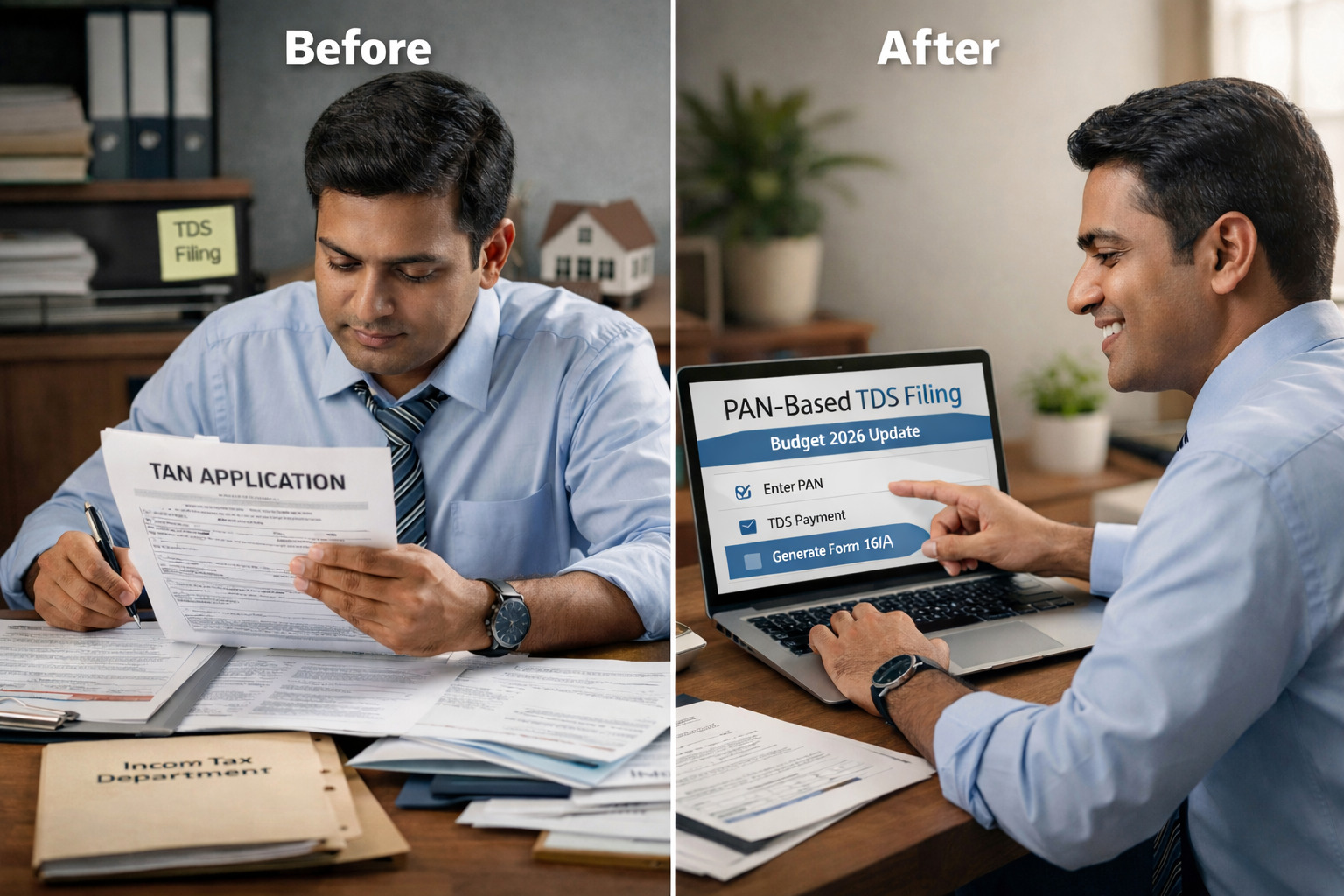
Before Budget 2026, buyers purchasing property from NRIs had to follow an additional compliance rule. They had to obtain a TAN (Tax Deduction and Collection Account Number).
Why TAN Was Mandatory Earlier
Under the old system:
- Even if a buyer was purchasing property only once, they had to apply for TAN.
- TAN was required to deduct TDS and file TDS returns with the Income Tax Department.
- Buyers also needed TAN to issue TDS certificates to sellers.
This created difficulties for many individual buyers because TAN is generally used by businesses or regular tax deductors. For normal property buyers, it added extra paperwork and delays.
Many genuine buyers made technical mistakes because the process was complicated — such as filing TAN incorrectly, missing deadlines, or misunderstanding compliance rules.
Budget 2026: Phasing Out TAN — What Changed
In a significant move to simplify compliance for individual and HUF buyers, Budget 2026 introduced a streamlined approach:
✔ TAN Requirement Removed
Effective 1 October 2026, resident buyers purchasing property from NRIs:
- No longer need to apply for or use a TAN to deduct and deposit TDS.
- Instead, buyers can use their existing PAN (Permanent Account Number) to make TDS payments through PAN-based challans.
✔ Same Tax Obligation, Less Red Tape
- The obligation to deduct and deposit TDS on payments to an NRI seller remains.
- The only change is procedural: PAN replaces TAN for identification and reporting purposes.
- This reduces paperwork, eliminates the need for a separate TAN application, and streamlines the process for one-time or infrequent buyers.
- The simpler PAN-based system helps minimise the errors the buyers used to commit and thus avoids unnecessary legal and tax complications.
Tax Responsibility Remains the Same
Although TAN has been removed:
- Buyers still must deduct and deposit TDS.
- Only the identification method has changed.
- PAN now replaces TAN for filing and reporting TDS.
This change removes unnecessary paperwork and makes compliance easier, especially for individuals buying property only once.
What This Change Means for Buyers
- Buyers can now use their existing PAN for TDS payments.
- The process becomes simpler and faster.
- It brings NRI property transactions in line with normal property transactions where PAN is commonly used.
Why This Change Is Important
The removal of TAN is more than just a small procedural update. It makes property transactions smoother for both buyers and NRI sellers.
Reduced Compliance Burden
Buyers no longer need to apply separately for TAN, saving time and effort.
Faster Transactions
Earlier, TAN application and approval could delay property deals. That delay is now removed.
Better Alignment With Tax System
Using PAN for TDS makes the tax system more uniform and easier to understand.
Wrapping Up
Selling property in India as an NRI requires careful planning. It involves calculating capital gains tax, following TDS rules, and completing documentation for sending money abroad. Earlier, buyers had to handle additional compliance by obtaining TAN before deducting TDS.
Budget 2026 has simplified this process. By removing the TAN requirement and allowing PAN-based TDS payment, the government has reduced compliance burden without changing tax liability.
This change makes property transactions easier for buyers and provides smoother compliance for NRI sellers.
Verified.RealEstate Helps Simplify NRI Property Transactions
Handling NRI property sales and purchases often involves multiple compliance layers, including TDS calculation, document verification, ownership validation, and legal due diligence. Verified.RealEstate supports buyers and sellers by providing structured verification services that help identify tax risks, ownership clarity, and transaction compliance before finalising a deal. From assisting with document validation and regulatory checks to guiding clients through procedural requirements involved in NRI transactions, the platform helps reduce legal uncertainty and promotes safer real estate decision-making.