

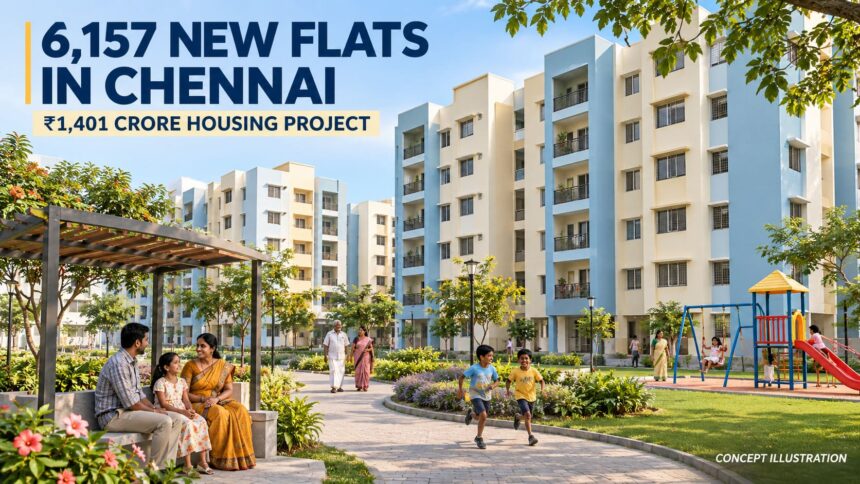
The Tamil Nadu government has approved ₹1,401.75 crore to construct 6,157 multi-storey flats across nine locations in Chennai, creating new housing opportunities for economically weaker sections (EWS).
Chief Minister C. Joseph Vijay announced the approval on November 12, 2026. The project will be implemented by the Tamil Nadu Urban Habitat Development Board (TNUHDB), focusing on rebuilding old residential complexes and providing better housing for low-income families.
Where Will the 6,157 Flats Be Built?
The government has identified nine locations across Chennai for the proposed housing projects.
| Location | Proposed new flats | Present condition / latest available information |
|---|---|---|
| Foreshore Estate (Pattinapakkam) | 1,484 | Existing old housing blocks have been identified as deteriorated. Old Foreshore Estate was included in the October 2026 advisory asking residents to vacate unsafe buildings. |
| Old Block, Vyasarpadi | 1,158 | Existing ageing tenements have been identified for evacuation due to safety risks. This is separate from the newer TT Block in Vyasarpadi, where structural defects were also reported. |
| Pachaikkal Veerasamy Street | 912 | Particularly concerning. In October 2026, the Housing Minister inspected the existing 876 tenements, which had deteriorated over time. Residents were advised to move to safer locations. |
| Udhayasuriyan Nagar | 850 | Existing tenements were included in the October evacuation advisory because of their deteriorating condition. |
| West Cemetery Road | 792 | Existing TNUHDB housing was identified among the locations requiring evacuation due to safety concerns. |
| Mullai Nagar | 462 | Different from the others. This is a proposed new housing development in the Perambur area, intended to accommodate eligible families currently living on unsuitable government land. |
| Kakkan Colony | 324 | Existing housing was included in the October advisory concerning unsafe tenements. |
| Rukmani Nagar | 111 | Existing housing was included in the October evacuation advisory. |
| Anadhaikuppam (Annathaikuppam) | 64 | Existing tenements were identified among the locations where residents were urged to vacate for safety reasons. |
| Total | 6,157 | Eight locations have been linked to existing housing safety concerns; Mullai Nagar is identified as a new development. |
Foreshore Estate will have the highest number of proposed flats, followed by Vyasarpadi and Pachaikkal Veerasamy Street.
What Is the Purpose of This Housing Project?
The project focuses on two major housing needs:
- Reconstruction of Old Flats: Existing TNUHDB residential buildings that have deteriorated over time will be replaced with modern housing complexes.
- New Housing for EWS Families: Additional homes are proposed for eligible low-income families who need affordable housing.
The proposed buildings will include essential infrastructure and basic civic amenities to improve residents’ living conditions.
Who Can Qualify for These 6,157 Flats?
Eligibility Status: The government has not yet officially announced the eligibility criteria or beneficiary list for this project. The following conditions are based on general TNUHDB housing practices. Applicants should confirm the final requirements with TNUHDB.
- Priority for Existing Residents: Families already living in TNUHDB buildings identified for reconstruction are generally given preference for allotment of replacement flats.
- EWS Income Limit: Families with a total annual household income of up to ₹3 lakh may be eligible under applicable EWS guidelines.
- Property Ownership: Applicants and their family members usually must not own a permanent (pucca) house anywhere in India.
- Chennai Residence: Applicants usually must be residents of Chennai or the respective project area and provide valid proof of residence.
Important: These are indicative requirements, not confirmed eligibility rules for the 6,157 flats.
How to Apply for the TNUHDB Housing Scheme?
The government has not yet announced application dates or opened registration for these flats.
Based on general TNUHDB procedures, the process may involve the following:
- Official Announcements: Application dates, eligibility conditions and allotment procedures will be announced through the TNUHDB website and relevant Greater Chennai Corporation notices. Applicants should regularly check these official channels for updates.
- Survey for Existing Residents: For reconstruction projects, TNUHDB generally conducts a survey (enumeration) to identify families already occupying the old housing blocks. Officials may verify their occupancy details and previous allotment records before issuing replacement allotment orders to eligible residents.
- Applications for New EWS Beneficiaries: Eligible low-income families may be able to submit applications through designated TNUHDB divisional offices or special housing camps. Officials may verify income, residence and property ownership details before selecting beneficiaries.
- Documents to Keep Ready: Applicants should ensure their Aadhaar card, ration card and income certificate are valid and up to date. Other commonly requested documents include address proof, community certificate (if applicable), bank passbook and passport-size photographs. Existing residents may also require their previous allotment or occupancy records.
Allotment Methods Generally Used in Government Housing Schemes
Government housing projects may use different allotment methods depending on the scheme, applicant eligibility and availability of flats.
| Allotment Method | How It Works |
|---|---|
| First-Come, First-Served (FCFS) | Eligible applicants are considered in the order valid applications are received, subject to availability. |
| Lottery System | Eligible applicants are selected through a random draw when applications exceed available flats. |
| Priority-Based Allotment | Preference is given to specified eligible groups under the scheme’s rules. |
| Rehabilitation Allotment | Existing eligible residents of buildings being reconstructed are considered for replacement flats under rehabilitation rules. |
These are possible allotment methods in government housing programmes; they are not all confirmed methods for this TNUHDB project.
Which Method Will Apply to the 6,157 Flats?
The Tamil Nadu government has not yet confirmed the allotment method for this project.
Since the project includes both reconstruction of existing buildings and new EWS housing, different procedures may apply.
Applicants should keep a close watch as the TNUHDB will soon be announcing the notification about the process of the allotment.
The Cost of the Project
The total estimated project expenditure is ₹1,401.75 crore, which works out to approximately ₹22.77 lakh per flat on average. This represents the average expenditure of this particular project.
In some earlier TNUHDB housing schemes, families had to pay around ₹1.5 lakh for their flats, while the government paid the rest of the cost.
The government is yet to announce how much people will need to pay for these 6,157 flats or whether any of them will be given free of cost.
When Will Construction Begin?
Although the government announced its approval on November 12, 2026, the construction commencement and completion dates have not yet been confirmed.
The specific Government Order authorising the ₹1,401.75-crore project also needs to be independently verified.
Further information on construction schedules, individual flat sizes, flat buyers selection and the payment details are expected soon through official announcements.
Beware of Housing Allotment Fraud
Since applications have not yet opened, residents should be cautious of anyone promising guaranteed government flats.
- Avoid Agents and Middlemen: Do not pay private agents claiming they can secure a government flat for you. No agent fee is required to obtain an official TNUHDB application.
- Protect Personal Information: Never share OTPs, banking passwords or sensitive financial details with anyone claiming to register you for the scheme.
- Use Official Channels: Check announcements through the TNUHDB website, authorised government offices and official notifications.
- Beware of Fake Registration Links: Avoid unverified WhatsApp messages or websites claiming applications have opened. Confirm all registration dates and payment instructions directly with TNUHDB.
Remember: Government approval of a housing project does not mean applications or allotments have started.
Other Housing and Revenue Announcements
On the same day, the Tamil Nadu government also announced two separate initiatives:
- TNHB Interest Waiver: A one-year special scheme intended to help approximately 6,496 Tamil Nadu Housing Board allottees settle outstanding hire-purchase dues and obtain their sale deeds.
- Mini Taluk Offices: Approval for 12 Mini Taluk Offices across eight taluks in Chennai district at an estimated cost of ₹2.14 crore to improve access to revenue and land-related services.
These are separate initiatives and are not part of the ₹1,401.75-crore TNUHDB project.
What Does This Mean for Chennai Residents?
The approval of 6,157 flats is an important step towards improving Chennai’s public housing infrastructure.
On 31 October, TNUHDB Chairman Ku. Pa. Krishnan indicated that reconstruction depended partly on residents agreeing to vacate. Demolition could proceed after evacuation, with reconstruction potentially beginning in January 2027 after the monsoon. That was an anticipated timeline, not a confirmed start date.
For families living in ageing TNUHDB buildings, reconstruction could provide safer homes with better facilities. For eligible EWS families, the project may create additional housing opportunities.
Residents should closely watch for any official TNUHDB announcements of the number of flats available to new applicants, beneficiary payments, allotment methods and application dates before submitting applications or making payments.