

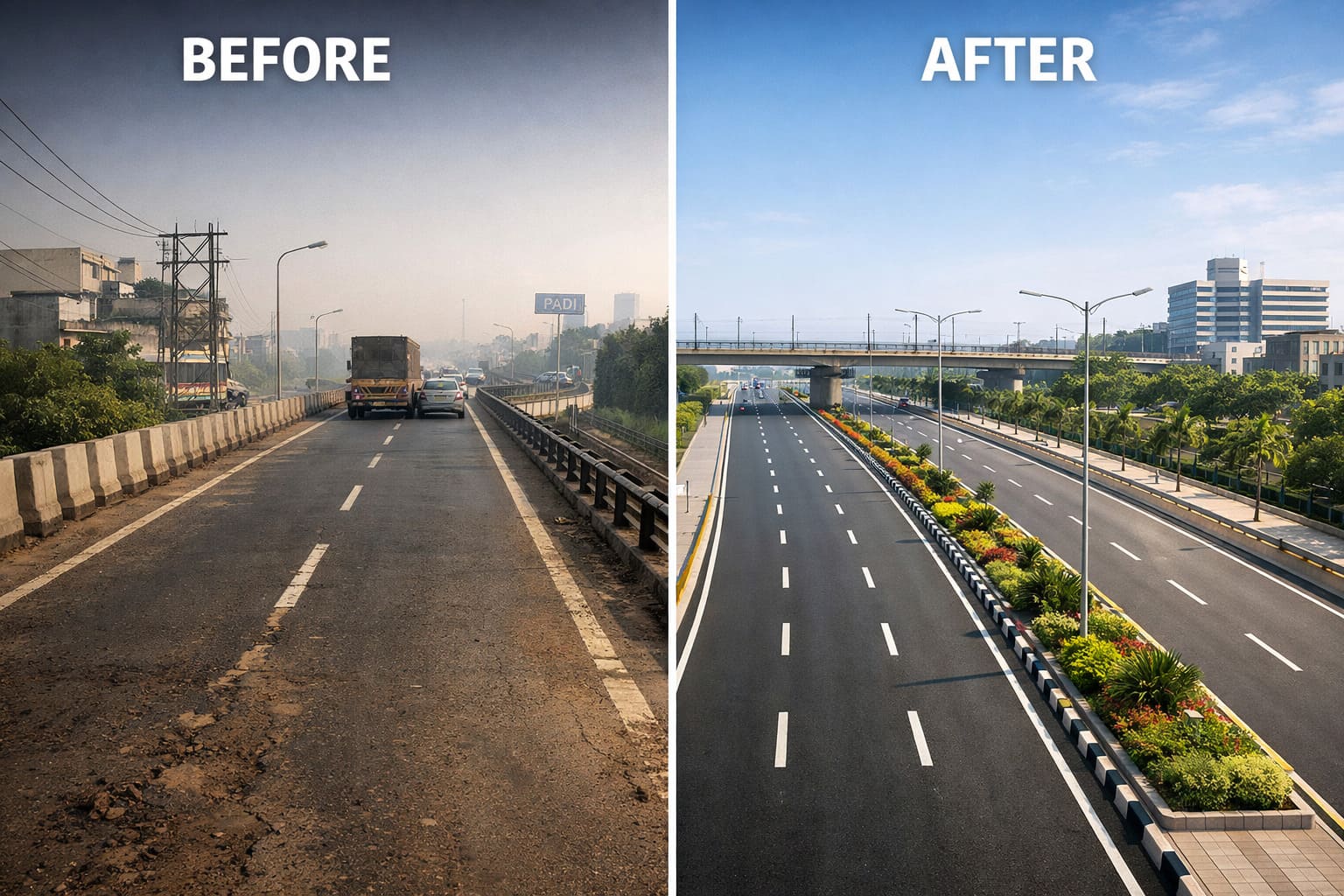
🚧 The Problem: A Critical Choke Point on Inner Ring Road
Chennai’s Inner Ring Road (IRR)—a key arterial corridor connecting Manali to Guindy—has long suffered from a major bottleneck near Padi.
While most stretches of this corridor support five lanes on either side, the 1-kilometre stretch between Villivakkam and Korattur railway stations narrows sharply to just two lanes near the railway overbridge (ROB).
This sudden lane drop has resulted in:
- Increased risk of accidents due to forced merging
- Frequent traffic snarls
- Long vehicle queues during peak hours
🏗️ The Upgrade: Expanding Capacity from 27m to 53m
To address this issue, the Highways Department has initiated a ₹139 crore widening project for the Padi ROB.
Key Infrastructure Improvements:
- Road width expansion from 27 metres to 53 metres
- Five lanes on each side (10 lanes total)
- Central median for traffic separation
- Footpaths on both sides for pedestrian safety
This upgrade ensures that the capacity of the ROB matches the rest of the Inner Ring Road, eliminating the current bottleneck.
⚙️ Multi-Agency Execution: Highways & Railways
The project involves coordination between multiple agencies:
🔹 Highways Department
- Widening of approach roads
- Road laying and median construction
- Infrastructure development within road limits
🔹 Southern Railway
- Construction of the stretch over railway tracks
- Placement of heavy girders sourced from Arakkonam yard
⚡ Utility Adjustments
- Shifting of electrical lines and infrastructure
- Necessary to clear space for widening
This division of responsibilities ensures that both road and rail components are handled efficiently, though coordination remains critical.
🔄 Smart Traffic Design: U-Shaped Service Roads
In addition to widening, the project includes two U-shaped service roads beneath the Villivakkam ROB, built at a cost of ₹14 crore.
Features:
- Width: 7.5 metres
- Allows vehicles to take U-turns without entering the main junction
Benefits:
- Reduces load on the North Korattur signal
- Enables light vehicles to bypass congested intersections
- Improves overall traffic distribution
This design separates turning traffic from through traffic—an essential step in modern urban traffic management.
🚦 Corridor-Level Impact: Restoring Inner Ring Road Efficiency
The Inner Ring Road is designed as a high-capacity urban corridor, but the Padi stretch has long disrupted its efficiency.
With the upgrade:
- Continuous five-lane flow will be maintained
- Elimination of sudden lane drops
- Reduced congestion and smoother traffic movement
- Improved safety due to better lane discipline and median separation
Additionally, the National Highways Authority of India (NHAI) is working on expanding other stretches of the corridor, ensuring uniform capacity across the route.
⏳ Timeline and Execution Challenges
Officials have indicated a target completion timeline of April, but infrastructure projects of this scale involve complexities such as:
- Railway coordination for girder placement
- Electrical and utility shifting
- Traffic management during construction
While progress is underway, timely completion depends on seamless coordination between agencies.
🧠 Infrastructure Insight: A System-Level Fix
This project is not just about widening a bridge—it represents a system-level correction of a broken traffic flow.
By combining:
- Capacity expansion
- Junction decongestion (via service roads)
- Corridor-level upgrades
Chennai is moving towards a more efficient and resilient urban transport network