

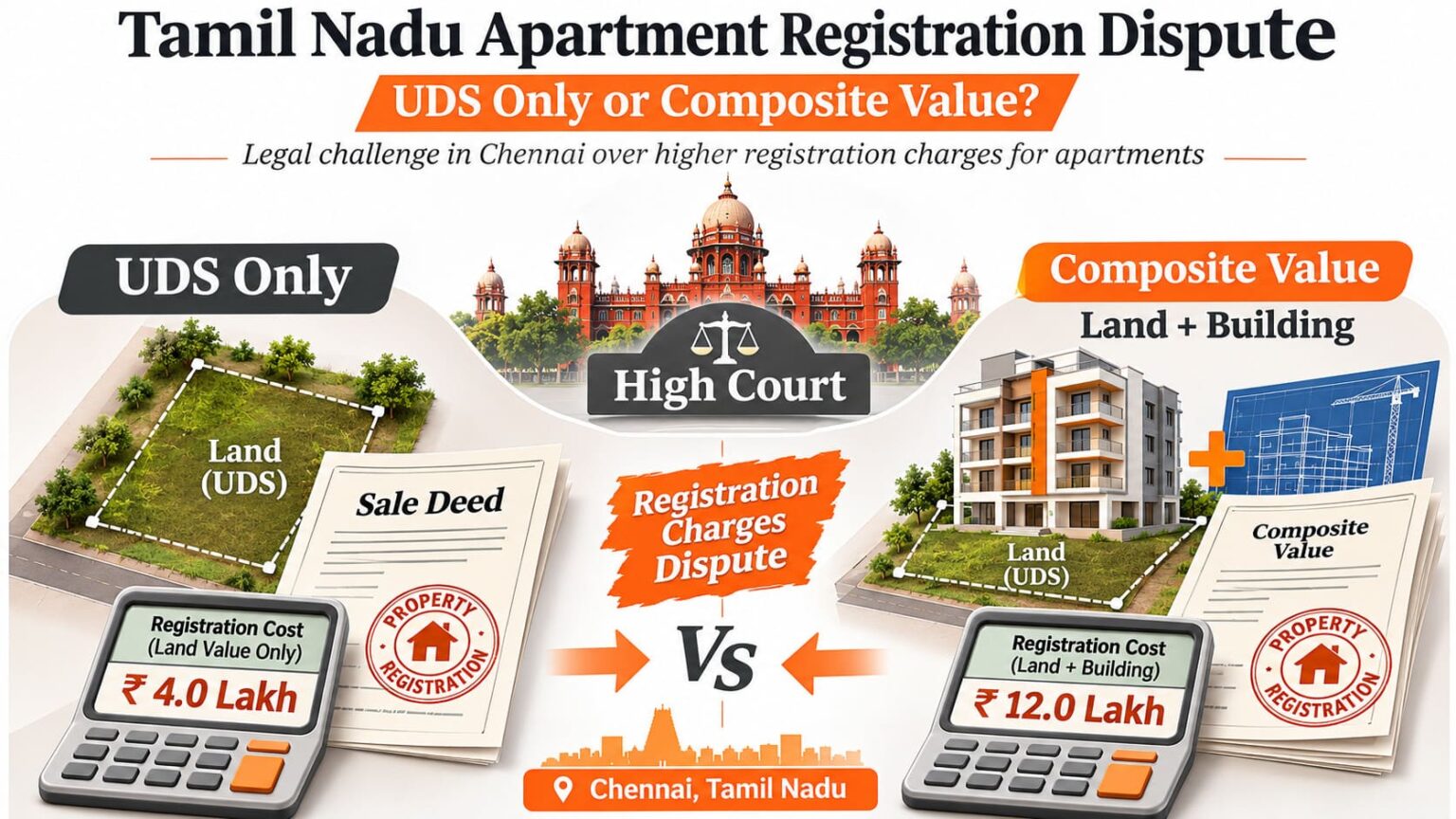
Can the Registration Department insist that a property buyer pay stamp duty on a building that has not yet been constructed?
This was the central question before the Madras High Court in a significant judgment delivered on 16 November 2026.
The case arose when a Chennai property purchaser was denied registration of an undivided share of land despite having paid nearly ₹14 lakh towards stamp duty and registration fees.
The High Court questioned the government’s legal authority to impose compulsory composite value registration under the Indian Stamp Act, 1899.
The judgment has important implications for apartment buyers, builders, developers and real estate professionals across Tamil Nadu.
Madras High Court Judgment: Case Details
| Particulars | Details |
|---|---|
| Case name | Hemamalini Suresh vs The Sub Registrar |
| Court | Madras High Court |
| Judge | Justice Krishnan Ramasamy |
| Judgment date | 16 November 2026 |
| Registration office | T. Nagar Sub-Registrar Office, Chennai |
| Government order concerned | G.O.Ms.No.131, dated 1 December 2023 |
Hemamalini Suresh sought to purchase an undivided share of land measuring 883.51 sq. ft. from a total land extent of 7,928.50 sq. ft. The transaction involved Lancor Holdings Limited.
An Undivided Share of Land (UDS) refers to a proportionate share of the land on which an apartment building is constructed, without physically dividing the land among individual owners.
On 15 November 2024, the petitioner presented the UDS sale deed for registration at the T. Nagar Sub-Registrar Office.
The petitioner had already paid the following charges:
| Particulars | Amount |
|---|---|
| Stamp duty | ₹10,88,486 |
| Registration fee | ₹3,10,998 |
| Total | ₹13,99,484 |
Despite the payment of ₹13,99,484 towards stamp duty and registration fees, the T. Nagar Sub-Registrar refused to register the UDS sale deed.
Following the refusal, the petitioner approached the Madras High Court, challenging the Sub-Registrar’s decision.
To understand the background of this dispute, it is important to examine how Tamil Nadu’s apartment registration system changed in December 2023.
What Is Composite Value Registration?
Composite value registration is a system under which the value of land and building is combined for calculating stamp duty and registration charges. The applicable building composite value must be checked for the respective locality to understand how this valuation affects the overall registration expenses.
But, Before December 2023, apartment purchases commonly involved two separate registered documents:
- UDS Sale Deed: A document through which the buyer purchases a proportionate share of the land.
- Construction Agreement: An agreement between the buyer and the developer for constructing the apartment.
Both documents attracted stamp duty and registration fees, but at different rates.
On 1 December 2023, the Tamil Nadu government introduced G.O.Ms.No.131, prescribing a combined valuation system for first-sale apartments.
How Were Apartment Registration Charges Calculated Before December 2023?
| Charges | Before 10 July 2023 – UDS | 10 July–30 Nov 2023 – UDS | Before 10 July 2023 – Construction | 10 July–30 Nov 2023 – Construction |
|---|---|---|---|---|
| Stamp duty | 7% | 7%(same) | 1% | 1%(same) |
| Registration fee | 2% | 2%(same) | 1% | 3%(increased) |
| Total charges | 9% | 9%(same) | 2% | 4%(increased) |
The Tamil Nadu government increased the registration fee for construction agreements from 1% to 3% on 10 July 2023, while the stamp duty and UDS registration charges remained unchanged.
Under both systems, land and construction were valued separately, with construction agreements attracting comparatively lower charges.
What Changed on 1 December 2023?
Under the composite value registration system, the government introduced the following registration charge slabs for first-sale apartments.
| Composite property value | Stamp and transfer duty | Registration fee | Total charges |
|---|---|---|---|
| Up to ₹50 lakh | 4% | 2% | 6% |
| Above ₹50 lakh and up to ₹3 crore | 5% | 2% | 7% |
| Above ₹3 crore | 7% | 2% | 9% |
Although stamp duty rates were reduced for certain property values, the amount on which duty was calculated expanded to include both land and construction.
Consequently, many apartment buyers faced higher overall registration expenses.
How Did Composite Value Registration Affect Apartment Buyers?
Consider a buyer purchasing an apartment worth ₹1 crore in Chennai.
| Property component | Value |
|---|---|
| UDS land value | ₹30 lakh |
| Construction value | ₹70 lakh |
| Total apartment value | ₹1 crore |
Before 10 July 2023
| Component | Calculation | Charges |
|---|---|---|
| UDS sale deed | 9% of ₹30 lakh | ₹2,70,000 |
| Construction agreement | 2% of ₹70 lakh | ₹1,40,000 |
| Total | ₹4,10,000 |
Between July and November 2023
| Component | Calculation | Charges |
|---|---|---|
| UDS sale deed | 9% of ₹30 lakh | ₹2,70,000 |
| Construction agreement | 4% of ₹70 lakh | ₹2,80,000 |
| Total | ₹5,50,000 |
From 1 December 2023
| Component | Calculation | Charges |
|---|---|---|
| Stamp and transfer duty | 5% of ₹1 crore | ₹5,00,000 |
| Registration fee | 2% of ₹1 crore | ₹2,00,000 |
| Total | ₹7,00,000 |
Overall Registration Cost Comparison
| Registration system | Total expenses |
|---|---|
| Before July 2023 | ₹4,10,000 |
| July–November 2023 | ₹5,50,000 |
| December 2023 composite valuation system | ₹7,00,000 |
In this example, the buyer pays an additional ₹2.90 lakh compared to the system followed before July 2023, representing an increase of approximately 70.7%.
However, the actual increase or decrease depends on the proportion of land and construction values in each transaction.
These calculations are illustrative and exclude GST and other incidental expenses.
Why Did the Government Introduce Composite Valuation?
The Tamil Nadu government introduced composite valuation to prevent completed apartments from being registered through separate UDS sale deeds and construction agreements to benefit from lower registration charges.
However, the policy also affected genuine land purchases involving future construction, leading to the dispute in the Hemamalini Suresh case..
What Did the Petitioner and the Registration Department Argue?
The Registration Department’s Argument
The Sub-Registrar refused the registration as the registration charges had been calculated only on the value of the undivided share of land, without including the value of the proposed apartment.
The Sub-Registrar insisted that the petitioner comply with the composite valuation system introduced by the Tamil Nadu government on 1 December 2023, under which both land and construction values had to be considered for calculating registration charges, irrespective of the stage of construction.
The Petitioner’s Argument
The petitioner maintained that the sale deed conveyed only the undivided share of land and not the proposed apartment.
The building was yet to be constructed and would be developed separately using funds contributed by the purchasers.
Therefore, the petitioner argued that stamp duty and registration fees on the UDS sale deed should be calculated only on the value of the land being transferred, without including the cost of future construction.
❓ The petitioner also questioned whether the government had the legal authority to impose compulsory composite valuation under Section 9 of the Indian Stamp Act.
What Did the Madras High Court Rule?
The High Court examined the powers granted to the government under the Indian Stamp Act and made several important findings.
1. Section 9 Does Not Authorise Compulsory Composite Valuation
Section 9 of the Indian Stamp Act gives the government certain powers to reduce, waive or combine stamp duties in specified circumstances.
In simple words: Section 9 allows the government to provide certain stamp duty concessions, but does not automatically authorise it to introduce an entirely new compulsory valuation method.
⚖️ The High Court held that Section 9 did not empower the state government to impose composite valuation on immovable property in the manner prescribed.
While Section 9 permits the government to reduce stamp duty, the court held that it does not empower the government to compulsorily include the value of a proposed building when the sale deed transfers only an undivided share of land.
2. Different Treatment of Land Purchasers Was Questioned
The Madras High Court questioned why an individual purchasing land to construct a house is treated differently from a group of individuals purchasing undivided shares of land to construct apartments.
In the present case, Hemamalini Suresh sought to purchase an undivided share of land measuring 883.51 sq. ft.
Although the petitioner had paid the applicable charges for the UDS sale deed, the Registration Department insisted on including the value of the proposed building.
The court examined this situation by comparing two types of purchasers:
Individual land purchaser
If a person purchases a plot of land and subsequently constructs a house using their own funds, stamp duty on the land sale deed is calculated on the land value alone, without including the cost of future construction.
Purchaser of an undivided share of land
In the present case, the petitioner sought to purchase a share of land, with the proposed building to be constructed separately using funds contributed by the purchasers. However, the Registration Department insisted on including the future construction value for registration.
⚖️ The court questioned why purchasers should face different registration requirements simply because they collectively own land and share construction expenses instead of individually owning land and constructing separate houses.
The court found such differential treatment discriminatory in the circumstances of this case.
In simple words: Purchasing land collectively to construct apartments should not, by itself, justify imposing a different stamp duty valuation method from that applicable to an individual purchasing land to construct a house.
3. How Did the High Court View the Stage of Construction?
The Registration Department argued that composite value registration was applicable irrespective of whether construction had commenced, was in progress or had been completed.
However, the Madras High Court focused on whether the government had the legal authority to impose compulsory composite valuation under Section 9 of the Indian Stamp Act.
In the present case, the petitioner sought to register only an undivided share of land, while the proposed building was to be constructed separately using funds contributed by the purchasers.
The court held that the government could not insist on composite valuation by relying on Section 9, as the provision did not grant such powers.
⚖️ The High Court questioned the legal authority behind compulsory composite valuation rather than determining registration charges based on the stage of construction.
4. The Registration Refusal Was Set Aside
The High Court set aside the refusal issued by the T. Nagar Sub-Registrar and directed the registration of the petitioner’s UDS sale deed without insisting on composite-value duties.
⚖️ The decision allowed the petitioner to proceed with the UDS registration without being compelled to include the proposed construction value solely on the basis of the government order.
5. The Government Can Still Take Action Against Undervaluation
⚖️ The High Court permitted the authorities to initiate proceedings under Section 47A of the Indian Stamp Act if they suspected undervaluation.
Section 47A, in simple words: This provision allows authorities to examine the actual market value of a property and recover additional stamp duty if the property has been undervalued.
For example, if a purchaser declares the UDS value as ₹30 lakh but the authorities have reason to believe its actual market value is ₹40 lakh, the matter can be referred to the competent authority for enquiry and determination of the correct duty.
Therefore, the judgment does not permit purchasers to deliberately declare a lower property value to reduce registration expenses.
Conclusion
The Madras High Court’s judgment in the Hemamalini Suresh case marks an important development in Tamil Nadu’s property registration system.
Although the court ruled in favour of the petitioner, its specific direction was to register the petitioner’s UDS sale deed without insisting on composite valuation.
The court did not issue a general direction abolishing composite value registration across Tamil Nadu or restoring the separate registration system followed before December 2023. It also did not grant any exemption from stamp duty on construction agreements or direct refunds of previously paid registration charges.
While the judgment provides legal grounds for other buyers facing similar circumstances to challenge compulsory composite valuation, its wider implementation remains to be clarified.
Legal Disclaimer: This article is intended for general informational and educational purposes only and does not constitute legal advice. The interpretation of the judgment may vary depending on individual circumstances, subsequent court orders and government clarifications. Readers are advised to consult a qualified legal professional and verify the prevailing registration requirements before making any property-related or financial decisions.