

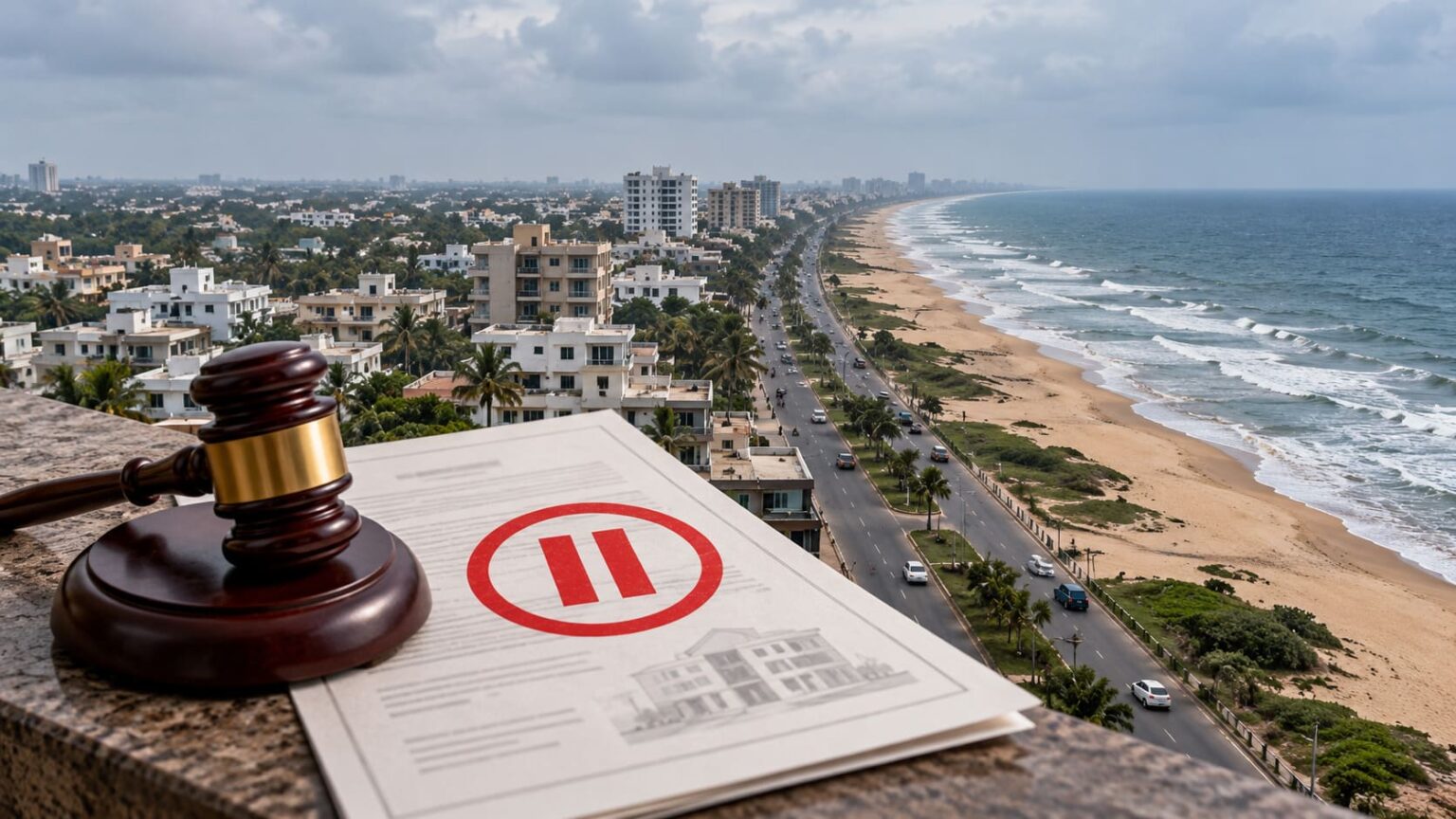
In a landmark decision, the Madras High Court has issued an interim order blocking government agencies from issuing Completion Certificates (CC) for buildings in Chennai’s coastal aquifer recharge zones. The Madras High Court passed this interim order on Tuesday (October 27, 2026).
The order targets property developments situated between the Bay of Bengal and the Buckingham Canal, covering key southern localities under Greater Chennai Corporation (GCC) Zones 14 and 15.
Here is a simple, complete breakdown of why the court stepped in, which areas are affected, and what this means for property buyers, builders, and home loans.
What Triggered the High Court Order?
The order comes in response to a Public Interest Litigation (PIL) filed by Mylapore resident Rajinder Kumar. The petition raised serious concerns about widespread construction violations that damage local water bodies and block natural groundwater recharge paths along Chennai’s East Coast Road (ECR).
Hearing the plea, a Division Bench comprising Justices S.M. Subramaniam and R. Rajesh Vivekanandan emphasized the Public Trust Doctrine. The court ruled that unregulated real estate expansion cannot be allowed to ruin shared natural groundwater reserves essential for Chennai’s long-term drinking water supply.
Which Areas Are Directly Affected?
The freeze applies to the coastal strip running parallel to ECR in GCC Zones 14 and 15, specifically targeting:
- Kottivakkam
- Palavakkam
- Neelankarai
- Injambakkam
- Thuraipakkam
- Karapakkam
- Sholinganallur
- Uthandi
Key Directives Issued by the Court
The High Court laid down strict mandates for civic authorities and property owners:
- Total Hold on Completion Certificates: The Chennai Metropolitan Development Authority (CMDA) and GCC are restrained from issuing CCs unless strict physical checks verify that the building complies completely with planning rules.
- No Utility Services Without CC: Without a valid Completion Certificate, service providers like TANGEDCO (Electricity) and CMWSSB (Water and Sewerage) cannot grant permanent connections to new buildings.
- Mandatory Compliance Affidavit: Property owners must sign a legal undertaking agreeing that their building follows all building codes. If violations are found later, their CC will be immediately revoked.
The 6-Month Comprehensive Enumeration Audit
- The GCC Commissioner was directed to constitute a dedicated Monitoring Committee.
- Scope: The panel must carry out a full field-level survey across Zones 14 & 15 (Kottivakkam to Uthandi) to identify:
- Unauthorized constructions built without planning permission.
- Deviations from sanctioned building plans (excess floors, set-back violations, hard-surface paving over open earth).
- Violations of permissible land use (e.g., unauthorized commercial conversions like party halls, event lawns, or industrial units in residential aquifer zones).
- Timeline: The enumeration exercise must be concluded preferably within 6 months, followed by a status and action-taken report submitted directly to the High Court.
Legal Doctrine & Judicial Observations
- Public Trust Doctrine: The bench emphasized that allowing reckless construction in eco-sensitive recharge belts infringes upon the fundamental rights of other citizens by destroying shared natural groundwater reserves.
- State Accountability: The court observed that municipal authorities (GCC & CMDA) failed in their oversight duties, creating a scenario where private developments jeopardized Chennai’s long-term drinking water security and coastal ecology.
Why Are Aquifer Recharge Zones Protected?
The sandy coastal soil along ECR acts as a natural sponge for rainwater.
- Prevents Seawater Intrusion: Rainwater soaking into the ground creates fresh groundwater pressure. This pressure keeps salty water from the ocean from seeping into inland wells.
- Reduces Urban Flooding: Open earth allows heavy monsoon rainwater to absorb quickly into the ground instead of flooding local roads.
What Are the Strict Rules (Appendix ‘A’) for Building Here?
Under Appendix ‘A’ of the Tamil Nadu Combined Development and Building Rules (TNCDBR), 2019, coastal aquifer zones follow strict limits:
- Height & Units: Low-rise developments only, limited to a maximum of 6 dwelling units per plot.
- Plot Coverage: Builders can only cover 40% to 50% of the plot with concrete structures.
- Mandatory Open Earth: At least 50% of the land must remain unpaved open ground so rainwater can soak naturally into the soil.
- Low FSI: Floor Space Index (FSI) bonuses given in other parts of Chennai are strictly prohibited here.
How This Order Affects Buyers, Loans, and Sales
                  [ High Court CC Freeze Order ]
                                │
       ┌────────────────────────┼────────────────────────┐
       ▼                        ▼                        ▼
【Homebuyers】           【Home Loans】           【Property Registrations】
  - Handover delays        - Final loan tranches    - Risky to buy without CC
  - Stuck paying Pre-EMIs    stopped by banks       - Deviations block resale
- Stalled Project Handovers: Builders cannot legally hand over physical possession of finished apartments without a valid CC.
- Home Loan Disbursal Delays: Banks usually withhold the final 10% to 20% of home loan payouts until a valid CC is submitted. This leaves buyers paying extra Pre-EMI interest while waiting for checks to complete.
- Impact on Resales & Title Transfers: Buying or selling properties with unauthorized extra floors or missing setbacks is on hold, as Sub-Registrar Offices and bank legal teams double-check physical plan compliance.
Next Steps
This High Court order shifts the focus along Chennai’s ECR belt back to environmental safety and legal discipline. While it causes short-term delays for ongoing projects, it protects homeowners in the long run by safeguarding coastal drinking water and preventing unauthorized, unsafe constructions.
Investing in coastal aquifer zones carries hidden legal and physical risks. Legally, strict regulations like Appendix ‘A’ limit building heights and plot coverage, meaning unauthorized constructions face completion certificate denials, utility cutoffs, and demolition threats.
Mandatory aquifer zone checks should be legally required for all coastal and water-body developments to verify 50% open-ground percolation compliance and prevent irreversible groundwater depletion. For advanced checks such as these, use hi tech tools like Landlens One to safeguard your property transactions.