

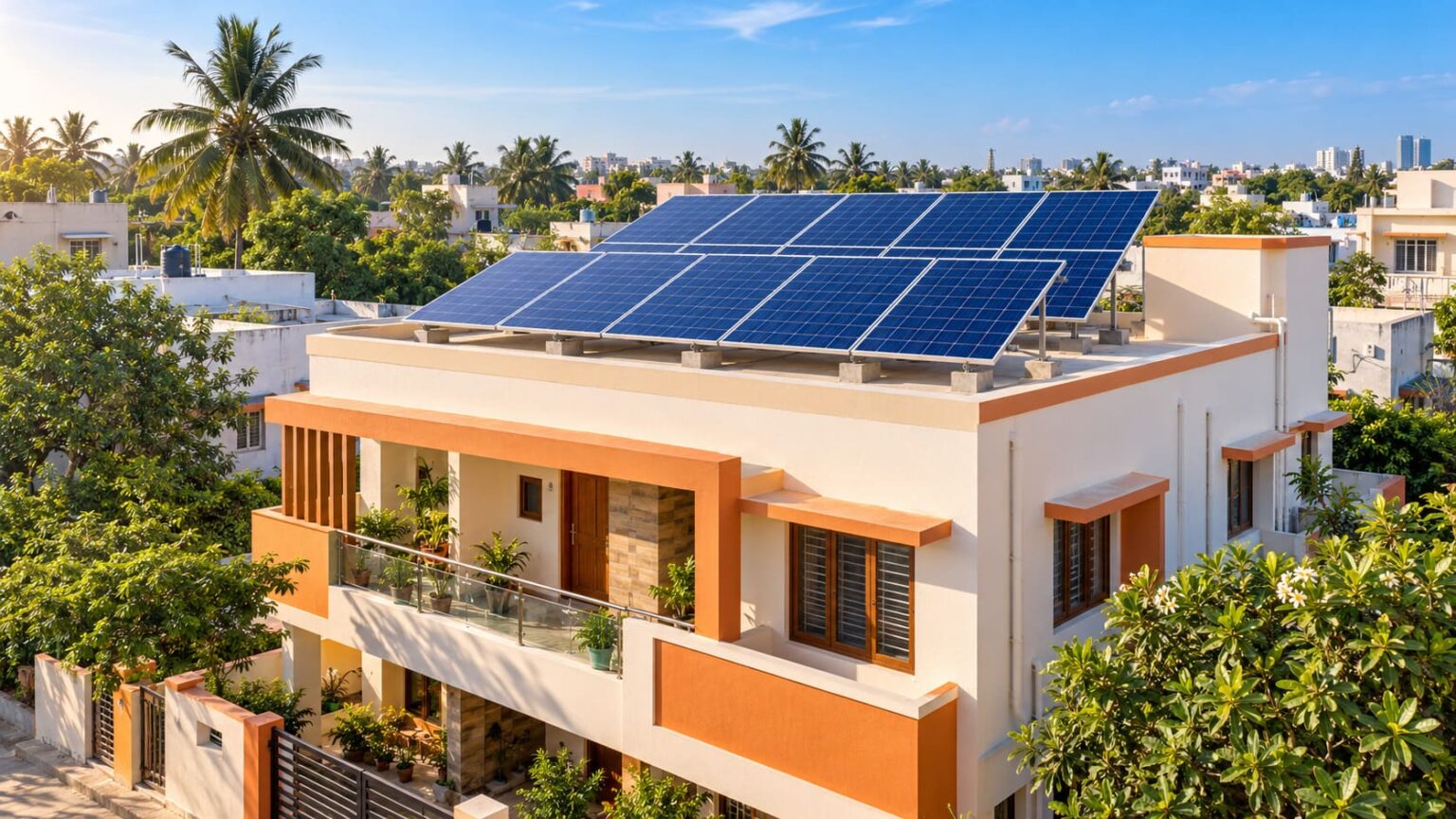
Your roof could do more than shelter your home—it could help cut your electricity bills. With Tamil Nadu’s new solar subsidy added to the central PM Surya Ghar scheme, eligible homeowners can now receive up to ₹1 lakh to install rooftop solar panels. Here’s who qualifies and what you need to get started.
What Is New in Tamil Nadu’s Solar Subsidy Scheme?
The Tamil Nadu Rooftop Solar Subsidy Scheme was launched on 21 September 2026. It adds state financial support to the existing central scheme, helping households reduce the cost of installing solar panels.
The state has allocated ₹50 crore and announced a target of covering one lakh homes by March 2027. According to the scheme’s launch reports, eligible homeowners who registered on the PM Surya Ghar portal on or after 5 August 2026 can receive the additional Tamil Nadu subsidy. If you registered before that date, check with TNPDCL whether your application qualifies for the state subsidy, even if you receive the central subsidy.
How Much Central and State Subsidy Can You Get?
| Rooftop solar capacity | Central subsidy | Tamil Nadu subsidy | Combined assistance |
|---|---|---|---|
| 1 kW | ₹30,000 | ₹5,000 | ₹35,000 |
| 2 kW | ₹60,000 | ₹10,000 | ₹70,000 |
| 3 kW | ₹78,000 | ₹22,000 | ₹1,00,000 |
| Above 3 kW, up to 10 kW | ₹78,000 maximum | ₹22,000 maximum | ₹1,00,000 maximum |
The state portal specifies residential rooftop systems up to 10 kW. Installing a larger system does not increase the combined subsidy beyond ₹1 lakh within this range.
What Does the Subsidy Cover?
The assistance reduces the cost of an eligible grid-connected residential rooftop solar installation. PM Surya Ghar provides Central Financial Assistance (CFA); Tamil Nadu adds its state contribution.
- This is a one-time installation subsidy.
- It does not automatically make the entire installation free or guarantee a zero electricity bill.
- The remaining cost depends on the vendor’s quotation, system size and equipment.
For example, if an eligible 3 kW installation costs ₹2 lakh and receives the full ₹1 lakh subsidy, the effective installation cost is ₹1 lakh. This is an illustration, not a fixed government installation price.
Who Is Eligible?
For an individual household, the central scheme’s basic conditions are:
- The applicant must be an Indian citizen.
- The household must own a house with a roof suitable for solar installation.
- It must have a valid residential electricity connection.
- It must not have already availed another solar-panel subsidy.
The Tamil Nadu contribution is an authorised top-up to PM Surya Ghar. The household must meet the state scheme’s conditions and complete the required installation and commissioning process.
Which Panels and Installers Qualify?
Use an empanelled vendor (a solar installation company registered for the scheme). The state portal requires DCR-compliant, ALMM-listed modules.
- DCR — Domestic Content Requirement: Both solar cells and modules must be manufactured in India.
- ALMM — Approved List of Models and Manufacturers: The government’s approved list of solar module models and manufacturers.
Ask the installer to document compliance before purchasing. A panel assembled in India using imported cells does not satisfy this DCR condition.
What Documents and Details Should You Prepare?
Before Registration:
First enter your mobile number and email id for registration, identification and verification purposes and then keep the following ready:
| Document | Purpose |
|---|---|
| Latest electricity bill and consumer number | Identifying your domestic electricity service |
| Identity proof | Applicant verification |
| Address proof | Confirming the installation address |
| Roof ownership evidence | Supporting your right to install the system, where requested |
Use the document types accepted by the portal. Not every document is necessarily uploaded during the first registration screen.
During Installation and the Subsidy Claim:
Prepare the vendor agreement, DCR undertaking/compliance details, site and plant photographs, metering agreement, commissioning report, bank account details and cancelled cheque as requested at the relevant stage. Keep the installation invoice and payment records as a record for future reference.
Your vendor should help with technical records.
When Is the Tamil Nadu Subsidy Paid?
The Tamil Nadu subsidy is processed after your solar system is installed, inspected and commissioned, and the central subsidy has been credited. The central payment details are automatically shared with the state portal. The state agency then verifies your eligibility, installation records and bank details before transferring the additional subsidy to your bank account. No separate application is required for the state top-up.
Read the companion guide, “How to Apply for Solar Subsidy in Tamil Nadu,” for the application steps and direct official links.
Common Queries Answered:
Can commercial properties receive this subsidy?
No. The central PM Surya Ghar subsidy and Tamil Nadu’s additional subsidy are for eligible residential consumers. Shops, offices and factories can install rooftop solar, but cannot claim these residential subsidies.
Can Tenants Install Rooftop Solar?
Yes. A tenant can install rooftop solar if the electricity connection is in their name, they regularly pay the electricity bills, and the owner permits them to use the roof. However, permission to install solar does not automatically establish eligibility for the subsidy; the scheme’s conditions must also be met.
Can I Move My Rooftop Solar System to a New Property?
Yes. The panels, inverter and mounting structures can be dismantled and reinstalled at another property. A qualified installer should assess the new roof and safely reconnect the system. Grid connection and metering approvals must be arranged for the new address.
Does Relocating Rooftop Solar Cost as Much as a New Installation?
Usually, no. You can reuse the existing panels and inverter if they are in good condition and suitable for the new property. However, you must pay for dismantling, transport and reinstallation. New wiring, earthing, mounting changes and electricity connection or metering charges may also be required. Get a site-specific quotation before moving. The relocated system is not eligible for another subsidy under PM Surya Ghar.
Roof Structural Requirements for Solar PV Installation
Rooftop solar PV systems can indeed be installed on almost any type of roof, provided that the structure has a sufficient load-bearing capacity to safely support the weight of the solar panels, mounting racks, and environmental factors like wind or snow loads.
Key Factors for Installation
While roof material is highly flexible, installers must evaluate several structural conditions:
- Roof Type compatibility: Systems can be securely mounted on flat concrete roofs, pitched clay tiles, asphalt shingles, and corrugated metal sheets using appropriate racking systems.
- Structural Integrity: The underlying rafters, trusses, and beams must be strong enough to handle both the dead load (weight of the equipment) and dynamic loads (wind uplift).
- Orientation and Shading: The roof must receive adequate sunlight, ideally facing south (in the Northern Hemisphere) or north (in the Southern Hemisphere), free from obstruction by trees or nearby buildings.
How Solar Power Can Reduce Your Electricity Bills
Rooftop solar generates electricity during the day, helping your home use less power from the grid. Surplus electricity can be exported, with credits calculated under the applicable billing rules. Learn more about on-grid systems, panel requirements and emerging balcony solar options in our guide to Solar Power for Urban Homes.