

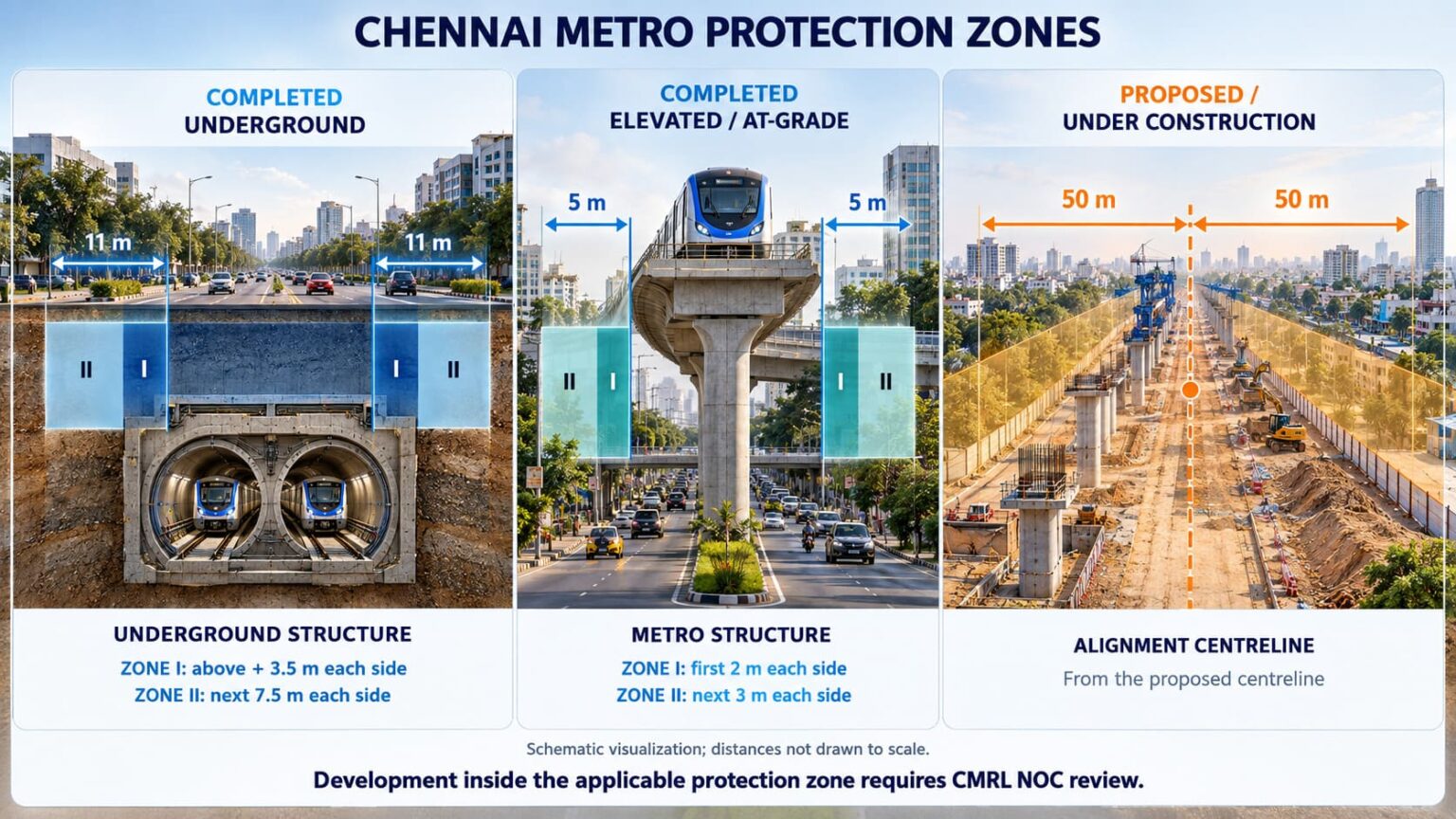
Planning to build near a Chennai Metro line? Your proposal may need a No Objection Certificate (NOC) from Chennai Metro Rail Limited (CMRL). The requirement depends on whether the metro corridor is completed or under development, where the property lies, and what construction work is proposed. CMRL uses the NOC process to protect existing metro structures and planned alignments.
When is a CMRL NOC required?
CMRL defines a Metro Protection Zone around its corridors. A development or construction proposal within this zone must be referred to CMRL for an NOC through the relevant approval authority.
| Metro corridor | Extent of the protection zone |
|---|---|
| Completed underground corridor | 11 m from either edge of the underground structure |
| Completed elevated or at-grade corridor | 5 m from either edge of the metro structure |
| Proposed or under-construction corridor | 50 m on either side of the alignment’s centreline |
For a completed corridor, measure from the edge of the metro structure. For a proposed or under-construction corridor, measure from the centreline of the alignment. The policy uses different reference points, so distance from the nearest track alone may give the wrong answer.
Rules near a completed underground metro corridor
The underground protection zone has two parts:
- Zone I: The area above the underground structure, plus 3.5 m beyond each edge.
- Zone II: The next 7.5 m on each side.
In Zone I, deep or pile foundations, ground anchors, borewells, boreholes and blasting are prohibited. Basement excavation, utility work and underground passageways are restricted and require CMRL’s technical consideration. Where development falls in Zone I, the policy also sets a maximum allowable pressure of 60 kPa at the tunnel top.
In Zone II, excavation, borewells and boreholes are restricted. Proposed pile foundations must meet the policy’s debonding requirement.
Rules near a completed elevated metro corridor
For elevated and at-grade structures, Zone I extends 2 m from the structure’s edge. Zone II covers the next 3 m.
CMRL prohibits construction, excavation, crane operation, scaffolding, utility work, storage of goods and explosives in Zone I. In Zone II, activities such as utility work, anchor drilling and work involving vibration are restricted. CMRL may permit a restricted activity only after reviewing its safety implications.
What about proposed or under-construction metro lines?
For these corridors, the protection zone extends 50 m on either side of the proposed alignment’s centreline, whether the planned metro section is underground or elevated. A property within that distance is subject to CMRL review when development or construction is proposed. Being within the zone does not, by itself, mean the land will be acquired or that construction will automatically be refused. The exact alignment and proposal must be checked.
Does an existing building need a CMRL NOC?
The policy deals with development and construction proposals. It does not state that an owner needs a retrospective NOC simply because an existing building stands near a metro line. If the owner later proposes an extension, redevelopment, basement or other construction, the new proposal may require CMRL review. Land acquisition, if proposed for that property, is a separate matter to check.
How do you apply for the CMRL NOC?
The approval authority—such as CMDA, GCC or another local body—forwards the application to CMRL directly or through the Single Window Portal. The submission must include a land plan, a design report covering the foundation and base-pressure calculations, structural drawings and relevant supporting documents.
CMRL verifies the site against its alignment, checks any land acquisition issue, and conducts a structural review. It then issues the NOC or communicates a rejection through the approval authority. The policy sets a 30-day reply period from receipt of all necessary documents.
Is a CMRL NOC needed for land regularisation or reclassification?
No. The policy expressly says a CMRL NOC is not required for land regularisation or reclassification, even if the property is within the Metro Protection Zone. This exception concerns the CMRL NOC; the applicant must still follow the applicable process for regularisation or reclassification.
Before preparing building plans near a metro corridor, establish the status and exact location of the alignment. That determines the applicable protection zone and whether the proposal must go to CMRL.
Check Metro Proximity Before You Buy or Build
With LandLens One, buyers, sellers and developers can ask Veritas a simple question: “Does a metro line pass near this property?” Provide a survey number, address or map pin to start the check. LandLens lists a metro-distance check that can flag nearby lines, helping you identify whether the CMRL NOC rules need closer attention before a purchase or development plan. Confirm the exact alignment and NOC requirement with CMRL and the approval authority for the specific property.