

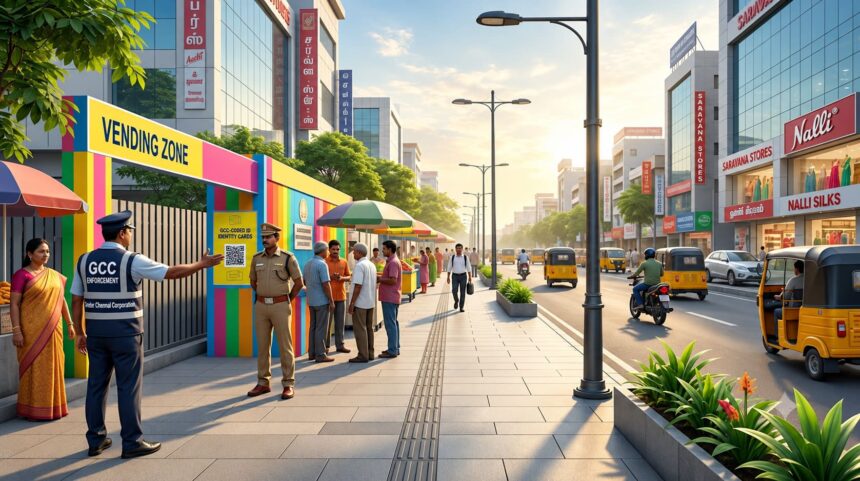
In a series of landmark rulings under the Street Vendors (Protection of Livelihood and Regulation of Street Vending) Act, 2014, the Madras High Court issued strict directives to the Greater Chennai Corporation (GCC) and the Chennai Metropolitan Traffic Police to systematically regulate street hawking. The recent judiciary order to the GCC has mandated the removal of unauthorized encroachments from high-density commercial centers—including T. Nagar, Purasawalkam, Adyar, and Royapettah—while ensuring that street vendors are restricted exclusively to officially published vending zones.
Following legal proceedings, the Greater Chennai Corporation notified 338 official zones, comprising 150 designated Vending Zones and 188 strictly enforced Non-Vending Zones distributed across all 15 administrative divisions of the civic body.
What Are Vending and Non-Vending Zones?
To balance urban mobility and pedestrian access with vendor livelihoods, public spaces in Chennai are categorized under statutory guidelines:
1. Vending Zones
Designated areas identified by the Town Vending Committees (TVC) where licensed hawkers are legally permitted to set up stalls, pushcarts, or temporary umbrellas under clear space-use regulations.
- Road Width Rules: Vending is allowed on –
- one side of a street if the road width is at least 5 metres, and
- on both sides if the road width is 10 metres or more.
- Certificate of Vending (CoV): Vendors must possess a valid, QR-code/chip-enabled Identity Card issued by the GCC for that specific zone.
- Space & Setup Restrictions: Stalls must be non-permanent (pushcarts or umbrellas) and leave at least 1 metre of clear footpath width for pedestrians.
- Stall Dimensions: Individual stall setups must measure no larger than 6 ft x 4 ft, maintaining at least a 2-foot buffer gap between adjacent stalls.
- No Heavy Equipment: Cooking apparatuses, gas cylinders, and permanent wooden/iron frameworks are prohibited on footpaths.
2. Non-Vending Zones
Street vending is completely prohibited in primary highways, main roads, commercial corridors, narrow residential lanes, and heritage zones.
- Buffer Clearances: Street vending is barred within 100 to 150 metres of hospitals, educational institutions, railway stations, religious structures, courts, and government offices.
- Police Arterials: 22 high-density corridors classified as “No Parking” zones by traffic authorities are automatically designated as non-vending spaces.
- Narrow Footpaths: Footpaths narrower than 5 feet or roads with two-way heavy traffic cannot accommodate street stalls
Key Directives of the Recent Madras High Court Ruling
- Strict Removal of Footpath Encroachments: The High Court ordered the eviction of unauthorized static bunks, food stalls, extended shop fronts, and pushcarts occupying pedestrian walkways in non-vending zones.
- Implementation of Zonal Town Vending Committees: To accelerate administration, 15 Zonal Town Vending Committees chaired by Regional Deputy Commissioners oversee localized implementation.
- Mandatory Certificates of Vending (CoV): Vendors must hold an official Certificate of Vending issued by the GCC. Unregistered hawkers or vendors operating outside their allotted zone are subject to immediate clearance.
- Prohibition of Permanent Structures: Street vendors are legally barred from building permanent wooden, iron, or concrete superstructures on footpaths. Vending must remain mobile or temporary.
- No Right to Vend in Non-Vending Zones: The court ruled that vendors cannot claim a constitutional right to occupy non-vending locations, affirming that public access and traffic flow take precedence.
Coverage Across GCC’s 15 Administrative Zones
The High Court mandate applies universally across all 15 administrative zones of the Greater Chennai Corporation:
| Zone No. | Zone Name | Primary Areas Included | Key Non-Vending Corridors |
| Zone 1 | Thiruvottiyur | Thiruvottiyur, Ennore | Ennore High Road, Theradi Junction |
| Zone 2 | Manali | Manali, Mathur | Express Highway Links |
| Zone 3 | Madhavaram | Madhavaram, Puzhal | GNT Road Intersections |
| Zone 4 | Tondiarpet | Tondiarpet, Korukkupet | Old Jail Road, Washermanpet Market Arterials |
| Zone 5 | Royapuram | Royapettah, Sowcarpet | NSC Bose Road, Whites Road, Royapettah High Road |
| Zone 6 | Thiru-Vi-Ka Nagar | Perambur, Kolathur | Paper Mills Road, Perambur High Road |
| Zone 7 | Ambattur | Ambattur, Mogappair | MTH Road, OT Bus Stand Corridor |
| Zone 8 | Anna Nagar | Purasawalkam, Shenoy Nagar | Purasawalkam High Road, Anna Nagar 2nd Avenue |
| Zone 9 | Teynampet | T. Nagar, Mylapore | Anna Salai (Mount Road near Higginbothams), Usman Rd, Pondy Bazaar Plaza |
| Zone 10 | Kodambakkam | Vadapalani, West Mambalam | Arcot Road, Vadapalani Junction |
| Zone 11 | Valasaravakkam | Porur, Ramapuram | Mount-Poonamallee Road Junctions |
| Zone 12 | Alandur | Nanganallur, Guindy | MK Natheri Street, GST Road Links |
| Zone 13 | Adyar | Adyar, Besant Nagar | Sardar Patel Road, L.B. Road, Adyar Signal Junction |
| Zone 14 | Perungudi | Perungudi, Madipakkam | OMR Main Arterial Intersections |
| Zone 15 | Sholinganallur | Sholinganallur, Akkarai | ECR / OMR Junction Points |
Restoring Balance to Chennai’s Streets
The High Court’s order marks a decisive step toward safer, more walkable streets. Clear demarcation of non-vending zones along major highways and key markets gives footpaths back to pedestrians while regulating traffic across all 15 GCC zones.
Moving licensed hawkers to dedicated spaces protects livelihoods while keeping public walkways clear. Going forward, sustained coordination between civic authorities, police, and vendor unions will be crucial to maintaining obstruction-free streets across the city.