

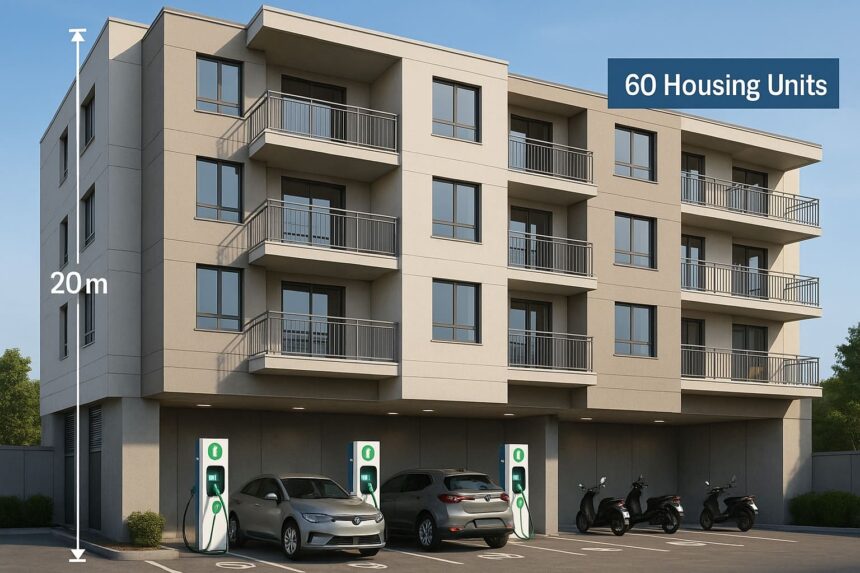
The Tamil Nadu Government has officially amended the Tamil Nadu Combined Development and Building Rules, 2019, introducing a mandatory EV charging infrastructure requirement for new residential, commercial, industrial, and institutional developments.
This Government Order (GO) marks a major regulatory push that aligns with the state’s EV adoption goals and urban planning vision.
The mandate is not symbolic — it places clear, measurable requirements on builders and project approvals. Here’s the full breakdown of what the GO says, and how it directly impacts the real estate market in Chennai and across Tamil Nadu.
🏠 Residential Buildings: Who Must Comply?
The GO applies to large residential developments that meet any of the following conditions:
- Height more than 14 metres, or
- More than 8 dwelling units, or
- Built-up area of 750 sq.m or more
This means almost all modern apartment projects in Chennai, Coimbatore, Trichy, Madurai, and tier-2 towns automatically fall under the mandate.
❌ Exemptions
Small residential buildings are exempt if they meet all the below:
- Height ≤ 14 metres,
- ≤ 8 dwelling units,
- Built-up area < 750 sq.m
Independent houses, duplexes, and very small apartments are generally exempt.
🔌 What Residential Projects Must Provide
For all qualifying buildings, the GO mandates:
1️⃣ One EV charging point for every required car parking slot
If a project has 120 required car slots, 120 EV-ready points must be provided.
2️⃣ One EV charging point for every required two-wheeler parking space
Two-wheeler EV adoption is exploding in TN — the GO recognises this.
3️⃣ Visitor Parking — Fast Charging for Large Projects
Residential developments with more than 50 units must provide:
- Fast-charging points in visitor parking zones
This is a strong regulatory shift — the state wants visitor, cab, and delivery EVs supported by default.
🏢 Commercial / Industrial / Institutional Buildings
For non-residential buildings, the rule is simpler:
Mandatory if FSI area exceeds 300 sq.m
Such projects must provide:
- EV charging in at least 10% of total parking spaces, and
- Those EV bays must offer fast-charging
Malls, IT parks, hotels, hospitals, educational institutions, office buildings, and warehouses all fall under this.
📅 Applicability: Only For New Approvals
The GO applies to buildings seeking planning permission after the publication of the Gazette notification.
- Existing buildings are not forced to retrofit EV chargers
- But the TN EV Policy 2023 encourages large apartments, malls, and townships to voluntarily adopt EV charging infrastructure
⚡EV Charging Allowed in Open Space, Recreational, Non-Urban, and Even Agricultural Zones
The Tamil Nadu Combined Development and Building Rules, EV charging facilities can now be set up in Open Space & Recreational Zones, Non-Urban Zones, and even Agricultural Zones. This means areas like parks, playgrounds, public recreation spaces, semi-urban belts within the Chennai Metropolitan Area, and rural/agricultural lands can all legally host EV charging infrastructure without needing special land-use conversion.
It makes statewide EV access easier, supports last-mile charging, and allows builders, township planners, and private operators to integrate charging facilities closer to residential and commercial developments. I
📘 Policy Background: Why This Mandate Was Introduced
Tamil Nadu’s EV ecosystem is one of the strongest in India, and the new building-rule amendment directly supports this momentum. It aligns with the Tamil Nadu EV Policy 2023, follows national guidelines issued by the Power Ministry, and fits into broader goals of decarbonisation and reduced urban congestion. With EV adoption rising rapidly in apartments and gated communities, the Government Order simply updates the planning rules to match the state’s shift toward cleaner, future-ready mobility.
💡 Real Estate Impact: What This Means for Buyers & Developers
1️⃣ Buyers Expect EV-Ready Homes
Homebuyers will now look for projects that include proper EV charging points and visitor fast-charging bays. Checking EV provisions in the approved plan becomes essential for convenience and long-term value.
2️⃣ Builders Must Update Designs
Developers are required to plan wiring, parking layouts, and charging bays before seeking approvals. This pushes builders to integrate EV infrastructure into the core design stage.
3️⃣ EV Compliance Becomes a Differentiator
Even with the mandate, projects that execute EV charging cleanly — structured bays, safe wiring, fast-charging — will stand out in the market and attract more buyers.
4️⃣ EV-Ready Buildings Hold Better Future Value
As EV use grows, non-compliant buildings will face retrofit issues and reduced appeal. New compliant projects will remain more future-proof and maintain stronger resale value.
🦁 Verified.RealEstate Tools That Help in EV-Compliance Transparency
✔️ CMDA Lookup– Check if the project’s approval references the updated building norms.
✔️ RERA Lookup -See whether the project’s RERA filing includes EV charging plans.
✔️ Verify My Land – Confirms property classification, ownership, and regulatory red flags.
✔️ Property Tracker -Track future regulatory updates or project modifications.