

The proposed Parandur Greenfield Airport near Chennai has come under fresh judicial scrutiny, with the Madras High Court questioning the Tamil Nadu Government’s decision to discontinue the project after substantial land acquisition and public expenditure.
During a hearing on 20 November 2026, the High Court raised important questions about the rationale behind abandoning a project that had already undergone feasibility assessments, received regulatory approvals and progressed through land acquisition.
The Court’s observations have brought into focus important issues concerning government accountability, public expenditure, land acquisition and the legal implications of reversing major infrastructure decisions.
The decision to abandon the Parandur Airport project was announced by Chief Minister C. Joseph Vijay in the Tamil Nadu Legislative Assembly on August 24, 2026, under Rule 110. This provision allows a Minister to make a statement on a matter of public importance with the Speaker’s permission, without an immediate debate on the statement.
Consequently, the announcement was made without an opportunity for immediate discussion on the floor of the Assembly, a procedural aspect that also drew criticism from the opposition.
A Brief Timeline of the Parandur Airport Project
The proposed Greenfield Airport at Parandur in Kancheepuram district was planned as Chennai’s second international airport to address the growing capacity requirements of the existing Chennai airport.
A brief timeline provides the necessary background:
- October 2023: The Tamil Nadu Government issued a Government Order granting administrative sanction for land acquisition and the transfer of government land for the proposed airport.
- August 24, 2026: Chief Minister C. Joseph Vijay announced in the Legislative Assembly that the government had decided to discontinue the Parandur airport project.
- November 20, 2026: The Madras High Court questioned the decision while hearing a Public Interest Litigation challenging the government’s move.
The project, estimated at approximately ₹27,400 crore, required around 5,368 acres. According to the petitioner, more than 1,700 acres had already been acquired, involving public expenditure exceeding ₹680 crore.
Why Did the Madras High Court Question the Decision?
A Division Bench comprising Chief Justice Sushrut Arvind Dharmadhikari and Justice G. Arul Murugan was hearing a Public Interest Litigation filed by G. Gouthaman, challenging the State Government’s decision to discontinue the proposed airport.
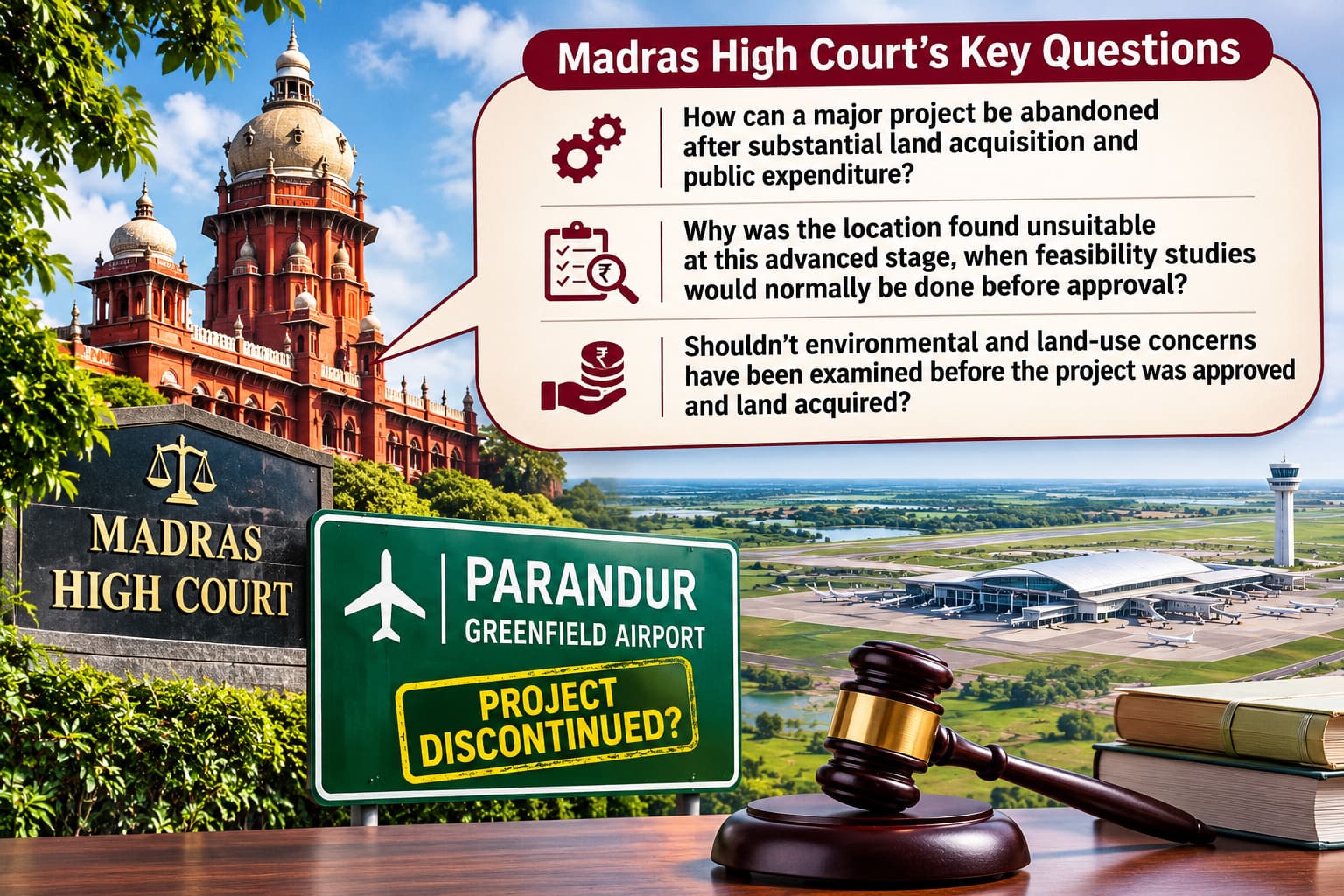
❓ The Bench questioned how a project could be abandoned midway after considerable progress in land acquisition and expenditure of public funds.
The Court orally observed that airports cannot be constructed or abandoned according to the whims and fancies of the government.
It also questioned why the government had decided that the location was unsuitable at this advanced stage when feasibility studies and assessments would ordinarily have been undertaken before selecting and approving the site.
The Court’s central concern was that the authorities should have examined these factors before proceeding with the project and acquiring land.
The important question raised by the Bench was: If the location was unsuitable because of environmental and land-use concerns, should those issues not have been identified during the original feasibility assessment?
What Does the PIL Contend?
The petitioner, G. Gouthaman, challenged the Tamil Nadu Government’s decision to abandon the Parandur Airport project, questioning whether the decision was supported by adequate technical, environmental and economic assessments, particularly after substantial land acquisition and public expenditure.
The petitioner sought the following reliefs from the Court:
- A declaration that the decision to discontinue the project was legally unsustainable.
- A direction to reconsider the decision based on proper technical and expert assessments.
- Production of relevant government records, including feasibility studies, environmental assessments and financial details.
- Interim protection against the transfer, reclassification or allotment of the acquired land for unrelated purposes while the case is pending.
These are the petitioner’s contentions and requests for relief, not findings or directions issued by the Court.
What Was the Government’s Explanation?
Appearing for the State Government, Advocate General Vijay Narayan explained that the decision to discontinue the project was based primarily on environmental and land-use concerns.
According to the Government, a substantial portion of the proposed site consisted of water bodies, wetlands and agricultural land. These circumstances could create difficulties in obtaining the necessary environmental clearance.
The Advocate General also submitted that an elected government has the authority to correct an earlier policy decision if it considers that decision unsuitable.
The Court, however, questioned whether such concerns should not have been examined during the initial feasibility studies before the project was approved.
Thus, the proceedings bring two important considerations into focus:
- the government’s responsibility to protect agricultural land and water resources, and
- its obligation to justify the reversal of a major infrastructure decision after substantial public expenditure.
What Happens to the Land Already Acquired?
One of the most important real estate and land-law questions arising from this case concerns the future of the land acquired for the airport.
With more than 1,700 acres reportedly acquired, the discontinuation of the project raises questions about the legal status and future use of these properties.
Some important issues require examination:
1. Can acquired land be used for another purpose?
If land was acquired specifically for an airport, can the government subsequently divert it to industrial parks, commercial developments or other infrastructure projects?
2. What happens to the original landowners?
Does discontinuation of the project automatically entitle the former owners to get their land back? The answer depends on the applicable land acquisition provisions, the terms of acquisition and the legal status of the acquired properties.
3. Can the government transfer the acquired land?
Any proposed transfer, reclassification or change of purpose must be examined in the light of the applicable acquisition law, government orders and judicial directions.
These questions are particularly significant for landowners, developers and investors in the surrounding region.
What Happens Next?
The Madras High Court has issued notice to the Tamil Nadu Government, Tamil Nadu Industrial Development Corporation (TIDCO), the Union Ministry of Civil Aviation and the Airports Authority of India (AAI), seeking their responses to the petition.
The matter has been posted for further hearing on December 21, 2026.
At this stage, the Court has not delivered a final judgment declaring the government’s decision unconstitutional, nor has it directed that the airport project must be revived.
The proceedings will examine the legal sustainability of the government’s decision and the material supporting it.
A Significant Question of Government Accountability
The Parandur airport case goes beyond the future of a proposed airport. It raises a wider question about the manner in which governments make, implement and reverse major infrastructure decisions.
While an elected government has the authority to change its policies in the public interest, such decisions must be supported by relevant material and must withstand legal scrutiny.
The High Court’s observations highlight the importance of conducting comprehensive feasibility assessments before committing public funds and acquiring private land.
For landowners, property investors and real estate developers, the outcome will be worth watching, particularly for its implications on land already acquired and the possibility of its future use.