

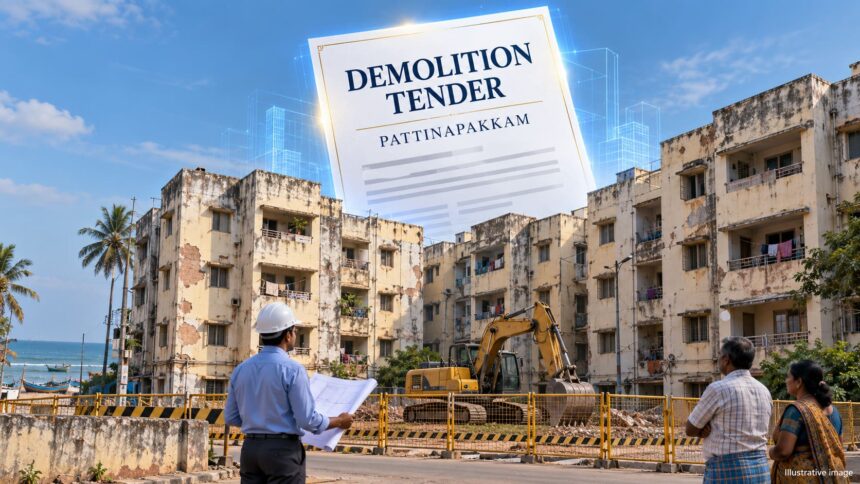
The iconic seafront neighborhood of Pattinapakkam along Chennai’s Foreshore Estate is heading for a major transformation. The Tamil Nadu Housing Board (TNHB) has officially started the process to knock down its old housing blocks, while planning authorities have cleared a massive zoning change for the prime coastal land.
Here is a clear breakdown of the ongoing developments, official tender details, scrap disposal terms, and surrounding proposals.
The Demolition Tender & Debris Salvage Rules
TNHB officially published the tender inviting contractors to tear down the run-down residential blocks across the Pattinapakkam estate
1. The 75-Day Completion Mandate
- Strict Timeline: The winning contractor is given 75 working days (roughly two and a half months) from the official issuance of the work order to finish the entire project.
- Scope of Work within 75 Days:
- Complete hand-dismantling or heavy-machinery tearing down of all old, dilapidated residential blocks across the designated site.
- Ground leveling and clearing out foundation rubble.
- Handing back a clean, flat 21.37-acre plot back to the Tamil Nadu Housing Board (TNHB).
2. How the “Contractor Takes the Debris” Rule Works
The demolition is auctioned on an “As Is, Where Is” / Salvage Disposal Model, which is why the tender involves a minimum upset price (approx. ₹41.61 lakh):
- The Contractor Pays TNHB (Not the other way around): In demolition auctions, the contractor bids for the right to dismantle the buildings and keep all reclaimed building material. The minimum price of ₹41.61 lakh (excluding GST) is the baseline revenue TNHB expects to receive from the contractor for selling those scrap rights.
- What the Contractor Reclaims & Keeps:
- Structural steel rebars and iron rods inside the concrete walls.
- Windows, door frames, wooden beams, plumbing fixtures, and electrical wiring.
- Concrete rubble and masonry waste (which can be crushed into aggregates and sold to nearby construction sites or road filling projects).
- Debris Removal Obligation: In return for keeping and selling all the scrap, the contractor is legally obligated to transport all non-usable debris completely away from the Pattinapakkam coast within the 75-day window without dumping it on the local beach or Loop Road.
3. Key Operational Terms for Bidders
- Submission Deadline: Bids opened today (November 2, 2026) and run until December 1, 2026, at 11:00 AM. Bids will be opened at 11:30 AM on the same day.
- Earnest Money Deposit (EMD): Contractors must lock in an EMD of ₹42,000 to qualify for bidding.
- Environmental & Coastal Rules: The contractor must follow dust suppression rules (water sprays) and noise restrictions, given the proximity to the ocean and existing high-rise residential blocks nearby.
4. Why the urgency?
Built decades ago along the marine corridor, the structures suffered severe ocean-air corrosion, leaving the concrete cracked and inner steel rusted, rendering them unsafe for human habitation.
CMDA Changes Land Rules (From Housing to Commercial)
The biggest legal step forward happened when the Chennai Metropolitan Development Authority (CMDA) officially approved a land-use modification for a sprawling 21.37-acre plot in Pattinapakkam.
- The Shift: The parcel—previously assigned under residential, institutional, and open space categories under the Master Plan—has been reclassified into a Commercial Use Zone.
- What it Allows: Commercial classification gives planning authorities permission to construct high-density vertical projects with significantly higher Floor Space Index (FSI) allowances than standard residential schemes permit.
The Big Speculation: A New Secretariat Complex?
The rapid push to clear the land and reclassify the plot sparked intense administrative and political discussions:
- The Proposal: Reports suggest the government is clearing this 21.37-acre seafront plot to construct a modern Tamil Nadu Secretariat-cum-Assembly Complex to replace or supplement existing operations at Fort St. George.
- Estimated Scale: Early proposals point toward an administrative campus featuring multi-story towers spanning approximately 20 lakh square feet, with an estimated project cost of ₹1,200 crore.
The Already Existing TNHB Towers Nearby
Visitors to the area often notice tall, modern TNHB residential towers already standing nearby. Here is why those went up first:
- Vertical Housing Scheme: TNHB constructed high-rise residential towers (stilt + 14 floors or higher) to fit existing tenants into a significantly smaller footprint on the ground.
- Unlocking Land: Going vertical allowed the housing board to rehouse thousands of families in modern apartments while consolidating and freeing up large contiguous acreage (the 21.37-acre plot) for commercial and state infrastructure.
- Coastal Checkpoint: Building tall structures right next to the beach requires strict Coastal Regulation Zone (CRZ) permissions. Local fishing groups and environmental monitoring bodies are keeping a close watch to ensure these vertical projects comply with coastal buffer guidelines and protect local groundwater.