


The Madras High Court on October 14, 2026, adjourned the Pallikaranai marsh case to November 11, 2026. The case concerns petitions challenging the National Green Tribunal’s construction ban within one kilometre of the marsh boundary.
The judges will examine the Tamil Nadu State Wetlands Authority’s (TNSWA) proposal for an interim Zone of Influence before passing orders.
What Is the Proposed Interim Zone of Influence?
A Zone of Influence (ZoI) identifies surrounding land where development or other activities could affect the marsh’s water flow and ecological functioning.
TNSWA has proposed 128.19 hectares across 36 survey numbers as an interim arrangement. The proposal identifies specific land parcels rather than relying only on a uniform distance from the marsh boundary.
This is a temporary proposal. The final zone will be determined after detailed scientific studies, land surveys and field checks.
Which areas are included?
The proposed interim zone includes parcels in Enjambakkam, Karappakkam, Okkiyam Thoraipakkam, Pallikaranai, Perungudi, Sholinganallur and Perumpakkam.
For more details on the survey numbers included in the proposed interim zone, read our article on Pallikaranai building approvals and conditional construction.
Owners therefore need to check the exact parcel boundary and proposed map, rather than assume that the entire survey number is covered.
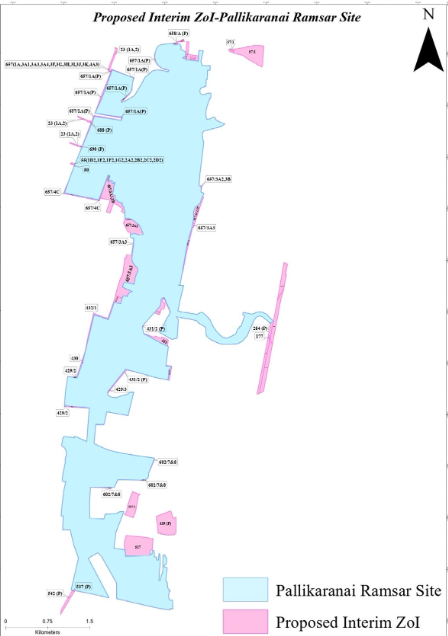
Map shows “TNSWA’s proposed interim Zone of Influence around Pallikaranai Marsh in Chennai”, submitted to the Madras High Court.
What the Lawyers Argued Before the Court
P.V. Balasubramaniam represented TNSWA, while T. Gowthaman represented the Chennai Metropolitan Development Authority (CMDA). Senior counsel P.S. Raman, V. Prakash and Srinath Sridevan represented CREDAI-Chennai and the other petitioners challenging the construction restrictions.
Mr. Raman said all petitioners accepted the proposed interim Zone of Influence. He argued that it leaves enough protective space around the marsh and identifies the specific survey numbers that need regulation.
Mr. Balasubramaniam said the marsh’s current boundary had not been finally determined and that the final exercise could identify a smaller marsh area. He argued that the existing buffer and proposed interim zone would provide sufficient protection.
This argument concerns the boundary identified through the final exercise; it does not mean permission to physically reduce or reclaim the marsh.
These were the lawyers’ arguments. The court has yet to decide on the proposal.
Construction May Be Regulated Within the Zone
TNSWA has proposed that construction need not be banned throughout the entire interim zone. Instead, each site could be assessed based on its scientific and hydrological conditions—particularly how water moves through the land and connects with the marsh.
Under the proposed mechanism, construction would require an NOC from the District Level Wetlands Management Committee. This would not amount to automatic permission for every property within the zone.
The proposed safeguards would prohibit:
- Blocking, diverting or obstructing natural drains and inlet or outlet channels.
- Dumping solid waste or construction debris in drainage pathways.
- Releasing untreated sewage or wastewater into watercourses connected to the marsh.
- Permanently disrupting established water connections.
- Setting up highly polluting Red Category industries.
The aim is to ensure that development does not interrupt water flowing into or out of the Pallikaranai Ramsar site or damage its ecological character.
Why Has the Court Sought More Time?
The judges want to examine the proposal and its safeguards before passing orders. They also raised concerns about what protection would apply if the final studies identify additional land outside the proposed interim zone.
This matters because the temporary boundary may change after the detailed assessment.
What Does This Mean for Property Owners?
The next hearing is scheduled for November 11, 2026. Until the court decides, owners and buyers should not treat the proposed survey-number list as final clearance for construction.
Before buying or investing in and around Pallikaranai, check your property’s survey number using LandLens One. Its map-based checks and AI-assisted analysis can help you identify relevant land records, waterways and mapped restrictions, giving you a clearer understanding of potential risks. Check the findings against the latest court orders and official boundaries before making your investment decision.
The proposed interim zone is awaiting court approval. The adjournment does not itself lift the construction ban or give permission to restart work.