

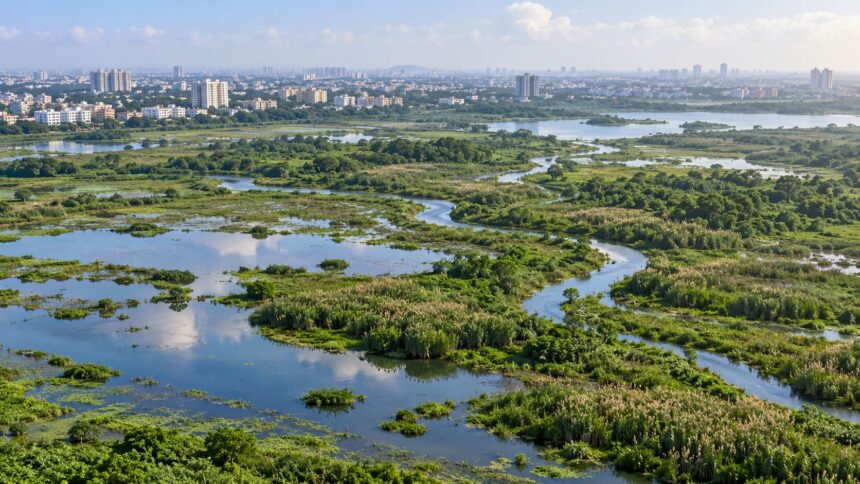
The Tamil Nadu State Wetlands Authority (TNSWA) has proposed a smaller interim Zone of Influence (ZoI) around Chennai’s Pallikaranai Marsh. The proposal could provide relief to property owners affected by construction restrictions, but it has also raised environmental concerns.
According to news reports, the proposed zone has been reduced from 3,358 hectares to approximately 128.19 hectares, a reduction of about 96.2%. It covers land parcels across 36 survey-number entries in seven villages.
As on October 13, 2026, the proposal was awaiting the Madras High Court’s consideration. It should not be treated as a confirmed lifting of construction restrictions.
What Is the Pallikaranai Zone of Influence?
The Zone of Influence is surrounding land that can affect the marsh’s water flow and ecological condition. It may include drainage channels, connected water bodies and areas through which rainwater reaches the wetland.
The marsh boundary and its influence zone are different. Reducing the proposed influence zone does not mean that the protected marsh itself has been reduced or opened for construction.
Why Was the Boundary Reconsidered?
TNSWA received 23 representations from landowners, developers and others. This led to reconsideration of private patta land, specific survey parcels, existing buildings and earlier development permissions.
Following court directions, officials met on September 30, 2026, to review the proposed boundary. Their assessment considered historical satellite imagery, water spread, drainage pathways, low-lying land, existing infrastructure and connections to nearby wetlands.
The revised interim proposal was presented before the High Court on October 12, 2026.
CREDAI Supports the Proposed Interim Zone
Senior counsel P.S. Raman, representing CREDAI Chennai, welcomed the proposal. He said TNSWA had completed the exercise quickly and that the proposed interim zone was acceptable to the developers’ association.
CREDAI Chennai was among the petitioners challenging the NGT’s construction restrictions. After hearing the submissions, the judges said they would examine TNSWA’s latest report and pass appropriate orders on October 14, 2026.
The Survey Numbers Proposed for Inclusion
According to the reported TNSWA submission, the following survey numbers and subdivisions could be included in the interim zone:
THE 36 SURVEY NUMBERS
Pallikaranai 23 (1A,2) · 55 (1D2, 1E2, 1F2, 1G2, 2A2, 2B2, 2C2, 2D2) · 80 · 429/2 · 429/3 · 430 · 431/2 (P) · 432/1 · 433 · 434/3 · 453/2C · 657 (1A, 3A1, 3A3, 3A4, 3F, 3G, 3H, 3I, 3J, 3K, 4A3) · 657/1A (P) · 657/1B3 · 657/3A2 · 657/3A3 · 657/3A5 · 657/3B · 657/4C · 658/1A (P) · 658/1B · 688 (P) · 690 (P) · 691 Perungudi 57/1
Sholinganallur 439 (P) · 507/1 · 527 · 602/7 · 602/8
Perumbakkam 537 (P) · 542 (P)
Injambakkam 283 · 284 (P)
Karapakkam 175 (P) · 177 · 189
Okkiyam Thoraipakkam 407 (P)
“(P)” generally denotes part of a survey number. The official survey schedule and boundary map are necessary to establish the exact portion included.
Would Construction Be Allowed Inside the Proposed Zone?
TNSWA has proposed regulating construction according to each site’s scientific and hydrological characteristics, rather than banning it throughout the entire interim zone.
The following are prohibited inside the interim zones:
- Blocking or diverting established inlet channels, outlet channels and natural drains.
- Dumping solid waste or construction debris in drainage pathways.
- Discharging untreated sewage or wastewater into connected watercourses.
- Permanently altering established water connections.
- Highly polluting Red Category industries.
Inside the Proposed Interim Zone: Construction With Conditions
- Construction could be allowed with an NOC from the District Level Wetlands Management Committee.
- Each site would be assessed separately, based on its conditions and effect on water flow.
- Any development works must not block water entering or leaving the marsh, or damage its ecosystem.
How Does the Wider Watershed Fit In?
The cited Citizen’s Charter for the Pallikaranai Watershed, published by the Chennai Wetlands Action Collective and Oorvani Foundation, describes a 306-square-kilometre watershed containing a cascade of 65 major lakes and hundreds of ponds.
It also cites a survey identifying 452 water bodies, of which 165 were reportedly lost.
These figures describe the larger system through which water reaches the marsh. They do not establish that the entire watershed is a legally declared no-construction zone. However, they help explain why environmental concerns extend beyond the proposed interim boundary.
What Should Property Owners Check?
Before buying, rebuilding or planning construction, owners should verify:
- The property’s revenue village, survey number and subdivision.
- Its position on the official wetland and influence-zone maps.
- Whether the schedule includes the whole survey parcel or only a part.
- The latest court order and applicable approval requirements.
- Drainage connections and restrictions affecting the site.
Private patta ownership does not, by itself, establish that construction is permitted. Likewise, a property’s exclusion from the proposed interim zone would not automatically establish its eligibility for building approval.
What Happens Next?
The reports said the High Court was expected to consider orders on October 14, 2026. The interim proposal is separate from the final delineation, which would require scientific assessment, land-record mapping and ground verification under the Wetlands (Conservation and Management) Rules, 2017.
Property owners should therefore distinguish between a proposed boundary, a court-approved arrangement and permission for their individual site.