

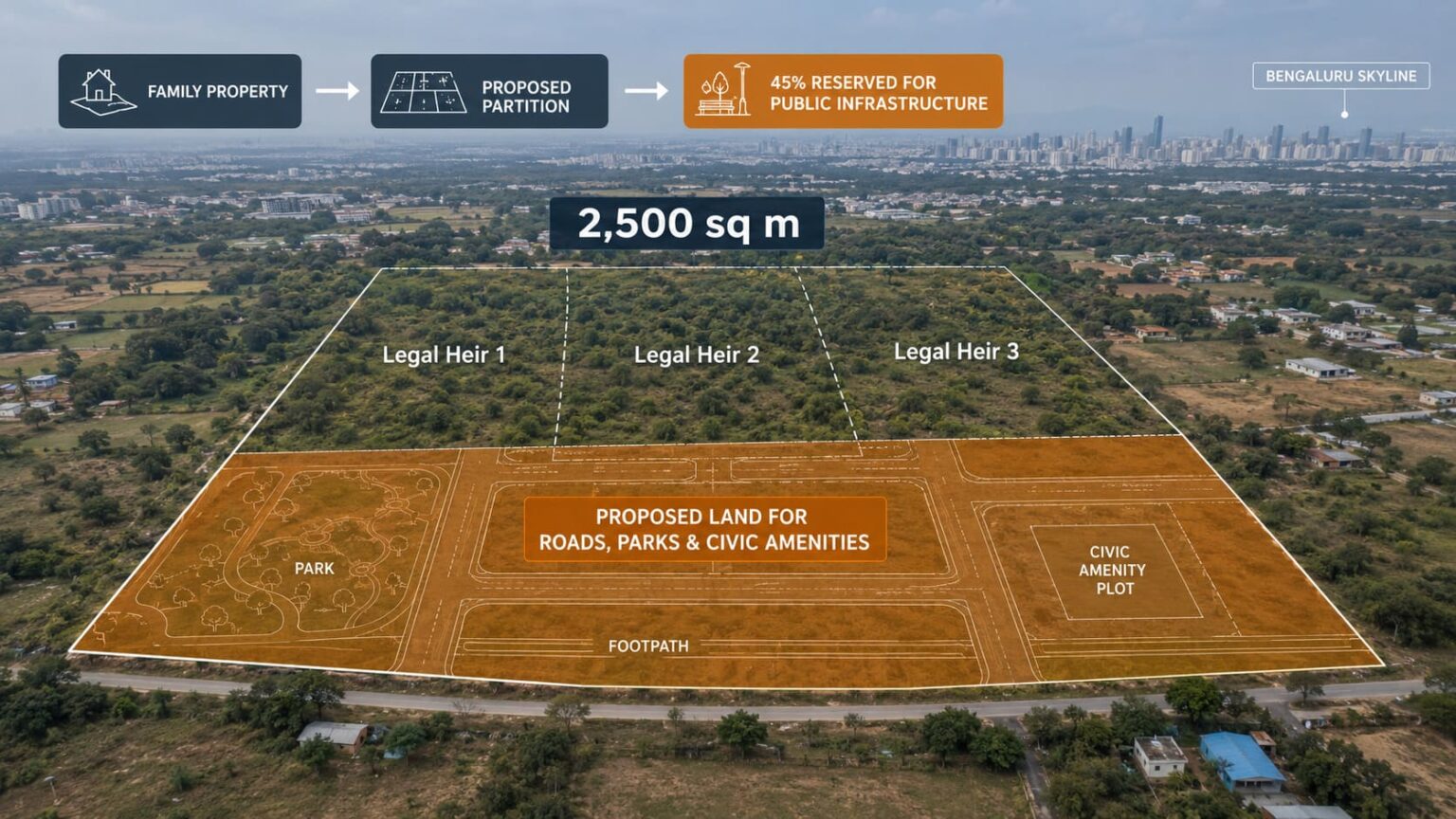
A major change could soon reshape the way large ancestral properties are divided in Karnataka. The Urban Development Department has issued a draft notification dated June 4, 2026, proposing amendments to the Karnataka Town and Country Planning (Development of Land by Partition of Joint Family Property) Rules. The proposal seeks to regulate the subdivision of large family-owned lands to ensure that new developments provide adequate public infrastructure.
Under the draft rules, joint family properties measuring more than 2,000 square metres that are proposed to be partitioned among family members may have to reserve or surrender approximately 45% of the land for public purposes before the partition can be approved. The reserved land would be earmarked for roads, parks, open spaces and civic amenity (CA) sites such as schools, community centres and other public facilities.
Has the rule come into force?
No. The proposal is still a draft notification and has not yet been implemented. The government has invited objections and suggestions from stakeholders before issuing the final notification.
There is no officially announced implementation date yet. The rules will come into force only after the Karnataka Government publishes the final notification in the Official Gazette, which could include modifications based on public feedback. Until then, the existing rules continue to apply.
How is the proposed rule expected to work?
If the draft is notified in its present form, the process is expected to work as follows:
- The rule will apply when a joint family property exceeding 2,000 sq m is proposed to be partitioned.
- Before approving the subdivision, the planning authority would examine whether the property falls under the prescribed planning regulations.
- Around 45% of the land would be earmarked for public infrastructure such as:
- Internal roads
- Parks and open spaces
- Civic amenity sites
- Other infrastructure required under planning norms.
- The remaining land would then be divided among the legal heirs according to the approved partition.
The government’s objective is to ensure that large family partitions do not effectively become residential layouts without providing land for essential public infrastructure. Officials believe that when large parcels are divided into several smaller plots, they eventually generate the same demand for roads, drainage, parks and civic facilities as any planned housing layout.
Why has the government proposed this change?
Urban planning authorities have observed that some large family-owned lands are being partitioned into multiple smaller plots and later developed or sold individually. Since these transactions occur through family partition deeds rather than conventional layout approvals, authorities believe that some developments escape the normal requirement of reserving land for public amenities.
The proposed amendment seeks to bring such subdivisions under a uniform planning framework so that future urban growth is supported by adequate infrastructure rather than creating unplanned neighbourhoods.
How do landowners view the proposal?
The proposal has drawn strong objections from many owners of large ancestral properties, particularly around Bengaluru.
Many landowners argue that:
- A family partition is fundamentally different from a commercial real estate project.
- Legal heirs are merely dividing property that they already own by inheritance and are not creating a residential layout for sale.
- Requiring the surrender of nearly 45% of ancestral land could substantially reduce the family’s inherited property.
- If the government requires land for public infrastructure, it should acquire it through established legal procedures rather than making land surrender a condition for partition.
Critics also caution that if the proposed land surrender requirement remains unchanged, some legal heirs may look for alternative legal methods to retain larger land parcels instead of opting for a formal partition, potentially defeating the very objective of the proposed rule.
Several owners also contend that they have already paid taxes and complied with earlier planning requirements and believe that the proposal places an additional burden on genuine family inheritances. These concerns have been highlighted in media reports covering the draft notification.
Public opinion on social media
The proposal has generated significant discussion across Reddit, Facebook, Instagram and X, with public opinion largely leaning against the draft.
Many social media users argue that inheritance should not be treated in the same manner as commercial land development. A commonly expressed view is that families dividing ancestral property among legal heirs should not be subject to the same obligations imposed on developers creating new layouts.
Some users have described the proposal as an excessive restriction on private property rights, while others questioned whether such a requirement could withstand legal scrutiny if challenged.
However, there is also a section of users who support the government’s move. They argue that Bengaluru has witnessed the growth of several unplanned layouts over the years and that reserving land for roads, parks and civic amenities at the time of subdivision would help improve long-term urban infrastructure.
Supporters believe that if large parcels are ultimately developed into residential neighbourhoods, they should contribute land for public facilities regardless of whether the subdivision happens through a developer or a family partition.
Overall, the online debate reflects a clear divide between those prioritising private property rights and those supporting better planned urban development.
What happens next?
For now, the proposal remains under consideration. The Karnataka Government is expected to review objections and suggestions before issuing the final notification. Until then, property owners are advised to monitor the progress of the draft rather than assume the proposed provisions have become law.
Potential impact on Bengaluru’s real estate
If implemented, the proposal could:
- Reduce the amount of developable land available after partition.
- Encourage some families to reconsider how they divide ancestral property.
- Increase the availability of land for public infrastructure such as roads and parks in newly developing areas.
- Lead to legal challenges if landowners argue that family inheritance should not be treated the same as private layout development.